



الصفحة 1
الصفحة 1

Wadi Flash Floods : Challenges and Advanced Approaches for Disaster Risk Reduction
The book chapters comprehensively and significantly highlight different scientific research disciplines related to wadi flash floods, including climatology, hydrological models, new monitoring techniques, remote sensing techniques, field investigations, international collaboration projects, risk assessment and mitigation, sedimentation and sediment transport, and groundwater quality and quantity assessment and management.

The Hindu Kush Himalaya Assessment : Mountains, Climate Change, Sustainability and People
Comprises important scientific research on the social, economic, and environmental pillars of sustainable mountain development and will serve as a basis for evidence-based decision-making to safeguard the environment and advance people’s well-being. This book consists of 16 chapters, which comprehensively assess the current state of knowledge of the HKH region, increase the understanding of various drivers of change and their impacts, address critical data gaps and develop a set of evidence-based and actionable policy solutions and recommendations. These are linked to nine mountain priorities for the mountains and people of the HKH consistent with the Sustainable Development Goals.

Technologies for Development : From Innovation to Social Impact
Presents 18 case studies that explore current scientific and technological efforts to address global development issues, such as poverty, from a holistic and interdisciplinary point of view, putting actual impacts at the centre of its analysis. It illustrates the use of technologies for development in various fields of research, such as humanitarian action, medical and information and communication technology, disaster risk-reduction technologies, habitat and sustainable access to energy. The authors discuss how innovative technologies, such as unmanned aerial vehicles for disaster risk reduction, crowdsourcing humanitarian data, online education and ICT-based medical technologies can have significant social impact. The book brings together the best papers of the 2016 International Conference on Technologies for Development at EPFL, Switzerland. The book explores how the gap between innovation in the global South and actual social impact can be bridged.

Renewing local planning to face climate change in the tropics
This book aims to inspire decision makers and practitioners to change their approach to climate planning in the tropics through the application of modern technologies for characterizing local climate and tracking vulnerability and risk, and using decision-making tools. Drawing on 16 case studies conducted mainly in the Caribbean, Central America, Western and Eastern Africa, and South East Asia it is shown how successful integration of traditional and modern knowledge can enhance disaster risk reduction and adaptation to climate change in the tropics. The case studies encompass both rural and urban settings and cover different scales: rural communities, cities, and regions. In addition, the book looks to the future of planning by addressing topics of major importance, including residual risk integration in local development plans, damage insurance and the potential role of climate vulnerability reduction credits.

Interlocal Adaptations to Climate Change in East and Southeast Asia : Sharing Lessons of Agriculture, Disaster Risk Reduction, and Resource Management
This Obook’s main focus is agriculture and natural resource management, disaster risk reduction, and human resource development in the countries of East and Southeast Asia and Japan.

Green infrastructure and climate change adaptation : Function, Implementation and Governance
This book introduces the function, implementation and governance of green infrastructure in Japan and other countries where lands are geologically fragile and climatologically susceptible to climate change. It proposes green infrastructure as an adaptation strategy for climate change and biodiversity conservation.

Earth observation science and applications for risk reduction and enhanced resilience in Hindu Kush Himalaya Region : A decade of experience from SERVIR
This book is a consolidation of lessons learnt and experiences gathered from our efforts to utilise Earth observation (EO) science and applications to address environmental challenges in the Hindu Kush Himalayan region.

Creating Resilient Futures : Integrating Disaster Risk Reduction, Sustainable Development Goals and Climate Change Adaptation Agendas
This excellent text recognises that efforts towards improving development outcomes must work in concert with strategies which promote planetary health and support the transition to a sustainable and climate-resilient future.
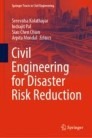
Civil engineering for disaster risk reduction
Brings together all diverse disciplines of civil engineering and related areas (for example, geotechnical engineering, water resources engineering, structural engineering, transportation engineering, environmental engineering, construction management, GIS, and remote sensing) towards a common goal of disaster resilience through an interdisciplinary approach. It contains methods and case studies focusing on civil engineering solutions to reduce the disaster risk. The book contents are aligned in line with the priorities set by UN-Sendai Framework for Disaster Risk Reduction and UN-SDGs to promote a global culture of risk-awareness and disaster reduction. The book will be a useful comprehensive reference for disaster risk reduction beneficial for engineering students, teaching faculty, researchers, industry professionals and policymakers.
