


تحسين النتائح
ترتيب حسب
من
الى

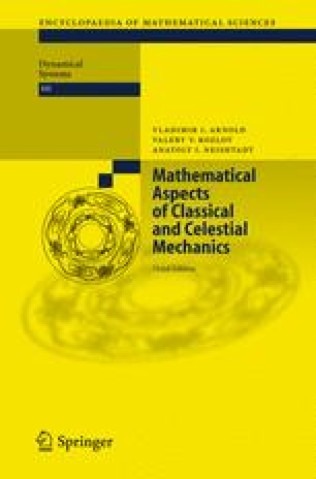
In this book we describe the basic principles, problems, and methods of clssical mechanics. Our main attention is devoted to the mathematical side of the subject. Although the physical background of the models considered here and the applied aspects of the phenomena studied in this book are explored to a considerably lesser extent, we have tried to set forth first and foremost the “working” apparatus of classical mechanics. This apparatus is contained mainly in Chapters 1, 3, 5, 6, and 8. Chapter 1 is devoted to the basic mathematical models of classical - chanics that are usually used for describing the motion of real mechanical systems. Special attention is given to the study of motion with constraints and to the problems of realization of constraints in dynamics. In Chapter 3 we discuss symmetry groups of mechanical systems and the corresponding conservation laws. We also expound various aspects of ord- reduction theory for systems with symmetries, which is often used in appli- tions. Chapter 4 is devoted to variational principles and methods of classical mechanics. They allow one, in particular, to obtain non-trivial results on the existence of periodic trajectories. Special attention is given to the case where the region of possible motion has a non-empty boundary. Applications of the variational methods to the theory of stability of motion are indicated.
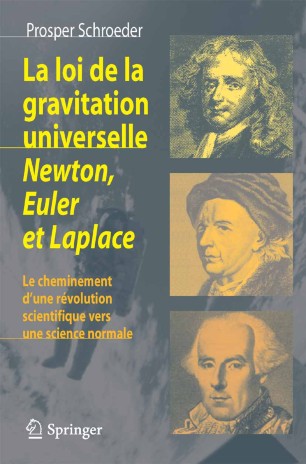
An analysis of Newton's ideas dismisses this hypothesis by the simple fact that the Principia sought to demonstrate the fallacy of earlier approaches. However, Newton suffered a failure in the application of his theory of gravitation to the explanation of the movement of the Moon, failure which marked the development of celestial mechanics throughout the 18th century. Clairaut, d'Alembert and Euler doubted the validity of Newtonian law almost at the same time and their ideas advanced celestial mechanics which reached the state of "normal science" with Laplace's treatise on celestial mechanics, a century after Newton.
This book is intended as an introduction to the field of planetary systems at the postgraduate level. It consists of four extensive lectures on Hamiltonian dynamics, celestial mechanics, the structure of extrasolar planetary systems and the formation of planets. As such, this volume is particularly suitable for those who need to understand the substantial connections between these different topics.
Contents are divided into major topics where the three "souls" of modern celestial mechanics (dynamical systems, Solar System and stellar systems, spaceflight dynamics) play a major role.
Canonical Perturbation Theories, Degenerate Systems and Resonance presents the foundations of Hamiltonian Perturbation Theories used in Celestial Mechanics, emphasizing the Lie Series Theory and its application to degenerate systems and resonance. This book is the complete text on the subject including advanced topics in Hamiltonian Mechanics, Hori’s Theory, and the classical theories of Poincaré, von Zeipel-Brouwer, and Delaunay.
Astronomy is the science of studying the sky using telescopes and light collectors such as photographic plates or CCD detectors. However, people have always studied the sky and continue to study the sky without the aid of instruments this is the realm of cultural astronomy. This is the first scholarly collection of articles focused on the cultural astronomy of Africans. It weaves together astronomy, anthropology, and Africa. The volume includes African myths and legends about the sky, alignments to celestial bodies found at archaeological sites and at places of worship, rock art with celestial imagery, and scientific thinking revealed in local astronomy traditions including ethnomathematics and the creation of calendars. Authors include astronomers Kim Malville, Johnson Urama, and Thebe Medupe; archaeologist Felix Chami, and geographer Michael Bonine, and many new authors.

سوريا - اتستراد درعا - غباغب
+963-15 2050 - 15 860 380 /1/2/3 - 11 662 3900