



الصفحة 1
الصفحة 1

Design of Observational Studies
This book introduction to statistical inference in observational studies and a detailed discussion of the principles that guide the design of observational studies. An observational study is an empiric investigation of effects caused by treatments when randomized experimentation is unethical or infeasible. Observational studies are common in most fields that study the effects of treatments on people, including medicine, economics, epidemiology, education, psychology, political science and sociology. The quality and strength of evidence provided by an observational study is determined largely by its design. Design of Observational Studies is organized into five parts. Chapters 2, 3, and 5 of Part I cover concisely many of the ideas discussed in Rosenbaum’s Observational Studies. Part II discusses the practical aspects of using propensity scores and other tools to create a matched comparison that balances many covariates, and includes an updated chapter on matching in R. In Part III, the concept of design sensitivity is used to appraise the relative ability of competing designs to distinguish treatment effects from biases due to unmeasured covariates. Part IV discusses evidence factors and the computerized construction of more than one comparison group. Part V discusses planning the analysis of an observational study, with particular reference to Sir Ronald Fisher’s striking advice for observational studies: "make your theories elaborate."
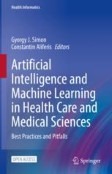
Artificial intelligence and machine learning in health care and medical sciences : Best practices and pitfalls
Provides a detailed review of the latest methods and applications of artificial intelligence (AI) and machine learning (ML) in medicine. With chapters focusing on enabling the reader to develop a thorough understanding of the key concepts in these subject areas along with a range of methods and resulting models that can be utilized to solve healthcare problems, the use of causal and predictive models are comprehensively discussed. Care is taken to systematically describe the concepts to facilitate the reader in developing a thorough conceptual understanding of how different methods and resulting models function and how these relate to their applicability to various issues in health care and medical sciences. Guidance is also given on how to avoid pitfalls that can be encountered on a day-to-day basis and stratify potential clinical risks.

AI in banking : Practical applications and case studies
Delves into the application of AI from theory to practice, offering detailed insights into AI project design and code implementation across eleven business scenarios in four major sectors: retail banking, e-banking, bank credit, and tech operations. it provides hands-on examples of various technologies, including automatic machine learning, integrated learning, graph computation, recommendation systems, causal inference, generative adversarial networks, supervised learning, unsupervised learning, computer vision, reinforcement learning, fuzzy control, automatic control, speech recognition, semantic understanding, bayesian networks, edge computing, and more. this book stands as a rare and practical guide to AI projects in the banking industry.
