



الصفحة 1
الصفحة 1
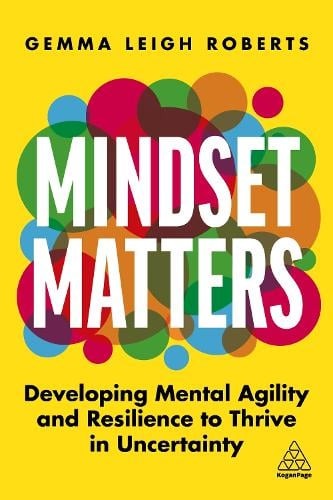
Mindset matters : Developing mental agility and resilience to thrive in uncertainty
Resilience is the skill to master for the future of work. The capacity to overcome adversity and, crucially, to learn from experiences and grow, resilience is the tool to have in your business leadership arsenal. From an individual perspective, it will lead to better performance and wellbeing, and for your team, you can positively affect change and build a culture of resilience that permeates your business.

Human and organisational factors : Practices and strategies for a changing world
This book addresses several questions regarding the implementation of human and organisational factors (HOF) so that recent improvements in industrial safety can be built upon.

Fragility fracture nursing : Holistic care and management of the orthogeriatric patient
Aims to provide a comprehensive but practical overview of the knowledge required for the assessment and management of the older adult with or at risk of fragility fracture. It considers this from the perspectives of all of the settings in which this group of patients receive nursing care.

Extreme Programming and Agile Processes in Software Engineering ; Vol.4044 ; 7th International Conference, XP 2006, Oulu, Finland, June 17-22, 2006, Proceedings
In its first editions, this conference was a get-together of a few pioneers who - bated about how to make agile processes and methods accepted by the mainstream researchers and practitioners in software engineering. Now agile approach to software development has been fully accepted by the software engineering community and this event has become the major forum for understanding better the implications of agility in software development and proposing extensions to the mainstream approaches. These two aspects were fully reflected in this year’s conference. They were - flected in the keynote speeches, which covered the background work done starting as early as the early eighties by Barry Boehm, definition of the field by Kent Beck, a successful industrial application in a success story by Sean Hanly, the perspective and the future of agile methods in large corporations by Jack Järkvik, and even some - sightful views from a philosopher, Pekka Himanen.

Enterprise Agility : A Practical Guide to Agile Business Management
Explains the main components of organizational agility, including structures, roles and ways of organizing work. It emphasizes the advantages of transitioning from traditional organizational management to agile. Finally, the latest phase, enterprise agility, applies to every functional operation of corporations. This phase is still developing, and the book focuses on the fundamentals of enterprise agility and transitioning to a fully agile organization.

Emergent Macroeconomics : An Agent-Based Approach to Business Fluctuations
This book contributes substantively to the current state-of-the-art of macroeconomics by providing a method for building models in which business cycles and economic growth emerge from the interactions of a large number of heterogeneous agents. Drawing from recent advances in agent-based computational modeling, the authors show how insights from dispersed fields like the microeconomics of capital market imperfections, industrial dynamics and the theory of stochastic processes can be fruitfully combined to improve our understanding of macroeconomic dynamics. This book should be a valuable resource for all researchers interested in analyzing macroeconomic issues without recurring to a fictitious representative agent.

Disrupting Finance : FinTech and Strategy in the 21st Century
This Pivot demonstrates how a variety of technologies act as innovation catalysts within the banking and financial services sector. Traditional banks and financial services are under increasing competition from global IT companies such as Google, Apple, Amazon and PayPal whilst facing pressure from investors to reduce costs, increase agility and improve customer retention. Technologies such as blockchain, cloud computing, mobile technologies, big data analytics and social media therefore have perhaps more potential in this industry and area of business than any other. This book defines a fintech ecosystem for the 21st century, providing a state-of-the art review of current literature, suggesting avenues for new research and offering perspectives from business, technology and industry.

Cybersecurity of Digital Service Chains : Challenges, Methodologies, and Tools
This book presents the main scientific results from the H2020 GUARD project. The GUARD project aims at filling the current technological gap between software management paradigms and cybersecurity models, the latter still lacking orchestration and agility to effectively address the dynamicity of the former. This book provides a comprehensive review of the main concepts, architectures, algorithms, and non-technical aspects developed during three years of investigation; the description of the Smart Mobility use case developed at the end of the project gives a practical example of how the GUARD platform and related technologies can be deployed in practical scenarios.
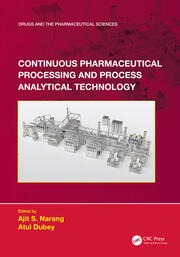
Continuous pharmaceutical processing and process analytical technology
Including aspects of modern process development is highlighted in this book with both the ‘why’ and the ‘how’, emphasizing process modeling and process analytical technologies. Presenting specific case studies and drawing upon extensive experience from industry and academic opinion leaders, this book focuses on the practical aspects of continuous manufacturing. It gives the readers the strategic perspective and technical depth needed to adopt and implement these technologies, where appropriate, in order to gain the competitive edge in speed, agility, and reliability.
Managing Agile Business Technology : The Business and Technology Relationship Model in Practice
Describes in detail how the BTRM, combined with a focus on value creation and value delivery, will enable continuous change, in the context of current, emerging and future technologies. It illustrates the potential for real-time insight and control not previously considered and provides a wide range of information to plan an implementation, understand where AI can be applied, and its importance in the world of self-managing systems.
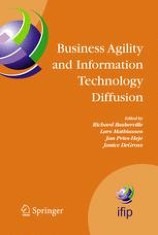
Business agility and information technology diffusion ; IFIP TC8 WG 8.6 International working Conference, May 8-11, 2005, Atlanta, Georgia, USA
Addresses issues related to business agility and the diffusion of Information Technology (IT). Success, even survival, in today's business environment has been made complex and difficult by technologically-based competitive pressure. One promising strategy is to be agile and ready to adapt quickly to changes in the environment or market. Such strategy takes shape as an agile software development, agile manufacturing, agile modeling and agile iterations. In contrast, successful IT diffusion is known to be a process that takes time and careful effort. Many IT projects that succeeded in developing a product have subsequently failed in changing the behavior of the target group when diffusion just didn't happen. Therefore this volume responds to the question: What is the relationship between agility and IT diffusion? The book's scope will cover information systems and technology issues, as well as organizational and managerial issues, related to agility and IT diffusion. The planned perspectives include topics such as diffusion of agile methods, enabling business agility with IT, creating agile environments that facilitate diffusion of IT, theories and frameworks for understanding diffusion and agility issues, best practices relating to business agility and IT diffusion, software process improvement and agility, diffusion studies of specific agile technologies, and impacts of diffusion of IT agile methods.
Balancing Agility and Formalism in Software Engineering ; 2nd IFIP TC 2 Central and East European Conference on Software Engineering Techniques, CEE-SET 2007, Poznan, Poland, October 10-12, 2007, Revised Selected Papers
This book constitutes the thoroughly refereed post-conference proceedings of the Second IFIP TC 2 Central and East Conference on Software Engineering Techniques, CEE-SET 2007, held in Poznan, Poland, in October 2007.

Atlas de chirurgie esthétique du sexe de lhomme = Atlas of Male Sexual Aesthetic Surgery
The author nevertheless calls for a certain reserve as to the indications for operation due to the psychological fragility frequent in such patients and whose screening requires careful listening; on the other hand, it is a surgery which has probably not reached its point of maturity and which we are nevertheless witnessing in full swing.
Anti-fragile ICT Systems
Introduces a novel approach to the design and operation of large ICT systems. It views the technical solutions and their stakeholders as complex adaptive systems and argues that traditional risk analyses cannot predict all future incidents with major impacts. To avoid unacceptable events, it is necessary to establish and operate anti-fragile ICT systems that limit the impact of all incidents, and which learn from small-impact incidents how to function increasingly well in changing environments. The book applies four design principles and one operational principle to achieve anti-fragility for different classes of incidents. It discusses how systems can achieve high availability, prevent malware epidemics, and detect anomalies. Analyses of Netflix’s media streaming solution, Norwegian telecom infrastructures, e-government platforms, and Numenta’s anomaly detection software show that cloud computing is essential to achieving anti-fragility for classes of events with negative impacts.
Aging, shaking, and cracking of infrastructures : From mechanics to concrete dams and nuclear structures
Focuses on the safety assessment of existing structures subjected to multi-hazard scenarios through advanced numerical methods. Whereas the focus is on concrete dams and nuclear containment structures, the presented methodologies can also be applied to other large-scale ones. This book is composed of seven sections: Fundamentals: theoretical coverage of solid mechnics, plasticity, fracture mechanics, creep, / seismology, dynamic analysis, probability and statistics / Damage: that can affect concrete structures, such as cracking of concrete, AAR, chloride ingress, and rebar corrosion, / Finite Element: formulation for both linear and nonlinear analysis including stress, heat and fracture mechanics, / Engineering Models: for soil/fluid-structure interaction, uncertainty quantification, probablilistic and random finite element analysis, machine learning, performance based earthquake engineering, ground motion intensity measures, seismic hazard analysis, capacity/fragility functions and damage indeces, / Applications to dams through potential failure mode analyses, risk-informed decision making, deterministic and probabilistic examples, / Applications to nuclear structures through modeling issues, aging management programs, critical review of some analyses, / Other applications and case studies: massive RC structures and bridges, detailed assessment of a nuclear containment structure evaluation for license renewal.

Agility by ARIS business process management : Yearbook business process excellence 2006/2007
Business Process Management has recently become a real "hype" topic. Too often, however, the technical aspects are being focused upon. The book offers valuable ideas to companies on how to optimize their own business processes and thus become more competitive.
Agile processes in software engineering and extreme programming ; XP 2019 Workshops, Montréal, QC, Canada, May 21–25, 2019, Proceedings
Includes a summary for each of the four panels at XP 2019 is included. The panels were on security and privacy; the impact of the agile manifesto on culture, education, and software practices; business agility – agile’s next frontier; and Agile – the next 20 years.
Agile processes in software engineering and extreme programming ; 20th International Conference, XP 2019, Montréal, QC, Canada, May 21–25, 2019, Proceedings
XP is the premier agile software development conference combining research and practice. It is a hybrid forum where agile researchers, academics, practitioners, thought leaders, coaches, and trainers get together to present and discuss their most recent innovations, research results, experiences, concerns, challenges, and trends. Following this history, for both researchers and seasoned practitioners XP 2019 provided an informal environment to network, share, and discover trends in Agile for the next 20 years.This volume presented agile adoption, agile practices; large-scale agile; agility beyond IT, and the future of agile.
Agile processes in software engineering and extreme programming ; XP 2020 Workshops, Copenhagen, Denmark, June 8–12, 2020, Revised Selected Papers
This book constitutes the 6 research workshops, the Agile Education and Training Track, the Doctoral Symposium, as well as a panel presented at XP 2020, the 21st International Conference on Agile Software Development, which was held during June 8-12, 2020.
Active Rheology Control of Cementitious Materials
The research presented here develops a new method of actively controlling the rheology of fresh concrete during casting operations by incorporating specially designed responsive components. This results in real-time changes to the rheological behaviour of the cementitious material, allowing the user to intervene actively after the cementitious material has left the mixing phase. This newly gained agility contributes to increased processing speed and placement reliability in the case of traditional casting methods and can also facilitate advanced 3D concrete printing. The different routes followed to achieve this Active Rheology Control are explained within.
