



الصفحة 1
الصفحة 1

Meaning and Language : Phenomenological Perspectives
This book is the first anthology to provide a wide-ranging picture of how phenomenology relates to language. It contains both in-depth studies on new aspects of language in Husserl’s thought as well as original phenomenological research that explores the respective potentials and limits of linguistic expression and conceptualization.

Islamic Philosophy and Occidental Phenomenology on the Perennial Issue of Microcosm and Macrocosm
this volume are reviving the perennial positioning of the human condition in the play of forces within and without the human being. This theme has run from Plato through the Middle Ages, Renaissance and Modernity, and has been ignored by contemporaries. It now acquires a new pertinence and striking significance due to the scientific discoveries into the "infinitely small" in life, on the one hand, and the prodigious technological discoveries of the "infinitely great" on the other. Both open up undreamt-of prospects for the continuing conquest of cosmic forces.

Introduction to Logic and Theory of Knowledge : Lectures 1906/07
This course on logic and theory of knowledge fell exactly midway between the publication of the Logical Investigations in 1900-01 and Ideas I in 1913. It constitutes a summation and consolidation of Husserl’s logico-scientific, epistemological, and epistemo-phenomenological investigations of the preceding years and an important step in the journey from the descriptivo-psychological elucidation of pure logic in the Logical Investigations to the transcendental phenomenology of the absolute consciousness of the objective correlates constituting themselves in its acts in Ideas I. In this course Husserl began developing his transcendental phenomenology as the genuine realization of what had only been realized in fragmentary form in the Logical Investigations.

Intersubjective Temporality : It's About Time
This book addresses the above problematic at several levels: First, it is a careful analysis of Husserl's understanding of inner time-consciousness. I take up each aspect of temporalizing consciousness ,explaining it in light of Husserl's phenomenology and showing how it functions in the whole of the "living present,” i. e. , our active, constituting consciousness. These sections of the book are helpful both to the uninitiated student trying to enter the world of Husserl's "inner ti- consciousness" and to the experienced Husserl scholar who desires a closer look at Husserl's theory of temporalizing consciousness. Second, as my analyses take us to Husserl's recently published manuscripts, I provide an explanation of Husserl's later considerations of temporalizing consciousness, showing how he developed his earliest conceptions.

Husserl’s Logical Investigations in the New Century : Western and Chinese Perspectives
In this volume, phenomenologists from the West join hands with specialists from mainland China and Hong Kong to discuss the heritage of Husserl's Logical Investigations.

Geschichte des Husserl-Archivs Leuven History
This short History of the Husserl-Archives offers a fascinating view on the foundation and development of this important research institute and of the Husserliana edition. Father Van Breda’s personal annotations, which are made public for the first time in English here, paint a captivating picture of the rescue of Husserl’s manuscripts and the foundation of the Archives shortly before the second world war. The overview of the further history of the Archives by Thomas Vongehr concentrates on the history of the editorial work and its reception. These two texts present not only a historical account but explain the scientific goals and tasks of the Husserl-Archives and its research.

Education In Human Creative Existential Planning
Education is the transmission of knowledge and skill from one generation to another, and is vitally significant for the growth and unfolding of the living individual. The present collection of papers focuses on the underpinnings of the creative workings of the human strategies of reason.

Diagrammatology : An investigation on the borderlines of phenomenology, ontology, and semiotics
Diagrammatology investigates the role of diagrams for thought and knowledge. Based on the general doctrine of diagrams in Charles Peirce's mature work, Diagrammatology claims diagrams to constitute a centerpiece of epistemology. The book reflects Peirce's work on the issue in Husserl's contemporanous doctrine of "categorial intuition" and charts the many unnoticed similarities between Peircean semiotics and early Husserlian phenomenology. Diagrams, on a Peircean account, allow for observation and experimentation with ideal structures and objects and thus furnish the access to the synthetic a priori of the regional and formal ontology of the Husserlian tradition.

De L’Éthique À La Justice : Langage et politique dans la philosophie de Lévinas = Language and politics in the philosophy of Levinas
Seeks to show that even if man is the event of the understanding of being, the whole of man and all meaning cannot be reduced to the understanding of being alone. On the political side, he questions the possibility of subjecting the totalitarian tendency of all politics to a search for justice that does not ultimately depend on politics itself. But these two sides are one. The discovery of a meaning beyond the comprehension of being - ethics - at the same time provides the source of the renewal of justice. Thus, by this double question, Lévinas presents to us the main threads of our investigation: a meaning beyond the comprehension of being and its ethical scope, which we call “language” and which we explore in the perspective of its importance.

Crisis and Reflection : An Essay on Husserl's Crisis of the European Sciences
In his last work, "Crisis of the European Sciences and Transcendental Phenomenology", Edmund Husserl formulated a radical new approach to phenomenological philosophy. Unlike his previous works, in the "Crisis" Husserl embedded this formulation in an ambitious reflection on the essence and value of the idea of rational thought and culture, a reflection that he considered to be an urgent necessity in light of the political, social, and intellectual crisis of the interwar period. In this book, James Dodd pursues an interpretation of Husserl's text that emphasizes the importance of the problem of the origin of philosophy, as well as advances the thesis that, for Husserl, the "crisis of reason" is not a contingent historical event, but a permanent feature of a life in reason generally.

Consciousness : From Perception to Reflection in the History of Philosophy
Consciousness: From Perception to Reflection in the History of Philosophy shows that the concept of consciousness was explicated relatively late in the tradition, but that its central features, such as reflexivity, subjectivity and aboutness, attained avid interest very early in philosophical debates. This book reveals how these features have been related to other central topics, such as selfhood, perception, attention and embodiment. At the same time, the articles display that consciousness is not just an isolated issue of philosophy of mind, but is bound to ontological, epistemological and moral discussions. Integrating historical inquiries into the systematic ones enables understanding the complexity and richness of conscious phenomena.

Logos of Phenomenology and Phenomenology of the Logos. Book One : Phenomenology as the Critique of Reason in Contemporary Criticism and Interpretation
During its century-long unfolding, spreading in numerous directions, Husserlian phenomenology while loosening inner articulations, has nevertheless maintained a somewhat consistent profile. As we see in this collection, the numerous conceptions and theories advanced in the various phases of reinterpretations have remained identifiable with phenomenology.
Logos of phenomenology and phenomenology of the logos ; Book Two : The Human Condition in-the-Unity-of-Everything-there-is-alive Individuation, Self, Person, Self-determination, Freedom, Necessity
The Human Condition-in-the-unity-of-everything-there-is-alive, under whose aegis the present selection of essays falls, offers the urgently needed new approach to reinvestigating humanness. While recent advances in the neurosciences, genetics and bio-engineering challenge the traditional abstract conception of "human nature", indicating its transformability, thus putting in question the main tenets of traditional philosophical anthropology, in the new perspective of the Human Creative Condition the human individual is seen in its emergence and unfolding within the dynamic networks of the logos of life, and within the evolution of living types.

Logos of phenomenology and phenomenology of the logos ; Book Three : Logos of history - logos of life, historicity, time, nature, communication, consciousness, Aalterity, Cculture
Situated at the crossroads of nature and culture, physics and consciousness, cosmos and life, history – intimately conjoined with time – continues to puzzle the philosopher as well as the scientist. Does brute nature unfold a history? Does human history have a telos? Does human existence have a purpose, Phenomenology of life projects a new interrogative system for reexamining these questions.We are invited to follow the logos of life as it spins in innumerable ways the interplay of natural factors, human passions, social forces, science and experience – through interruptions and kairic moments of accomplishment .

Logos of phenomenology and phenomenology of the logos ; Book Four : The logos of scientific interrogation, participating in nature-Life-saring in life
Prompted and ever diversified by the specifically human interrogative logos, scientific inquiries seek a common system of links in order to mutually confirm and rectify their results. Coming closer and closer to phenomenology, the sciences of life find the common ground of the reality in the ontopoiesis of life.Could it not be that the interrogative logos of science, participating in human creative inventiveness will bring together also the divergent scientific methods in a common network? A network which comprises natural processes, societal sharing-in-life, and existential communication.
Language, Meaning, Interpretation
Philosophy of logic and language, and of meaning and communication are central to this volume. The discussion of these issues involves analytical approaches, including semantics and semiotics, philosophy of science, mathematical logic, phenomenology, hermeneutics and some aspects of philosophical anthropology and aesthetics. Philosophy of the Absolute also belongs to this broad repertoire of philosophical problems and disciplines. A number of problems and viewpoints derive from the metaphysical system; any relativistic view on ethical values, for instance, makes sense in relation to some absolute. Metaphysical system building may have come to an end, but after all it belongs to philosophy to remind us of our past.
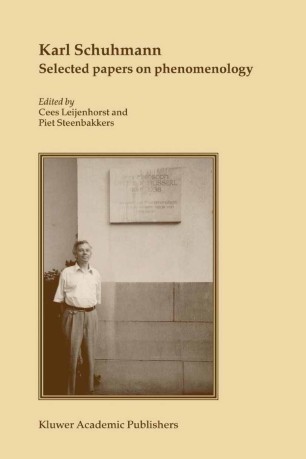
Karl Schuhmann, Selected papers on phenomenology
Selected papers on phenomenology offers the best work in this field by the acclaimed historian of philosophy, Karl Schuhmann (1941-2003),Topics covered include the development of Husserl's concept of intentionality, Husserl and Indian philosophy, the origins of speech act theory in Munich phenomenology, the historical background of the notion of "phenomenology", and Johannes Daubert's critique of Martin Heidegger,This book brings together, in chronological arrangement, fourteen papers. Though thirteen of these were published before in some form, several were not easily accessible so far. In addition, a substantial piece of research, Schuhmann's chronicle of Johannes Daubert.

Brouwer meets Husserl : On the Phenomenology of Choice Sequences
Can the straight line be analysed mathematically such that it does not fall apart into a set of discrete points, as is usually done but through which its fundamental continuity is lost? And are there objects of pure mathematics that can change through time? The mathematician and philosopher L.E.J. Brouwer argued that the two questions are closely related and that the answer to both is "yes''. To this end he introduced a new kind of object into mathematics, the choice sequence. But other mathematicians and philosophers have been voicing objections to choice sequences from the start. This book aims to provide a sound philosophical basis for Brouwer's choice sequences by subjecting them to a phenomenological critique in the style of the later Husserl.
