



الصفحة 9
الصفحة 9

Global perspectives on recognising non-formal and Informal Learning : Why recognition matters
This book deals with the relevance of recognition and validation of non-formal and informal learning in education and training, the workplace and society. In an increasing number of countries, it is at the top of the policy and research agenda ranking among the possible ways to redress the glaring lack of relevant academic and vocational qualifications and to promote the development of competences and certification procedures which recognise different types of learning, including formal, non-formal and informal learning. The aim of the book is therefore to present and share experience, expertise and lessons in such a way that enables its effective and immediate use across the full spectrum of country contexts, whether in the developing or developed world. It examines the importance of meeting institutional and political requirements that give genuine value to the recognition of non-formal and informal learning; it shows why recognition is important and clarifies its usefulness and the role it serves in education, working life and voluntary work; it emphasises the importance of the coordination, interests, motivations, trust and acceptance by all stakeholders.

Gesture smart control
Nowadays actions are increasingly being handled in electronic ways, instead of physical interaction. From earlier times biometrics is used in the authentication of a person. It recognizes a person by using a human trait associated with it like eyes (by calculating the distance between the eyes) and using hand gestures, fingerprint detection, face detection etc. Advantages of using these traits for identification are that they uniquely identify a person and cannot be forgotten or lost. These are unique features of a human being which are being used widely to make the human life simpler. Hand gesture recognition system is a powerful tool that supports efficient interaction between the user and the computer.
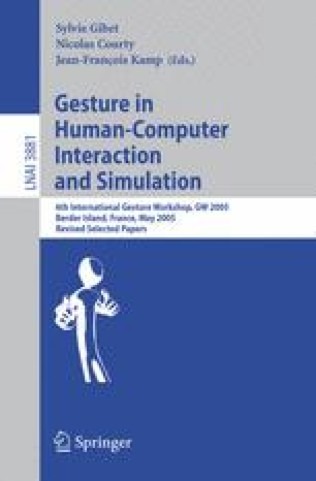
Gesture in Human-Computer Interaction and Simulation ; 6th International Gesture Workshop, GW 2005, Berder Island, France, May 18-20, 2005, Revised Selected Papers
The international Gesture Workshops have become the leading interdisciplinary events for dissemination of the latest results on gesture-based communication. The goal of these workshops is to bring together researchers who want to meet and share ideas on advanced research on gesture related to multidisciplinary scienti?c ?elds. Depending on the ?elds, the objectives can be very di?erent. While physiology and biomechanics aim to extract fundamental knowledge of physical gesture, computer sciences try to capture di?erent aspects of gesture and extract features that help to identify, interpret or rebuild the underlying mechanisms of communication gestures. Other approaches and methodologies are followed by cognitive sciences and linguistics, bringing a complementary - derstanding of motor control and gesture meaning. The results can be enhanced by technological applications or demonstrations.

Geometric Modeling and Processing - GMP 2006 ; 4th International Conference, GMP 2006, Pittsburgh, PA, USA, July 26-28, 2006, Proceedings
This book constitutes the refereed proceedings of the 4th International Conference on Geometric Modeling and Processing, GMP 2006, held in Pittsburgh, PA, USA in July 2006. The 36 revised full papers and 21 revised short papers presented were carefully reviewed and selected from a total of 84 submissions. All current issues in the area of geometric modeling and processing are addressed and the impact in such areas as computer graphics, computer vision, machining, robotics, and scientific visualization is shown. The papers are organized in topical sections on shape reconstruction, curves and surfaces, geometric processing, shape deformation, shape description, shape recognition, geometric modeling, subdivision surfaces, and engineering applications.

Fuzzy systems and knowledge discovery ; Vol. 3614 ; 2nd International Conference, FSKD 2005, Changsha, China, August 27-29, 2005, Proceedings, Part II
This book and its sister volume, LNAI 3613 and 3614, constitute the proce- ings of the Second International Conference on Fuzzy Systems and Knowledge Discovery (FSKD 2005), jointly held with the First International Conference on Natural Computation (ICNC 2005, LNCS 3610, 3611, and 3612) from - gust 27–29, 2005 in Changsha, Hunan, China. FSKD 2005 successfully attracted 1249 submissions from 32 countries/regions (the joint ICNC-FSKD 2005 received 3136 submissions). After rigorous reviews, 333 high-quality papers, i. e. , 206 long papers and 127 short papers, were included in the FSKD 2005 proceedings, r- resenting an acceptance rate of 26. 7%. The ICNC-FSKD 2005 conference featured the most up-to-date research - sults in computational algorithms inspired from nature, including biological, e- logical, and physical systems. It is an exciting and emerging interdisciplinary area in which a wide range of techniques and methods are being studied for dealing with large, complex, and dynamic problems. The joint conferences also promoted cross-fertilization over these exciting and yet closely-related areas, which had a signi?cant impact on the advancement of these important technologies. Speci?c areas included computation with words, fuzzy computation, granular com- tation, neural computation, quantum computation, evolutionary computation, DNA computation, chemical computation, information processing in cells and tissues, molecular computation, arti?cial life, swarm intelligence, ants colony, arti?cial immune systems, etc. , with innovative applications to knowledge d- covery, ?nance, operations research, and more.

Fuzzy systems and knowledge discovery ; Vol. 3613 ; 2nd International Conference, FSKD 2005, Changsha, China, August 27-29, 2005, Proceedings, Part I
This book and its sister volume, LNAI 3613 and 3614, constitute the proce- ings of the Second International Conference on Fuzzy Systems and Knowledge Discovery (FSKD 2005), jointly held with the First International Conference on Natural Computation (ICNC 2005, LNCS 3610, 3611, and 3612) from - gust 27–29, 2005 in Changsha, Hunan, China. FSKD 2005 successfully attracted 1249 submissions from 32 countries/regions (the joint ICNC-FSKD 2005 received 3136 submissions). After rigorous reviews, 333 high-quality papers, i. e. , 206 long papers and 127 short papers, were included in the FSKD 2005 proceedings, r- resenting an acceptance rate of 26. 7%. The ICNC-FSKD 2005 conference featured the most up-to-date research - sults in computational algorithms inspired from nature, including biological, e- logical, and physical systems. It is an exciting and emerging interdisciplinary area in which a wide range of techniques and methods are being studied for dealing with large, complex, and dynamic problems. The joint conferences also promoted cross-fertilization over these exciting and yet closely-related areas, which had a signi?cant impact on the advancement of these important technologies. Speci?c areas included computation with words, fuzzy computation, granular com- tation, neural computation, quantum computation, evolutionary computation, DNA computation, chemical computation, information processing in cells and tissues, molecular computation, arti?cial life, swarm intelligence, ants colony, arti?cial immune systems, etc. , with innovative applications to knowledge d- covery, ?nance, operations research, and more.

Fuzzy Models and Algorithms for Pattern Recognition and Image Processing
Fuzzy Models and Algorithms for Pattern Recognition and Image Processing presents a comprehensive introduction of the use of fuzzy models in pattern recognition and selected topics in image processing and computer vision. Unique to this volume in the Kluwer Handbooks of Fuzzy Sets Series is the fact that this book was written in its entirety by its four authors. A single notation, presentation style, and purpose are used throughout. The result is an extensive unified treatment of many fuzzy models for pattern recognition. The main topics are clustering and classifier design, with extensive material on feature analysis relational clustering, image processing and computer vision. Also included are numerous figures, images and numerical examples that illustrate the use of various models involving applications in medicine, character and word recognition, remote sensing, military image analysis, and industrial engineering.

Fuzzy Logic and Applications ; Vol. 3849 ; 6th International Workshop, WILF 2005, Crema, Italy, September 15-17, 2005, Revised Selected Papers
This volume contains the proceedings of the 6th International Workshop on Soft Computing and Applications (WILF 2005), which took place in Crema, Italy, on September 15–17, 2005, continuing an established tradition of biannual meetings among researchers and developers from both academia and industry to report on the latest scienti?c and theoretical advances, to discuss and debate major issues, and to demonstrate state-of-the-art systems. This edition of the workshop included two special sessions, sort of subwo- shops, focusing on the application of soft computing techniques (or compu- tional intelligence) to image processing (SCIP) and bioinformatics (CIBB).

Fuzzy Logic : A Spectrum of Theoretical & Practical Issues
This book exclusively surveys the active on-going research of the current maturity of fuzzy logic over the last four decades. Many world leaders of fuzzy logic have enthusiastically contributed their best research results into five theoretical, philosophical and fundamental sub areas and nine distinctive applications, including two PhD dissertations from two world class universities dealing with cutting-edge research areas of bioinformatics and geological science. Beyond the scope of survey and collection of the book, one important spin off is the emerging and recognition of a major scientific paradigm shift from the conventional mathematics to the mathematics of uncertainty, which arguably holds the key to solving very difficult and complex problems in biological and social sciences alike. The book, loaded with historical perspective, creative thinking, critical reviewing, and uniquely constructed strategy for future growth of this dynamic research area, is an invaluable resource for active researchers at all levels, university administrators, foundation directors, funding agency program chiefs, research & development planners and technological assessors.

Fuzzy Group Theory
This book presents an up-to-date account of research in important topics of fuzzy group theory. The book concentrates on the theoretical aspects of fuzzy subgroups of a group. It also includes applications to some abstract recognition problems and to coding theory. The book begins with basic properties of fuzzy subgroups. The notions of ascending series and descending series of fuzzy subgroups are used to define nilpotency of a fuzzy subgroup. The material presented in this book makes it a good reference for graduate students and researchers working in fuzzy group theory.

Fundamentals of Robotic Mechanical Systems : Theory, Methods, and Algorithms
Fundamentals of Robotic Mechanical Systems, Third Edition addresses robots at large - such as multi-fingered hands, walking machines, flight simulators, and machine tools - that rely on mechanical systems to perform their tasks. The author establishes the foundations on which the design, control, and implementation of the underlying mechanical subsystems are based. The treatment assumes familiarity with some calculus, linear algebra, and elementary mechanics; however, the elements of rigid-body mechanics and linear transformations are reviewed in the first chapters, making the presentation self-contained.

Fundamentals of pattern recognition and machine learning
Fundamentals of Pattern Recognition and Machine Learning is designed for a one or two-semester introductory course in Pattern Recognition or Machine Learning at the graduate or advanced undergraduate level. The book combines theory and practice and is suitable to the classroom and self-study.

Fundamentals of multimedia ; 3rd ed.
Addresses real issues commonly faced in the workplace. The essential concepts are explained in a practical way to enable students to apply their existing skills to address problems in multimedia. Fully revised and updated, this new edition now includes coverage of such topics as 3D TV, social networks, high-efficiency video compression and conferencing, wireless and mobile networks, and their attendant technologies.

Fundamentals of multimedia ; 2nd ed.
Addresses real issues commonly faced in the workplace. The essential concepts are explained in a practical way to enable students to apply their existing skills to address problems in multimedia. Fully revised and updated, this new edition now includes coverage of such topics as 3D TV, social networks, high-efficiency video compression and conferencing, wireless and mobile networks, and their attendant technologies.

Functional Molecular Nanostructures
in This book some recent advances in the structural design of nanoscale assemblies are shown, along with examples from the following areas: supramolecular catalysis, photoactive assemblies, molecular recognition and switches, and electroactive assemblies.The last decade has witnessed an unprecedented pursuit of discrete, nanoscale supramolecular aggregates, built by modern methods of self-assembly strategies. Several efficient new synthetic methods have been developed for engineering spectacular multicomponentsupramolecular aggregates.

Functional and operatorial statistics
An increasing number of statistical problems and methods involve infinite-dimensional aspects. This is due to the progress of technologies which allow us to store more and more information while modern instruments are able to collect data much more effectively due to their increasingly sophisticated design. This evolution directly concerns statisticians, who have to propose new methodologies while taking into account such high-dimensional data (e.g. continuous processes, functional data, etc.). The numerous applications (micro-arrays, paleo-ecological data, radar waveforms, spectrometric curves, speech recognition, continuous time series, 3-D images, etc.) in various fields (biology, econometrics, environmetrics, the food industry, medical sciences, paper industry, etc.) make researching this statistical topic very worthwhile. This book gathers important contributions on the functional and operatorial statistics fields

Fun and Games ; 2nd International conference, Eindhoven, The Netherlands, October 20-21, 2008. Proceedings
This book constitutes the refereed proceedings of the Second International Conference on Fun and Games, held in Eindhoven, The Netherlands, in October 2008.The 17 revised full papers, presented together with 2 invited talks were carefully reviewed and selected from a total of 36 submissions. The papers encompass the study of computer games, game development and experiences by researchers from social sciences, computing, electrical engineering, design, etc. Main focus is given to topics such as tightly-coupled embodied control of movement-sensitive mobile devices, hypercomputation and cultural computing, emerging gaming paradigms.

From the Act of Judging to the Sentence : The Problem of Truth Bearers from Bolzano to Tarski
This book offers a detailed study of the truth-bearers problem, that is, the question of which category of items the predicates ‘true’ and ‘false’ are predicated. The book has two dimensions: historical and systematic. Both focus around Tarski’s semantic theory of truth. The author locates Tarski’s ideas in a broad context of Austrian philosophy, in particular, Brentano’s tradition. However, Bolzano and phenomenology (Husserl and Reinach) are also taken into account. The historical perspective is completed by showing how Tarski was rooted in Polish philosophical tradition originated with Twardowski and his version of Brentanism. The historical considerations are the basis for showing how the idea of truth-bearers as acts of judging was transformed into the theory of truth-bearers as sentences. In particular, the author analyses the way to nominalism in Polish philosophy, culminating in Lesniewski, Kotarbinski and Tarski. This book is indispensable for everybody interested in the evolution of Austrian philosophy from descriptive psychology to semantics.

From integrated publication and information systems to information and knowledge environments : Essays dedicated to Erich J. Neuhold on the Occasion of His 65th Birthday
This book constitutes a commemorative volume devoted to Erich J. Neuhold on the occasion of his 65th birthday. The 32 invited reviewed papers presented are written by students and colleagues of Erich Neuhold throughout all periods of his scientific career. The papers are organized in the following topical sections: Database management enabling information systems Semantic Web drivers for advanced information management Securing dynamic media content integration From digital libraries to intelligent knowledge environments Visualization – key to external cognition in virtual information environments From human-computer interaction to human-artefact interaction Domains for virtual information and knowledge environments.

From Innate Immunity to Immunological Memory
The ability to remember an antigenic encounter for several decades, even for a life time, is one of the fundamental properties of the immune system. This phenomenon known as "immunological memory", is the foundation upon which the concept if vaccination rests. Therefore, understanding the mechanisms by which immunological memory is regulated is of paramount importance. Recent advances in immunology, particularly in the field of innate immunity, suggest that the innate immune system plays fundamental roles in influencing immunological memory. Indeed, emerging evidence suggests that events that occur early, within hours if not minutes of pathogen or vaccine entry profoundly shape the quantity, quality and duration of immunological memory. The present volume assembles a collection of essays from leading experts that span the entire spectrum research from understanding the molecular mechanisms of innate immune recognition, to dendritic cell function, to the generation and maintenance of antigen-specific B and T-cell responses.
