



الصفحة 88
الصفحة 88
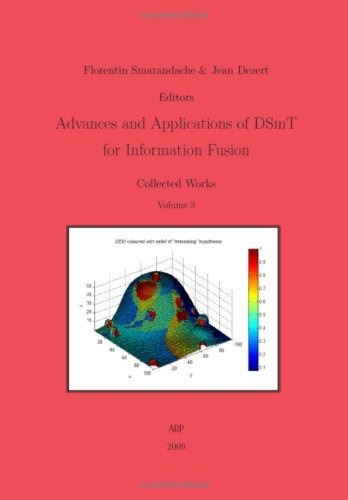
Advances and applications of DSmT for information fusion: Collected works ; Vol.3
One of the most comprehensive and flexible fusion theory based on belief functions. It can work in all fusion spaces: power set, hyper-power set, and super-power set, and has various fusion and conditioning rules that can be applied depending on each application. Some new generalized rules are introduced in this volume with codes for implementing some of them. For the qualitative fusion, the DSm Field and Linear Algebra of Refined Labels (FLARL) is proposed which can convert any numerical fusion rule to a qualitative fusion rule. When one needs to work on a refined frame of discernment, the refinement is done using Smarandache s algebraic codification. New interpretations and implementations of the fusion rules based on sampling techniques and referee functions are proposed, including the probabilistic proportional conflict redistribution rule.
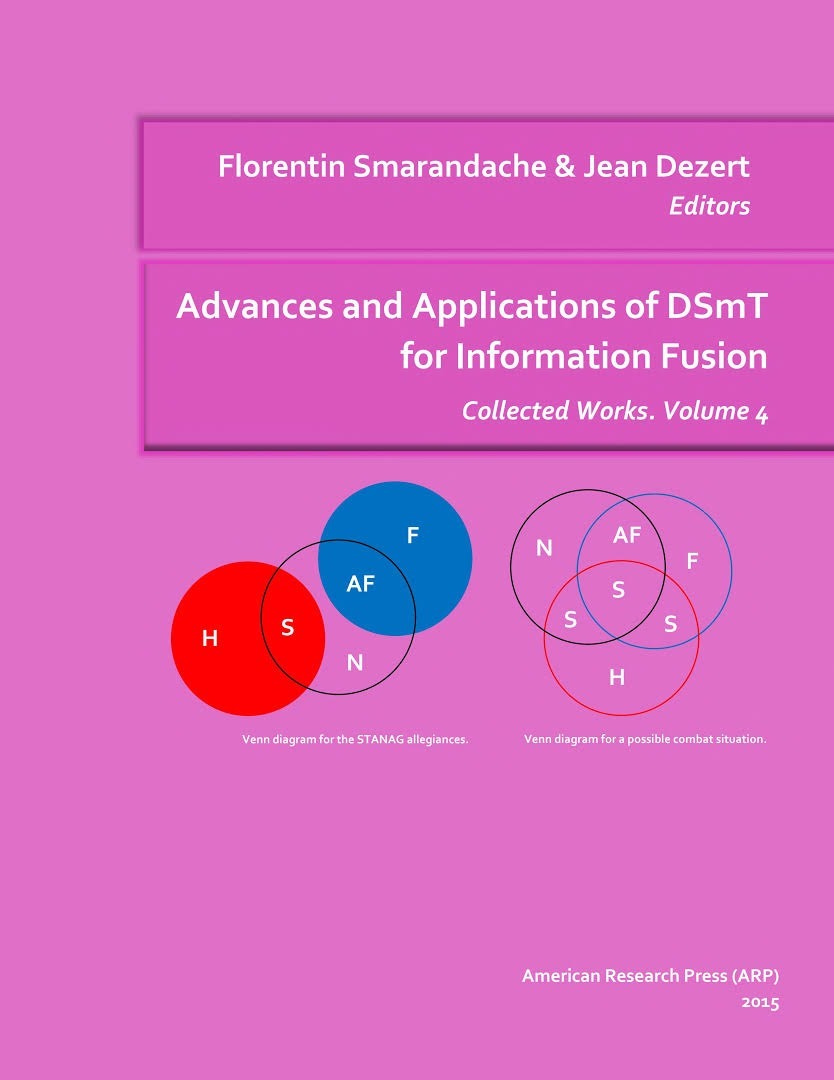
Advances and applications of DSmT for information fusion ; Vol. 4
One of the most comprehensive and flexible fusion theory based on belief functions. It can work in all fusion spaces: power set, hyper-power set, and super-power set, and has various fusion and conditioning rules that can be applied depending on each application. Some new generalized rules are introduced in this volume with codes for implementing some of them. For the qualitative fusion, the DSm Field and Linear Algebra of Refined Labels (FLARL) is proposed which can convert any numerical fusion rule to a qualitative fusion rule. When one needs to work on a refined frame of discernment, the refinement is done using Smarandache s algebraic codification. New interpretations and implementations of the fusion rules based on sampling techniques and referee functions are proposed, including the probabilistic proportional conflict redistribution rule.
Advanced Visual Quantum Mechanics
Investigate and to teach quantum mechanics with the aid of computer-generated animations. It is a self-contained textbook that combines selected topics from atomic physics (spherical symmetry, the hydrogen atom, and particles with spin) with an introduction to quantum information theory (qubits, EPR paradox, teleportation, quantum computers). It explores relativistic quantum mechanics and the strange behavior of Dirac equation solutions. A series of appendices covers important topics from perturbation and scattering theory. The book places an emphasis on ideas and concepts, with a fair to moderate amount of mathematical rigor. Though this book stands alone, it can also be paired with Thaller Visual Quantum Mechanics to form a comprehensive course in quantum mechanics. The software for the first book earned the European Academic Software Award 2000 for outstanding innovation in its field.
Advanced Real Analysis
Basic Real Analysis and Advanced Real Analysis (available separately or together as a Set) systematically develop those concepts and tools in real analysis that are vital to every mathematician, whether pure or applied, aspiring or established. These works present a comprehensive treatment with a global view of the subject, emphasizing the connections between real analysis and other branches of mathematics.
Advanced Quantum Mechanics
Discusses nonrelativistic multi-particle systems, relativistic wave equations and relativistic quantum fields. Characteristic of the author´s work are the comprehensive mathematical discussions in which all intermediate steps are derived and where numerous examples of application and exercises help the reader gain a thorough working knowledge of the subject. The topics treated in the book lay the foundation for advanced studies in solid-state physics, nuclear and elementary particle physics. This text both extends and complements Schwabl´s introductory Quantum Mechanics, which covers nonrelativistic quantum mechanics and offers a short treatment of the quantization of the radiation field. The fourth edition has been thoroughly revised with new material having been added. Furthermore, the layout of the figures has been unified, which should facilitate comprehension.
Advanced Quantum Mechanics
Advanced Quantum Mechanics, the second volume on quantum mechanics by Franz Schwabl, discusses nonrelativistic multi-particle systems, relativistic wave equations and relativistic fields. Characteristic of Schwabl’s work, this volume features a compelling mathematical presentation in which all intermediate steps are derived and where numerous examples for application and exercises help the reader to gain a thorough working knowledge of the subject. The treatment of relativistic wave equations and their symmetries and the fundamentals of quantum field theory lay the foundations for advanced studies in solid-state physics, nuclear and elementary particle physics. This text extends and complements Schwabl’s introductory Quantum Mechanics, which covers nonrelativistic quantum mechanics and offers a short treatment of the quantization of the radiation field. New material has been added to this third edition of Advanced Quantum Mechanics on Bose gases, the Lorentz covariance of the Dirac equation, and the ‘hole theory’ in the chapter "Physical Interpretation of the Solutions to the Dirac Equation."
Advanced Physicochemical Treatment Processes
Leading pollution control educators and practicing professionals describe how various combinations of different physicochemical treatment processes can be arranged to solve air, noise, and thermal pollution problems. In Advanced Physicochemical Treatment Processes, the authors discuss strategies for abating pollution by converting it into a less noxious form, using the most feasible technologies. Each chapter discusses in detail a variety of process combinations, along with technical and economic evaluations, and presents explanations of the principles behind the designs, as well as numerous variant designs useful to practicing engineers. The emphasis throughout is on developing the necessary engineering solutions from fundamental principles of chemistry, physics, and mathematics.
Advanced Multivariate Statistics with Matrices
Presents important tools and techniques for treating problems in m- ern multivariate statistics in a systematic way. The ambition is to indicate new directions as well as to present the classical part of multivariate statistical analysis in this framework.
Advanced Methods for Inconsistent Knowledge Management
This book presents a unified and systematic description of a wide class of miscellaneous problems of inconsistent knowledge management, analyzed by traditional mathematical methods using relational and logical representations.
Advanced mathematical science for mobility society
The automotive industry has made steady progress in technological innovations under the names of Connected Autonomous-Shared-Electric (CASE) and Mobility as a Service (MaaS). Needless to say, mathematics and informatics are important to support such innovations. As the concept of cars and movement itself is diversifying, they are indispensable for grasping the essence of the future mobility society and building the foundation for the next generation. This book contains three main contents. 1. Mathematical models of flow 2. Mathematical methodsfor huge data and network analysis 3. Algorithm for mobility society The first one discusses mathematical models of pedestrian and traffic flow, as they are important for preventing accidents and achieving efficient transportation.
Advanced Linear Algebra
For the third edition, the author has added a new chapter on associative algebras that includes the well known characterizations of the finite-dimensional division algebras over the real field (a theorem of Frobenius) and over a finite field (Wedderburn's theorem); polished and refined some arguments (such as the discussion of reflexivity, the rational canonical form, best approximations and the definitions of tensor products); upgraded some proofs that were originally done only for finite-dimensional/rank cases; added new theorems, including the spectral mapping theorem; considerably expanded the reference section with over a hundred references to books on linear algebra.
Advanced Linear Algebra
The first part of the book contains a careful but rapid discussion of the basics of linear algebra, including vector spaces, linear transformations, quotient spaces, and isomorphism theorems. The author then proceeds to modules, emphasizing a comparison with vector spaces. A thorough discussion of inner product spaces, eigenvalues, eigenvectors, and finite dimensional spectral theory follows, culminating in the finite dimensional spectral theorem for normal operators. The second part of the book is a collection of topics, including metric vector spaces, metric spaces, Hilbert spaces, tensor products, and affine geometry. The last chapter discusses the umbral calculus, an area of modern algebra with many important applications.
Advanced Intelligent Computing Theories and Applications : With Aspects of Artificial Intelligence ; 4th International Conference on Intelligent Computing, ICIC 2008 Shanghai, China, September 15-18, 2008 Proceeding
This book - in conjunction with the two volumes CCIS 0015 and LNCS 5226 - constitutes the refereed proceedings of the 4th International Conference on Intelligent Computing, ICIC 2008, held in Shanghai, China, in September 2008.
Advanced engineering mathematics : A second course with MatLab
Presents a wide variety of topics needed by today's engineers. The fifth edition of that book, available now, has been broken into two parts: topics currently needed in mathematics courses and a new stand-alone volume presenting topics not often included in these courses and consequently unknown to engineering students and many professionals.
Advanced artificial intelligence models and its applications
The field of artificial intelligence (AI) has undergone enormous expansion since its inception in the mid-20th century, as demonstrated by its application across an array of engineering and scientific challenges. Particularly in the last decade, AI has witnessed a significant breakthrough with the advent of deep learning, which has facilitated the employment of various AI models across a multitude of domains. This reprint features ten papers accepted for publication in the Special Issue titled "Advanced Artificial Intelligence Models and Their Applications," published in the MDPI Mathematics journal. These papers explore numerous facets of advanced artificial intelligence models and their applications, covering areas such as cybersecurity, image classification, logistics optimization, automatic music generation, human capital investment, writer recognition, remote sensing image indexing, target tracking, and more.
Advanced Algebra : Along with a companion Vol. Basic Algebra
Basic Algebra and Advanced Algebra systematically develop concepts and tools in algebra that are vital to every mathematician, whether pure or applied, aspiring or established. Together, the two books give the reader a global view of algebra and its role in mathematics as a whole.

Advanced Air and Noise Pollution Control ; Vol.2
Handbook of Environmental Engineering, Volume 2, leading pollution control educators and practicing professionals describe how various combinations of different cutting-edge process systems can be arranged to solve air, noise, and thermal pollution problems. Each chapter discusses in detail a variety of process combinations, along with technical and economic evaluations, and presents explanations of the principles behind the designs, as well as numerous variant designs useful to practicing engineers. The emphasis throughout is on developing the necessary engineering solutions from fundamental principles of chemistry, physics, and mathematics. The authors also include extensive references, cost data, design methods, guidance on the installation and operation of various air pollution control process equipment and systems, and Best Available Technologies (BAT) for air, thermal, and noise pollution control. A companion volume, Air Pollution Control Engineering: Handbook of Environmental Engineering, Volume 1 critically surveys the principles and practices involved in basic air pollution control processes.
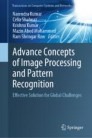
Advance Concepts of Image Processing and Pattern Recognition : Effective Solution for Global Challenges
Explains the important concepts and principles of image processing to implement the algorithms and techniques to discover new problems and applications. It contains numerous fundamental and advanced image processing algorithms and pattern recognition techniques to illustrate the framework. It presents essential background theory, shape methods, texture about new methods, and techniques for image processing and pattern recognition. It maintains a good balance between a mathematical background and practical implementation. This book also contains the comparison table and images that are used to show the results of enhanced techniques. This book consists of novel concepts and hybrid methods for providing effective solutions for society. It also includes a detailed explanation of algorithms in various programming languages like MATLAB, Python, etc.

Ad-Hoc, mobile, and wireless networks ; 6th International Conference, ADHOC-NOW 2007, Morelia, Mexico, September 24-26, 2007, Proceedings
The sixth international conference on AD-HOC NetwOrks and Wireless was held in the city of Morelia, Michoacan State, Mexico. It follows the tradition of a multidisciplinary research program on all aspects of ad hoc networks that aims to create a collaborative forum between mathematicians, computer scientists and engineers. Previous Ad-Hoc Networks and Wireless conferences were held.
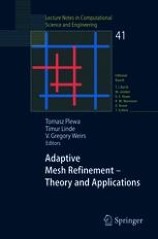
Adaptive Mesh Refinement - Theory and Applications; Proceedings of the Chicago Workshop on Adaptive Mesh Refinement Methods, Sept. 3-5, 2003
Advanced numerical simulations that use adaptive mesh refinement (AMR) methods have now become routine in engineering and science. Originally developed for computational fluid dynamics applications these methods have propagated to fields as diverse as astrophysics, climate modeling, combustion, biophysics and many others. The underlying physical models and equations used in these disciplines are rather different, yet algorithmic and implementation issues facing practitioners are often remarkably similar. Unfortunately, there has been little effort to review the advances and outstanding issues of adaptive mesh refinement methods across such a variety of fields. This book attempts to bridge this gap. The book presents a collection of papers by experts in the field of AMR who analyze past advances in the field and evaluate the current state of adaptive mesh refinement methods in scientific computing.
