



الصفحة 84
الصفحة 84

MATLAB® Recipes for Earth Sciences
MATLAB® is used in a wide range of applications in geosciences, such as image processing in remote sensing, generation and processing of digital elevation models and the analysis of time series. This book introduces methods of data analysis in geosciences using MATLAB such as basic statistics for univariate, bivariate and multivariate datasets, jackknife and bootstrap resampling schemes, processing of digital elevation models, gridding and contouring, geostatistics and kriging, processing and georeferencing of satellite images, digitizing from the screen, linear and nonlinear time-series analysis and the application of linear time-invariant and adaptive filters. The revised and updated Second Edition includes new subchapters on windowed Blackman-Tukey, Lomb-Scargle and Wavelet powerspectral analysis, statistical analysis of point distributions and digital elevation models, and a full new chapter on the statistical analysis of directional data. The text includes a brief description of each method and numerous examples demonstrating how MATLAB can be used on data sets from earth sciences. All MATLAB recipes can be easily modified in order to analyse the reader's own data sets.

Mathématiques, informatique, physique. Au fil des TIPE = Mathematics, computer science, physics : Throughout the TIPE projects
Presents nine cases in mathematics, physics, or computer science used in the competition. Each case study is accompanied by general remarks, commentary, a suggested outline, questions a jury might ask, and an explanation placing the case study's theme within its scientific context. The authors hope not only to assist CPGE students in their preparation but also to provide valuable support to teachers who have embraced this new pedagogical approach. Laurent Decreusefond and Alain Maruani, the pedagogical coordinators for the mathematics, computer science, and physics component of the TIPE, have made significant contributions to its design and implementation.

Mathématiques de base pour économistes = Basic Mathematics for Economists
This book contains fundamental elements of mathematics and includes the following elements: notion of logic, propositions, theorems, sets, relations and functions; graphical representations of functions, economic applications of lines and functions, sequences, limits and first derivative, differential economic applications of derivatives; integrals: undefined and defined with economic applications; mathematical series; functions of several variables, partial derivatives, Lagrange multiplier with economic applications; linear algebra: matrix calculus, system of linear equations, vectors, differential calculus in matrix form.

Mathematics teacher preparation in Central America and the Caribbean : The cases of Colombia, Costa Rica, the Dominican Republic and Venezuela
This book brings to the international Educational Community an important collection of experiences and ideas in the Mathematics Education of four countries of a region within the heart of the American continent, a region that has been many times forgotten. The dissemination of these results can promote the search for international collaborative actions in a wider scale.

Mathematics teacher education in the Andean region and Paraguay : A comparative analysis of issues and challenges
This Open Access book is an excellent synthesis of the initial and continuing preparation for Mathematics Teaching in Bolivia, Ecuador, Paraguay and Peru, from which comparative analyses can be made that show similarities and differences, and highlight various perspectives. This book brings to the international Educational Community an important collection of experiences and ideas in the Mathematics Education of four Latin-American countries in the developing Andean region and Paraguay. The dissemination of these results can promote the search for international collaborative actions in a wider scale.

Mathematics of Uncertainty : Ideas, Methods, Application Problems
Mathematics of Uncertainty" provides the basic ideas and foundations of uncertainty, covering the fields of mathematics in which uncertainty, variability, imprecision and fuzziness of data are of importance. This introductory book describes the basic ideas of the mathematical fields of uncertainty from simple interpolation to wavelets, from error propagation to fuzzy sets and neural networks. The book presents the treatment of problems of interpolation and approximation, as well as observation fuzziness which can essentially influence the preciseness and reliability of statements on functional relationships.

Mathematics of Surfaces XII ; 12th IMA International Conference, Sheffield, UK, September 4-6, 2007, Proceedings
This book constitutes the refereed proceedings of the 12th IMA International Conference on the Mathematics of Surfaces, held in Sheffield, UK in September 2007. The papers cover a range of ideas from underlying theoretical tools to industrial uses of surfaces.
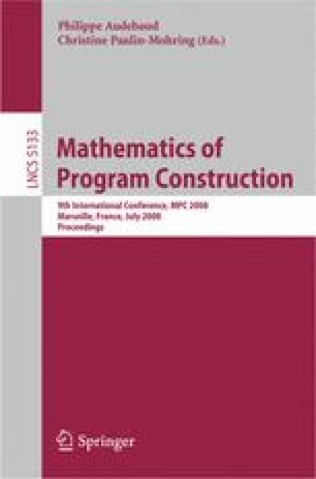
Mathematics of Program Construction ; 9th International Conference, MPC 2008, Marseille, France, July 15-18, 2008. Proceedings
This book constitutes the refereed proceedings of the 9th International Conference on Mathematics of Program Construction, MPC 2008, held in Marseille, France in July 2008.The 18 revised full papers presented together with 1 invited talk were carefully reviewed and selected from 41 submissions. Issues addressed range from algorithmics to support for program construction in programming languages and systems. Topics of special interest are type systems, program analysis and transformation, programming language semantics, program logics.

Mathematics of Program Construction ; 8th International Conference, MPC 2006, Kuressaare, Estonia, July 3-5, 2006, Proceedings
This volume contains the proceedings of the 8th International Conference on Mathematics of ProgramConstruction, MPC 2006,held at Kuressaare, Estonia, July 3-5, 2006, colocated with the 11th International Conference on Algebraic Methodology and Software Technology, AMAST 2006, July 5-8, 2006. TheMPCconferencesaimtopromotethedevelopmentofmathematicalpr- ciples and techniques that are demonstrably useful and usable in the process of constructing computer programs. Topics of interest range from algorithmics to support for program construction in programming languages and systems.

Mathematics of Large Eddy Simulation of Turbulent Flows
Large eddy simulation (LES) is a method of scientific computation seeking to predict the dynamics of organized structures in turbulent flows by approximating local, spatial averages of the flow. This book focuses on the mathematical foundations of LES and its models and provides a connection between the powerful tools of applied mathematics, partial differential equations and LES. Thus, it is concerned with fundamental aspects not treated so deeply in the other books in the field, aspects such as well-posedness of the models, their energy balance and the connection to the Leray theory of weak solutions of the Navier-Stokes equations.

Mathematics of Financial Markets
This book presents the mathematics that underpins pricing models for derivative securities, such as options, futures and swaps, in modern financial markets. The idealized continuous-time models built upon the famous Black-Scholes theory require sophisticated mathematical tools drawn from modern stochastic calculus. However, many of the underlying ideas can be explained more simply within a discrete-time framework. This is developed extensively in this substantially revised second edition to motivate the technically more demanding continuous-time theory, which includes a detailed analysis of the Black-Scholes model and its generalizations, American put options, term structure models and consumption-investment problems. The mathematics of martingales and stochastic calculus is developed where it is needed.

Mathematics Is Not a Spectator Sport
Mathematics Is Not a Spectator Sport challenges the reader to become an active mathematician. Beginning at a gentle pace, the author encourages the reader to get involved, with discussions of an exciting variety of topics, each placed in its historical context, The chapters are largely self-contained and each topic can be understood independently. However, the author draws many connections between the various topics to demonstrate their interplay and role within the context of mathematics as a whole. Lots of carefully chosen problems are included at the end of each section to stimulate the reader's development as a mathematician.

Mathematics for Life Science and Medicine
Dynamical systems theory in mathematical biology has attracted much attention from many scientific directions. The purpose of this volume is to present and discuss the many rich properties of the dynamical systems that appear in life science and medicine. The main topics include cancer treatment, dynamics of paroxysmal tachycardia, vector disease models, epidemic diseases and metapopulations, immune systems, pathogen competition and coexistence and the evolution of virulence and the rapid evolution of viruses within a host. Each chapter will serve to introduce students and scholars to the state-of-the-art in an exciting area, to present new results, and to inspire future contributions to mathematical modeling in life science and medicine.

Mathematics for enzyme reaction kinetics and Reactor performance ; 2 Volumes set
The second volume begins with an introduction to basic concepts in calculus, i.e. limits, derivatives, integrals and differential equations; limits, along with continuity, are further expanded afterwards, covering uni- and multivariate cases, as well as classical theorems. After recovering the concept of differential and applying it to generate (regular and partial) derivatives, the most important rules of differentiation of functions, in explicit, implicit and parametric form, are retrieved – together with the nuclear theorems supporting simpler manipulation thereof. The book then tackles strategies to optimize uni- and multivariate functions, before addressing integrals in both indefinite and definite forms.

Mathematics for Ecology and Environmental Sciences
Dynamical systems theory in mathematical biology has attracted much attention from many scientific directions. The purpose of this volume is to discuss the many rich and interesting properties of dynamical systems that appear in ecology and environmental sciences. The main topics include population dynamics with dispersal, nonlinear discrete population dynamics, structured population models, mathematical models in evolutionary ecology, stochastic spatial models in ecology, game dynamics and the chemostat model. Each chapter will serve to introduce students and scholars to the state-of-the-art in an exciting area, to present important new results, and to inspire future contributions to mathematical modeling in ecology and environmental sciences.

Mathematics Education in East Africa : Towards Harmonization and Enhancement of Education Quality
In the increasingly global and technological world mathematics is seen as a significant gatekeeper of opportunities for social and economic advancement and mobility. Hence, countries and development agencies in the broader sub-Saharan Africa region are looking towards increasing access to relevant and high-quality secondary education as a lever towards economic development. Policy makers and other key decision makers in education look towards improvement in mathematics teaching and learning as a key focus in education reform. In the East Africa region also a number of initiatives have been taken at the national level in the respective countries to improve the quality of mathematics education. This book provides an in-depth comparative analysis of the developments and issues in mathematics education in Kenya, Tanzania, Rwanda and Uganda, and advances our understanding of the state of secondary mathematics education in East Africa.

Mathematics Education in Different Cultural Traditions- A Comparative Study of East Asia and the West : The 13th ICMI Study
The volume covers a very wide field including the contexts of mathematics education, the curriculum, teaching and learning, and teachers’ values and beliefs. Within these broad parameters some of the particular cross-cultural issues that are discussed include intuition and logical reasoning, influences of Confucianism and Ancient Greek traditions, basic skills and process abilities, learners’ perspectives, assessment practices, text books and ICT multimedia.

Mathematics Education and Language Diversity : The 21st ICMI Study
This book examines multiple facets of language diversity and mathematics education. It features renowned authors from around the world and explores the learning and teaching of mathematics in contexts that include multilingual classrooms, indigenous education, teacher education, blind and deaf learners, new media and tertiary education. Each chapter draws on research from two or more countries to illustrate important research findings, theoretical developments and practical strategies.

Mathematics and the Historians Craft : The Kenneth O. May Lectures
Mathematical practitioners, for pedagogical reasons or to contextualize the work, tend to focus on finding the antecedents for current mathematical theories in a search for how particular subdisciplines and results came to be as they are today. On the other hand, historians of mathematics bypass the current state of affairs, and are more interested in questions that bear on the changing nature of the discipline itself.

Mathematics and the Aesthetic : New Approaches to an Ancient Affinity
The essays in this book explore the ancient affinity between the mathematical and the aesthetic, focusing on the fundamental connections between these two modes of reasoning and communicating. From historical, philosophical and psychological perspectives, with particular attention to certain mathematical areas such as geometry and analysis, the authors examine the ways in which the aesthetic is ever present in mathematical thinking and contributes to the growth and value of mathematical knowledge.
