



الصفحة 81
الصفحة 81

Formal Techniques for Networked and Distributed Systems - FORTE 2008 ; 28th IFIP WG 6.1 International Conference Tokyo, Japan, June 10-13, 2008 Proceedings
This book constitutes the refereed proceedings of the 28th IFIP WG 6.1 International Conference on Formal Techniques for Networked and Distributed Systems, FORTE 2008, held in Tokyo, Japan, in June 2008 co-located with TestCom/FATES 2008.The 19 revised full papers and 1 revised short paper presented together with 1 invited talk were carefully reviewed and selected from 44 submissions. The papers cover new approaches, concepts and experience in the application of formal methods for the specification and verification of distributed systems and applications.

Formal Techniques for Networked and Distributed Systems - FORTE 2006 ; 26th IFIP WG 6.1 International Conference, Paris, France, September 26-29, 2006, Proceedings
This book constitutes the refereed proceedings of the 26th IFIP WG 6.1 International Conference on Formal Techniques for Networked and Distributed Systems, FORTE 2006, held in Paris, France, in September 2006. The 26 revised full papers and 4 short papers presented together with 3 invited lectures were carefully reviewed and selected from 177 submissions. The papers focus on the construction of middleware and services using formalised and verified approaches.

Formal techniques for computer systems and business processes ; European performance engineering workshop, EPEW 2005 and International workshop on web services and formal methods, WS-FM 2005, Versailles, France, September 1-3, 2005, Proceedings
This book constitutes the refereed proceedings of two colocated international workshops EPEW 2005 (European Performance Engineering Workshop) and WS-FM 2005 (Web Services and Formal Methods) held in Versailles, France in September 2005. The 20 revised full papers presented were carefully reviewed and selected from 59 submissions. For EPEW 2005 only 10 papers - of the 32 submitted - were accepted for presentation; they deal with queueing theory, bounding techniques, stochastic model checking, communication schemes analysis for high-speed LAN, QOS analysis in wireless ad-hoc networks and optical networks analysis. The main topics of the 10 papers accepted for WS-FM 2005 - from 27 submissions - include: protocols and standards for WS (SOAP, WSDL, UDDI, etc.); languages and description methodologies for Choreography/Orchestration/Workflow (BPML, XLANG and BizTalk, WSFL, WS-BPEL, etc.); coordination techniques for WS (transactions, agreement, coordination services, etc.); semantics-based dynamic WS discovery services (based on Semantic Web/Ontology Techniques or other semantic theories); security, performance evaluation and quality of service of WS; semi-structured data and XML related technologies; comparisons with different related technologies/approaches.

Formal Modeling and Analysis of Timed Systems ; Vol. 3829 ; 3rd International Conference, FORMATS 2005, Uppsala, Sweden, September 26-28, 2005, Proceedings
This book constitutes the thoroughly refereed post-proceedings of the Third International Conference on Formal Modeling and Analysis of Timed Systems, FORMATS 2005, held in Uppsala, Sweden in September 2005 in conjunction with ARTIST2 summer school on Component Modelling, Testing and Verification, and Static analysis of embedded systems. The 19 revised full papers presented together with the abstracts of 3 invited talks were carefully selected from 43 submissions. The papers cover work on semantics and modeling of timed systems, formalisms for modeling and verification including timed automata, hybrid automata, and timed petri nets, games for verification and synthesis, model-checking, case studies and issues related to implementation, security and performance analysis.

Formal Modeling and Analysis of Timed Systems ; 6th International Conference, FORMATS 2008, Saint Malo, France, September 15-17, 2008. Proceedings
This book constitutes the refereed proceedings of the 6th International Conference on Formal Modeling and Analysis of Timed Systems, FORMATS 2008, held in Saint Malo, France, September 2008.The 17 revised full papers presented together with 3 invited talks were carefully reviewed and selected from 37 submissions. The papers are organized in topical sections on extensions of timed automata and semantics; timed games and logic; case studies; model-checking of probabilistic systems; verification and test; timed petri nets.

Formal Methods for Open Object-Based Distributed Systems ; 10th IFIP WG 6.1 International Conference, FMOODS 2008, Oslo, Norway, June 4-6, 2008 Proceedings
This book constitutes the refereed proceedings of the 10th IFIP WG 6.1 International Conference on Formal Methods for Open Object-Based Distributed Systems, FMOODS 2008, held in Oslo, Norway, in June 2008.The 14 revised full papers presented together with 1 invited lecture were carefully reviewed and selected from 35 submissions. The papers cover topcics such as semantics of object-oriented programming; formal techniques for specification, analysis, and refinement; model checking; theorem proving and deductive verification.

Formal Methods for Components and Objects ; 6th International Symposium, FMCO 2007, Amsterdam, The Netherlands, October 24-26, 2007, Revised Lectures
Formal methods have been applied successfully to the verification of medium-sized programs in protocol and hardware design.This book presents 12 revised papers submitted after the symposium by the speakers of each of the following European IST projects: the IST-FP6 project Mobius, developing the technology for establishing trust and security for the next generation of global computers; the IST-FP6 project SelfMan on self management for large-scale distributed systems based on structured overlay networks and components

Formal Methods and Testing : An Outcome of the FORTEST Network, Revised Selected Papers
This book constitutes the thoroughly refereed and peer-reviewed outcome of the Formal Methods and Testing (FORTEST) network - formed as a network established under UK EPSRC funding that investigated the relationships between formal (and semi-formal) methods and software testing - now being a subject group of two BCS Special Interest Groups: Formal Aspects of Computing Science (BCS FACS) and Special Interest Group in Software Testing (BCS SIGIST).

Formal Methods and Stochastic Models for Performance Evaluation ; 4th European Performance Engineering Workshop, EPEW 2007, Berlin, Germany, September 27-28, 2007, Proceedings
This book constitutes the refereed proceedings of the 4th European Performance Engineering Workshop, EPEW 2007, held in Berlin, Germany, September 27-28, 2007.The 20 revised full papers presented were carefully reviewed and selected from 53 submissions.

Formal Methods and Stochastic Models for Performance Evaluation ; 3rd European Performance Engineering Workshop, EPEW 2006, Budapest, Hungary, June 21-22, 2006, Proceedings
This volume contains the proceedings of the third EPEW workshop held at the Technical University of Budapest, Budapest, Hungary, June 21-22, 2006. These proceedings comprise the 16 accepted contributed papers of EPEW 2006.Toensurethehigh-qualityevaluationofthesubmittedpapersweextended the ProgramCommittee of EPEW 2006 with international experts from all over the world. The ?nal workshop program, as well as this volume, are made up of ?ve thematic sessions: – Stochastic process algebra – Workloads and benchmarks – Theory of stochastic processes – Formal dependability and performance evaluation – Queues, theory and practice These sessions cover a wide range of performance evaluation methods and c- pose an overview of the current research directions in performance evaluation.

Formal Methods and Software Engineering ; Vol. 3785 ; 7th International Conference on Formal Engineering Methods, ICFEM 2005, Manchester, UK, November 1-4, 2005, Proceedings
This volume contains papers presented at the 7th International Conference on Formal Engineering Methods (ICFEM 2005), 1-4 November 2005, Manchester, UK. Formal engineering methods are changing the way that systems are dev- oped. With language and tool support, these methods are being used for se- automatic code generation, and for the automatic abstraction and checking of implementations. In the future, they will be used at every stage of development: requirements, speci?cation, design, implementation, testing, anddocumentation. The aim of ICFEM 2005 was to bring together those interested in the - plication of formal engineering methods to computer systems. Researchers and practitioners, from industry, academia, and government, were encouraged to - tend, and to help advance the state of the art. The conference was supported by sponsorships from Microsoft Research, USA, the Software Engineers Association of Japan, the University of Man- ester, Manchester City Council, FormalMethods Europe (FME) and the British Computer Society FormalAspects ofComputing Specialist Group(BCS-FACS). We wish to thank these sponsors for their generosity. The ?nal programme consisted of 3 invited talks and 30 technical papers selected from a total of 74 submissions. The invited speakers were: Anthony Hall, independent consultant, UK; Egon B] orger, University of Pisa, Italy; John Rushby, SRI, USA. Their talks were sponsored by BCS-FACS, Microsoft - search and FME respectively. We wish to thank the invited speakers for their inspiring talks.

Formal Methods and Software Engineering ; 10th International Conference on Formal Engineering Methods, ICFEM 2008, Kitakyushu-City, Japan, October 27-31, 2008. Proceedings
This book constitutes the refereed proceedings of the 10th International Conference on Formal Engineering Methods, ICFEM 2008, held in Kitakyushu-City, Japan, October 2008.The 20 revised full papers together with 3 invited talks presented were carefully reviewed and selected from 62 submissions. The papers address all current issues in formal methods and their applications in software engineering. They are organized in topical sections on specification and verification; testing; verification; model checking and analysis; tools; application of formal methods; semantics.

Formal approaches to software testing ; Vol. 3395 ; 4th International workshop, FATES 2004, Linz, Austria, September 21, 2004, Revised Selected Papers
Testing often accounts for more than 50% of the required e?ort during system development.Thechallengeforresearchistoreducethesecostsbyprovidingnew methods for the speci?cation and generation of high-quality tests. Experience has shown that the use of formal methods in testing represents a very important means for improving the testing process. Formal methods allow for the analysis andinterpretationofmodelsinarigorousandprecisemathematicalmanner.The use of formal methods is not restricted to system models only. Test models may alsobeexamined.Analyzingsystemmodelsprovidesthepossibilityofgenerating complete test suites in a systematic and possibly automated manner whereas examining test models allows for the detection of design errors in test suites and their optimization with respect to readability or compilation and execution time. Due to the numerous possibilities for their application, formal methods have become more and more popular in recent years. The Formal Approaches in Software Testing (FATES) workshop series also bene?ts from the growing popularity of formal methods. After the workshops in Aalborg (Denmark, 2001), Brno (Czech Republic, 2002) and Montr´ eal (Canada, 2003), FATES 2004 in Linz (Austria) was the fourth workshop of this series. Similar to the workshop in 2003, FATES 2004 was organized in a?liation with the IEEE/ACM Conference on Automated Software Engineering (ASE 2004). FATES 2004 received 41 submissions. Each submission was reviewed by at least three independent reviewers from the Program Committee with the help of some additional reviewers. Based on their evaluations, 14 full papers and one wo- in-progress paper from 11 di?erent countries were selected for presentation.

Forest Restoration in Landscapes
This book integrates the restoration of forest functions into landscape conservation plans. and this book represents the collective body of knowledge and experience of WWF and its many partners--which is collected here for the first time and which will be invaluable to all of those working in the field. This guide will serve as a first stop for practitioners and researchers in any organization or region and as a key reference on the subject. Along with concise, practical information for a variety of specific systems and issues, it gives many suggestions for further research.

Forest Mensuration
Van Laar and Akça’s popular text book, Forest Mensuration, was first published in 1997. Like that first edition, this modern update is based on extensive research, teaching and practical experience in both Europe, and the tropics and subtropics. However, it has also been extensively revised, and now includes chapters on remote sensing and the application of aerial photographs and satellite imagery. As with its predecessor, this book assumes no advanced knowledge of statistical methods, and combines practical techniques with important historical and disciplinary context. The result is a strong balance between a handbook on traditional mensuration methods, and a valuable reference on the many recent research and inventory-related innovations which have emerged in recent years.

Forest Entomology in East Africa : Forest Insects of Tanzania
East African forests, among the world’s most biologically rich and diverse, are subject to multiple pressures, including insects. As the first work to focus exclusively on East African forest insects, this monograph distils 135 years of scientific and historical literature extending from before the colonial era to the present into an authoritative survey of this region’s major pests of trees and wood, as well as their antagonists. This comprehensive treatise also addresses insects of social and economic importance, such as endemics, edible and collectible insects, wild bees and silk producers. It should be of great value to foresters, entomologists, conservation biologists, resource managers, safari outfitters and anyone else interested in the natural history of this fascinating region.

Forensic pathology reviews ; Vol. 3
Maintaining the high quality achieved in earlier volumes, leading national and international forensic pathologists provide in Forensic Pathology Reviews, Volume 3 evidence-based accounts of special topics of current interest from various fields of forensic pathology and death-scene investigation. The authors offer cutting-edge insights into the medicolegal investigation of bodies found in water, the forensic aspects of the human immunodeficiency virus (HIV)-1 infection of the central nervous system, deaths in a head-down position, and forensic bitemark analysis. Additional chapters address taphonomic changes in human bodies during the early postmortem interval, arrhythmogenic ventricular dysplasia that produces sudden death in young people, the postmortem diagnosis of death in anaphylaxis, and iatrogenic deaths. The forensic aspects of suicide, murder-suicide, and suicide trends in the United States are also discussed, along with the evaluation of fatal pulmonary thromboembolism and the use of radiology in medicolegal investigations. A comprehensive, up-to-date review of the international literature is given for each chapter. Evidence-based and state-of-the-art, Forensic Pathology Reviews, Volume 3 synthesizes the practical advances made in a variety of important subspecialties of forensic pathology, demonstrating how the latest medical and scientific advances are being applied to solve current problems of high interest to forensic pathologists today.

Forensic Computing
In the second edition of this very successful book, Tony Sammes and Brian Jenkinson show how information held in computer systems can be recovered when it has been hidden or subverted by criminals, and give the reader the means to insure that it is accepted as admissible evidence in court.
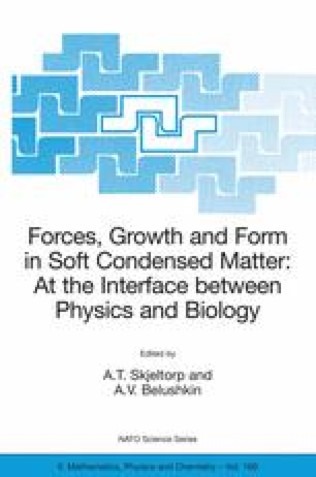
Forces, Growth and Form in Soft Condensed Matter : At the Interface between Physics and Biology
This volume comprises the proceedings of a NATO Advanced Study Institute held at Geilo, Norway, 24 March - 3 April 2003, the seventeenth ASI in a series held every two years since 1971. The objective of this ASI was to identify and discuss areas where synergism between modern physics, soft condensed matter and biology might be most fruitful. The main pedagogical approach was to have lecturers focussing on basic understanding of important aspects of the relative role of the various interaction- electrostatic, hydrophobic, steric, conformational, van der Waals etc. Soft condensed matter and the connection between physics and biology have been the themes of several earlier Geilo Schools. A return to these subjects thus allowed a fresh look and a possibility for defining new directions for research. Examples of soft materials, which were discussed at this ASI, included colloidal dispersions, gels, biopolymers and charged polymer solutions, polyelectrolytes, protein/membrane complexes, nucleic acids and their complexes. Indeed, most forms of condensed matter are soft and these substances are composed of aggregates and macromolecules, with interactions that are too weak and complex to form crystals spontaneously. A characteristic feature is that small external forces, slight perturbations in temperature, pressure or concentration, can all be enough to induce significant structural changes. Thermal fluctuations are almost by definition strong in soft materials and entropy is a predominant determinant of structure, so that disorder, slow dynamics and plastic deformation are the rule. Hence the phrase ‘soft condensed matter’ has been coined.

Force Sensors for Microelectronic Packaging Applications
This monograph is intended for wire bonding and flip-chip packaging professionals and for scientists and engineers working in the field of mechanical microsensors. New measurement technologies are introduced that allow in situ and real-time examination of physical processes during the packaging process or during subsequent reliability tests. The measurement system presented here enables measurements at formerly inaccessible packaging interconnects. For the first time it becomes possible to describe the wire bonding process window in terms of the physical forces at the contact zone instead of the applied machine settings. This is significant for a deeper understanding of these packaging processes. Applications of the sensor in the field of wire bonding and flip-chip characterization are illustrated. The reader will gain much insight into the important field of interconnection technology in semiconductor packaging.
