


تحسين النتائح
ترتيب حسب
من
الى


This book considers the potential and limitations of the various mathematical approaches and thereby aims to give a balanced view of the usability of each mathematical approach. Written with both student and professional in mind, this book assists the reader in applying mathematical methods to solve practical problems that are relevant to software engineers. It is suitable for coursework or self-study and there is helpful material on tools to support the various mathematical approaches.

The Engineering Materials and Processes series focuses on all forms of materials and the processes used to synthesise and formulate them as they relate to the various engineering disciplines.

This open access book presents the outcomes of the “Design for Future – Managed Software Evolution” .The different lifecycles of software and hardware platforms lead to interoperability problems in such systems. Instead of separating the development, adaptation and evolution of software and its platforms, as well as aspects like operation, monitoring and maintenance, they should all be integrated into one overarching process. Accordingly, the book is split into three major parts, the first of which includes an introduction to the nature of software evolution, followed by an overview of the specific challenges and a general introduction to the case studies used in the project. The second part of the book consists of the main chapters on knowledge carrying software, and cover tacit knowledge in software evolution, continuous design decision support, model-based round-trip engineering for software product lines, performance analysis strategies, maintaining security in software evolution, learning from evolution for evolution, and formal verification of evolutionary changes. In turn, the last part of the book presents key findings and spin-offs. The individual chapters there describe various case studies, along with their benefits, deliverables and the respective lessons learned. An overview of future research topics rounds out the coverage.
Focuses on the most recent developments in intelligent optimization methods and their applications in various test cases. The reprint covers various topics, including distributed multiagent modeling, metaheuristic algorithms, multisource data fusion, mobile computing and mobile sensing, machine learning-based intelligent processing for modeling complex manufacturing systems, and data-driven intelligent modeling
Discusses how to build various ML algorithms and how they can be applied to improve healthcare systems. Healthcare applications of AI are innumerable: medical data analysis, early detection and diagnosis of disease, providing objective-based evidence to reduce human errors, curtailing inter- and intra-observer errors, risk identification and interventions for healthcare management, real-time health monitoring, assisting clinicians and patients for selecting appropriate medications, and evaluating drug responses. Extensive demonstrations and discussion on the various principles of machine learning and its application in healthcare is provided, along with solved examples and exercises.
The goal of this book is to address the use of several important machine learning techniques into computer vision applications. An innovative combination of computer vision and machine learning techniques has the promise of advancing the field of computer vision, which contributes to better understanding of complex real-world applications. The effective usage of machine learning technology in real-world computer vision problems requires understanding the domain of application, abstraction of a learning problem from a given computer vision task, and the selection of appropriate representations for the learnable (input) and learned (internal) entities of the system. In this book, we address all these important aspects from a new perspective: that the key element in the current computer revolution is the use of machine learning to capture the variations in visual appearance, rather than having the designer of the model accomplish this. As a bonus, models learned from large datasets are likely to be more robust and more realistic than the brittle all-design models.
Challenges in complexity and variability of multimedia data have led to revolutions in machine learning techniques. Multimedia data, such as digital images, audio streams and motion video programs, exhibit richer structures than simple, isolated data items. A number of pixels in a digital image collectively conveys certain visual content to viewers. A TV video program consists of both audio and image streams that unfold the underlying story. To recognize the visual content of a digital image, or to understand the underlying story of a video program, we may need to label sets of pixels or groups of image and audio frames jointly.
Organized into five parts. Part One presents the fundamentals of ML. Part Two looks at the main types of data used to characterize brain disorders, including clinical assessments, neuroimaging, electro- and magnetoencephalography, genetics and omics data, electronic health records, mobile devices, connected objects and sensors. Part Three covers the core methodologies of ML in brain disorders and the latest techniques used to study them. Part Four is dedicated to validation and datasets, and Part Five discusses applications of ML to various neurological and psychiatric disorders.

Biomedicine is a multidisciplinary branch of medical science that consists of many scientific disciplines, e.g., biology, biotechnology, bioinformatics, and genetics; moreover, it covers various medical specialties. In recent years, this field of science has developed rapidly. This means that a large amount of data has been generated, due to (among other reasons) the processing, analysis, and recognition of a wide range of biomedical signals and images obtained through increasingly advanced medical imaging devices. The analysis of these data requires the use of advanced IT methods, which include those related to the use of artificial intelligence, and in particular machine learning. It is a summary of the Special Issue “Machine Learning for Biomedical Application”, briefly outlining selected applications of machine learning in the processing, analysis, and recognition of biomedical data, mostly regarding biosignals and medical images.
Introduces various machine learning methods for cyber security analytics. With an overwhelming amount of data being generated and transferred over various networks, monitoring everything that is exchanged and identifying potential cyber threats and attacks poses a serious challenge for cyber experts. Further, as cyber attacks become more frequent and sophisticated, there is a requirement for machines to predict, detect, and identify them more rapidly. Machine learning offers various tools and techniques to automate and quickly predict, detect, and identify cyber attacks.
Covers the multidimensional perspective of machine learning through the perspective of cloud computing and Internet of Things ranging from fundamentals to advanced applications. Elucidates some of the best practices and their respective outcomes in cloud and fog computing environments. It focuses on all the various research issues related to big data storage and analysis, large-scale data processing, knowledge discovery and knowledge management, computational intelligence, data security and privacy, data representation and visualization, and data analytics. The featured technologies presented in the book optimizes various industry processes using business intelligence in engineering and technology. Light is also shed on cloud-based embedded software development practices to integrate complex machines so as to increase productivity and reduce operational costs. The various practices of data science and analytics which are used in all sectors to understand big data and analyze massive data patterns are also detailed in the book.
Presents recent advancements in research, a review of new methods and techniques, and applications in decision support systems (DSS) with Machine Learning and Probabilistic Graphical Models, which are very effective techniques in gaining knowledge from Big Data and in interpreting decisions. It explores Bayesian network learning, Control Chart, Reinforcement Learning for multicriteria DSS, Anomaly Detection in Smart Manufacturing with Federated Learning, DSS in healthcare, DSS for supply chain management, etc. Researchers and practitioners alike will benefit from this book to enhance the understanding of machine learning, Probabilistic Graphical Models, and their uses in DSS in the context of decision making with uncertainty. The real-world case studies in various fields with guidance and recommendations for the practical applications of these studies are introduced in each chapter.
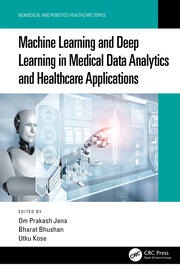
Introduces and explores a variety of schemes designed to empower, enhance, and represent multi-institutional and multi-disciplinary machine learning (ML) and deep learning (DL) research in healthcare paradigms. Serving as a unique compendium of existing and emerging ML/DL paradigms for the healthcare sector, this book demonstrates the depth, breadth, complexity, and diversity of this multi-disciplinary area. It provides a comprehensive overview of ML/DL algorithms and explores the related use cases in enterprises such as computer-aided medical diagnostics, drug discovery and development, medical imaging, automation, robotic surgery, electronic smart records creation, outbreak prediction, medical image analysis, and radiation treatments.
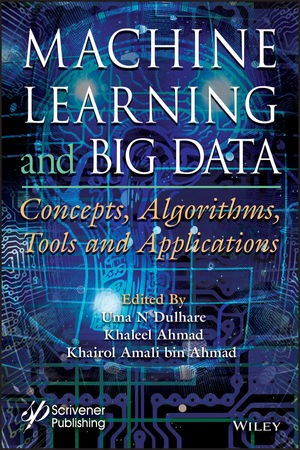
Showcase novel use-cases and applications, present empirical research results from user-centered qualitative and quantitative experiments of these new applications, and facilitate a discussion forum to explore the latest trends in big data and machine learning by providing algorithms which can be trained to perform interdisciplinary techniques such as statistics, linear algebra, and optimization and also create automated systems that can sift through large volumes of data at high speed to make predictions or decisions without human intervention
Approaches ML as the computational implementation of the scientific principle. This principle consists of continuously adapting a model of a given data-generating phenomenon by minimizing some form of loss incurred by its predictions. Trains readers to break down various ML applications and methods in terms of data, model, and loss, thus helping them to choose from the vast range of ready-made ML methods.
Machine Learning - Modeling Data Locally and Globally presents a novel and unified theory that tries to seamlessly integrate different algorithms. Specifically, the book distinguishes the inner nature of machine learning algorithms as either "local learning"or "global learning."This theory not only connects previous machine learning methods, or serves as roadmap in various models, but – more importantly – it also motivates a theory that can learn from data both locally and globally. This would help the researchers gain a deeper insight and comprehensive understanding of the techniques in this field. The book reviews current topics,new theories and applications.
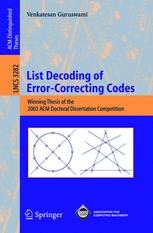
Presents some spectacular new results in the area of decoding algorithms for error-correcting codes. Specifically, it shows how the notion of “list-decoding” can be applied to recover from far more errors, for a wide variety of err- correcting codes, than achievable before. A brief bit of background : error-correcting codes are combinatorial str- tures that show how to represent (or “encode”) information so that it is - silient to a moderate number of errors. Speci?cally, an error-correcting code takes a short binary string, called the message, and shows how to transform it into a longer binary string, called the codeword, so that if a small number of bits of the codewordare ?ipped, the resulting string does not look like any other codeword. The maximum number of errorsthat the code is guaranteed to detect, denoted d, is a central parameter in its design. A basic property of such a code is that if the number of errors that occur is known to be smaller than d/2, the message is determined uniquely. This poses a computational problem, called the decoding problem : compute the message from a corrupted codeword, when the number of errors is less than d/2.

includes contributions originating from a conference held at Chapman University during November 14-19, 2017. It presents original research by experts in signal processing, linear systems, operator theory, complex and hypercomplex analysis and related topics.

Linear Genetic Programming examines the evolution of imperative computer programs written as linear sequences of instructions. In contrast to functional expressions or syntax trees used in traditional Genetic Programming (GP), Linear Genetic Programming (LGP) employs a linear program structure as genetic material whose primary characteristics are exploited to achieve acceleration of both execution time and evolutionary progress.
This book covers two major classes of mixed effects models—linear mixed models and generalized linear mixed models—and it presents an up-to-date account of theory and methods in analysis of these models as well as their applications in various fields. It offers a systematic approach to inference about non-Gaussian linear mixed models. Furthermore, it discusses the latest developments and methods in the field, incorporating relevant updates since publication of the first edition. These include advances in high-dimensional linear mixed models in genome-wide association studies (GWAS), advances in inference about generalized linear mixed models with crossed random effects, new methods in mixed model prediction, mixed model selection, and mixed model diagnostics.

سوريا - اتستراد درعا - غباغب
+963-15 2050 - 15 860 380 /1/2/3 - 11 662 3900