



الصفحة 8
الصفحة 8

Metaheuristics : Progress in Complex Systems Optimization
The aim of METAHEURISTICS: Progress in Complex Systems Optimization is to provide several different kinds of information: a delineation of general metaheuristics methods, a number of state-of-the-art articles from a variety of well-known classical application areas as well as an outlook to modern computational methods in promising new areas. Therefore, this book may equally serve as a textbook in graduate courses for students, as a reference book for people interested in engineering or social sciences, and as a collection of new and promising avenues for researchers working in this field.

Metaheuristics : Progress as Real Problem Solvers
Metaheuristics: Progress as Real Problem Solvers is a peer-reviewed volume of eighteen current, cutting-edge papers by leading researchers in the field. Included are an invited paper by F. Glover and G. Kochenberger, which discusses the concept of Metaheuristic agent processes, and a tutorial paper by M.G.C. Resende and C.C. Ribeiro discussing GRASP with path-relinking. Other papers discuss problem-solving approaches to timetabling, automated planograms, elevators, space allocation, shift design, cutting stock, flexible shop scheduling, colorectal cancer and cartography. A final group of methodology papers clarify various aspects of Metaheuristics from the computational view point

Metaheuristic Procedures for Training Neural Networks
Metaheuristic Procedures For Training Neural Networks provides successful implementations of metaheuristic methods for neural network training. Apart from Chapter 1, which reviews classical training methods, the chapters are divided into three main categories. The first one is devoted to local search based methods, including Simulated Annealing, Tabu Search, and Variable Neighborhood Search.

Metaheuristic Optimization via Memory and Evolution : Tabu Search and Scatter Search
Tabu Search (TS) and, more recently, Scatter Search (SS) have proved highly effective in solving a wide range of optimization problems, and have had a variety of applications in industry, science, and government. The goal of METAHEURISTIC OPTIMIZATION VIA MEMORY AND EVOLUTION: Tabu Search and Scatter Search is to report original research on algorithms and applications of tabu search, scatter search or both, as well as variations and extensions having "adaptive memory programming" as a primary focus. Individual chapters identify useful new implementations or new ways to integrate and apply the principles of TS and SS, or that prove new theoretical results, or describe the successful application of these methods to real world problems.The chapters of this book provide a series of landmarks along the way as we investigate and seek to better understand the elements of tabu search and scatter search that account for their successes in an astonishingly varied range of applications.

Metaheuristic Optimization Algorithms in Civil Engineering : New Applications
Discusses the application of metaheuristic algorithms in a number of important optimization problems in civil engineering. Advances in civil engineering technologies require greater accuracy, efficiency and speed in terms of the analysis and design of the corresponding systems. As such, it is not surprising that novel methods have been developed for the optimal design of real-world systems and models with complex configurations and large numbers of elements.
Metagraphs and Their Applications
The graph is a critical and useful concept in designing many information processing systems. Systems such as transaction processing systems, decision support systems, and workflow systems are all helped immensely by a graphical structure. Simple graphs and digraphs allow for the construction of a variety of system design tools that provide a convenient and appealing format for illustrating information infrastructures, while allowing any subsequent analyses to be performed by the user. However, the metagraph, a new graphical structure that is developed in this book, goes beyond the representational and provides Information Systems with a robust, analytical modeling graphic tool.
Meshless Methods in Solid Mechanics
The main objective of this book is to provide a textbook for graduate courses on the computational analysis of continuum and solid mechanics based on meshless (also known as mesh free) methods. It can also be used as a reference book for engineers and scientists who are exploring the physical world through computer simulations. Emphasis of this book is given to the understanding of the physical and mathematical characteristics of the procedures of computational solid mechanics. It naturally brings the essence, advantages and challenging problems of meshless methods into the picture. The subjects in this book cover the fundamentals of continuum mechanics, the integral formulation methods of continuum problems, the basic concepts of finite element methods, and the methodologies, formulations, procedures, and applications of various meshless methods. It also provides general and detailed procedures of meshless analysis on elastostatics, elastodynamics, non-local continuum mechanics and plasticity with a large number of numerical examples. Some basic and important mathematical methods are included in the Appendixes. For the readers who want to gain knowledge through hands-on experience, the meshless programs for elastostatics and elastodynamics are also introduced in the book and included in the disc.
Meshfree Methods for Partial Differential Equations IV
The numerical treatment of partial differential equations with particle methods and meshfree discretization techniques is a very active research field both in the mathematics and engineering community. Due to their independence of a mesh, particle schemes and meshfree methods can deal with large geometric changes of the domain more easily than classical discretization techniques. Furthermore, meshfree methods offer a promising approach for the coupling of particle models to continuous models. This volume of LNCSE is a collection of the proceedings papers of the Fourth International Workshop on Meshfree Methods held in September 2007 in Bonn. The articles address the different meshfree methods (SPH, PUM, GFEM, EFGM, RKPM, etc.) and their application in applied mathematics, physics and engineering. The volume is intended to foster this very active and exciting area of interdisciplinary research and to present recent advances and results in this field.
MEGAFLOW - Numerical Flow Simulation for Aircraft Design ; Results of the second phase of the German CFD initiative MEGAFLOW, presented during its closing symposium at DLR, Braunschweig, Germany, December 10 and 11, 2002
This volume contains results of the German CFD initiative MEGAFLOW which combines many of the CFD development activities from DLR, universities and aircraft industry. It highlights recent improvements and enhancements of the MEGAFLOW software system.
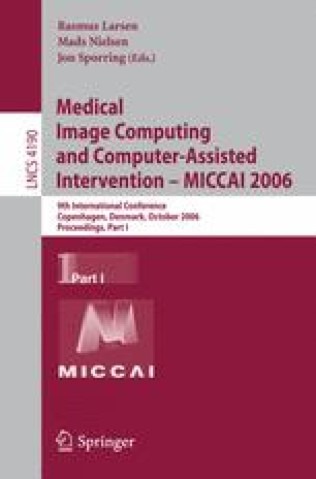
Medical Image Computing and Computer-Assisted Intervention – MICCAI 2006 ; Vol. 4190 ; 9th International Conference, Copenhagen, Denmark, October 1-6, 2006, Proceedings, Part I
MICCAI papers are of high standard and have a long lifetime. In this v- ume as well as in the latest journal issues of Medical Image Analysis and IEEE Transactions on Medical Imaging papers cite previous MICCAIs including the ?rst MICCAI conference in Cambridge, Massachusetts, 1998. It is obvious that the community requires the MICCAI papers as archive material. Therefore the proceedingsofMICCAIarefrom2005andhenceforthbeing indexedbyMedline. Acarefulreviewandselectionprocesswasexecutedinordertosecurethebest possible program for the MICCAI 2006 conference. We received 578 scienti?c papers from which 39 papers were selected for the oral program and 193 papers for the poster program.

Mechatronics and Machine Vision in Practice
From grading and preparing harvested vegetables to the tactile probing of a patient’s innermost recesses, mechatronics has become part of our way of life. The addition of senses and computing intelligence to blend with mechanical actuation gives rise to a breed of new machines with all the best attributes of a robot.

Mechanics of Microelectronics
Written by the leading experts with both profound knowledge and rich practical experience in advanced mechanics and microelectronics industry, this book aims to provide the cutting edge knowledge and solutions for various mechanical related problems, in a systematic way. It contains essential and detailed information about the state-of-the-art theories, methodologies, the way of working and real case studies.

Mechanics of Material Forces
The book covers both theoretical and numerical developments. Conceptually speaking, common continuum mechanics in the sense of Newton—which gives rise to the notion of spatial (mechanical) forces—considers the response to variations of spatial placements of "physical particles” with respect to the ambient space, whereas continuum mechanics in the sense of Eshelby—which gives rise to the notion of material (configurational) forces—is concerned with the response to variations of material placements of "physical particles” with respect to the ambient material. Well-known examples of material forces are driving forces on defects like the Peach-Koehler forece, the J-Integral in fracture mechanics, and energy release. The consideration of material forces goes back to the works of Eshelby, who investigated forces on defects; therefore this area of continuum mechanics is sometimes denoted Eshelbian mechanics.

Mechanical Response of Composites
This book contains twelve selected papers presented at the ECCOMAS Thematic Conference — Mechanical Response of Composites, and the papers presented by the three plenary speakers. It describes recent advances in the field of analysis models for the mechanical response of advanced composite materials, ranging from the simulation of the manufacturing process to the inelastic response and collapse of the material. The analysis models are based on recent advances in computational mechanics such as multi-scale modeling, cohesive and partition of unity models.

Measure Theory and Probability Theory
The book can be used as a text for a two semester sequence of courses in measure theory and probability theory, with an option to include supplemental material on stochastic processes and special topics.Prerequisites are kept to the minimal level of an understanding of basic real analysis concepts such as limits, continuity, differentiability, Riemann integration, and convergence of sequences and series. A review of this material is included in the appendix. The book starts with an informal introduction that provides some heuristics into the abstract concepts of measure and integration theory, which are then rigorously developed. The first part of the book can be used for a standard real analysis course for both mathematics and statistics Ph.D. students as it provides full coverage of topics such as the construction of Lebesgue-Stieltjes measures on real line and Euclidean spaces, the basic convergence theorems, L^p spaces, signed measures, Radon-Nikodym theorem, Lebesgue's decomposition theorem and the fundamental theorem of Lebesgue integration on R, product spaces and product measures, and Fubini-Tonelli theorems. It also provides an elementary introduction to Banach and Hilbert spaces, convolutions, Fourier series and Fourier and Plancherel transforms.

Measure Theory
This book gives a systematic presentation of modern measure theory as it has developed over the past century and offers three levels of presentation: a standard university graduate course, an advanced study containing some complements to the basic course (the material of this level corresponds to a variety of special courses), and, finally, more specialized topics partly covered by more than 850 exercises. Bibliographical and historical comments and an extensive bibliography with 2000 works covering more than a century are provided.

Mathematics and Democracy : Recent Advances in Voting Systems and Collective Choice
In this book, different quantitative approaches to the study of electoral systems have been developed: game-theoretic, decision-theoretic, statistical, probabilistic, combinatorial, geometric, and optimization ones. All the authors are prominent scholars from these disciplines. Quantitative approaches offer a powerful tool to detect inconsistencies or poor performance in actual systems. Applications to concrete settings such as EU, American Congress, regional, and committee voting are discussed.

Mathematics and Culture II : Visual Perfection: Mathematics and Creativity
This book presents the mathematical foundations of systems theory in a self-contained, comprehensive, detailed and mathematically rigorous way. This volume is devoted to the analysis of dynamical systems with emphasis on problems of uncertainty, whereas the second volume will be devoted to control. It combines features of a detailed introductory textbook with that of a reference source. The book contains many examples and figures illustrating the text which help to bring out the intuitive ideas behind the mathematical constructions.

Mathematics - Key Technology for the Future : Joint Projects Between Universities and Industry 2004–2007
This book is about the results of a number of projects funded by the BMBF in the initiative "Mathematics for Innovations in Industry and Services". It shows that a broad spectrum of analytical and numerical mathematical methods and programming techniques are used to solve a lot of different specific industrial or services problems. The main focus is on the fact that the mathematics used is not usually standard mathematics or black box mathematics but is specifically developed for specific industrial or services problems. Mathematics is more than a tool box or an ancilarry science for other scientific disciplines or users. Through this book the reader will gain insight into the details of mathematical modeling and numerical simulation for a lot of industrial applications.

Mathematical Systems Theory I : Modelling, State Space Analysis, Stability and Robustness
This book presents the mathematical foundations of systems theory in a self-contained, comprehensive, detailed and mathematically rigorous way. This volume is devoted to the analysis of dynamical systems with emphasis on problems of uncertainty, whereas the second volume will be devoted to control. It combines features of a detailed introductory textbook with that of a reference source. The book contains many examples and figures illustrating the text which help to bring out the intuitive ideas behind the mathematical constructions.
