


تحسين النتائح
ترتيب حسب
من
الى


Advanced Quantum Mechanics, the second volume on quantum mechanics by Franz Schwabl, discusses nonrelativistic multi-particle systems, relativistic wave equations and relativistic fields. Characteristic of Schwabl’s work, this volume features a compelling mathematical presentation in which all intermediate steps are derived and where numerous examples for application and exercises help the reader to gain a thorough working knowledge of the subject. The treatment of relativistic wave equations and their symmetries and the fundamentals of quantum field theory lay the foundations for advanced studies in solid-state physics, nuclear and elementary particle physics. This text extends and complements Schwabl’s introductory Quantum Mechanics, which covers nonrelativistic quantum mechanics and offers a short treatment of the quantization of the radiation field. New material has been added to this third edition of Advanced Quantum Mechanics on Bose gases, the Lorentz covariance of the Dirac equation, and the ‘hole theory’ in the chapter "Physical Interpretation of the Solutions to the Dirac Equation."

Advanced Organic Chemistry Part A provides a close look at the structural concepts and mechanistic patterns that are fundamental to organic chemistry. It relates those mechanistic patterns, including relative reactivity and stereochemistry, to underlying structural factors. Understanding these concepts and relationships will allow students to recognize the cohesive patterns of reactivity in organic chemistry. Part A: Structure and Mechanism and Part B: Reaction and Synthesis - taken together - are intended to provide the advanced undergraduate or beginning graduate student in chemistry with a foundation to comprehend and use the research literature in organic chemistry

What makes an event count as an action? Typical answers appeal to the way in which the event was produced: e.g., perhaps an arm movement is an action when caused by mental states (in particular ways), but not when caused in other ways. Andrew Sneddon argues that this type of answer, which he calls "productionism", is methodologically and substantially mistaken. In particular, productionist answers to this question tend to be either individualistic or foundationalist, or both, without explicit defence.
Abductive Reasoning: Logical Investigations into Discovery and Explanation is a much awaited original contribution to the study of abductive reasoning, providing logical foundations and a rich sample of pertinent applications.

presents a systemic analysis of Spinoza’s philosophy and challenges the traditional views. It deals with Spinoza’s concepts of substance, truth conditions, attributes, and the first, second, and supreme grades of knowledge. Based upon an analysis of the relevant details in all of Spinoza’s philosophical works, reveals many important points, including the following: Spinoza’s system is not, nor is meant to be, a foundational-deductive system but was meant to be a coherent system of a network model. Spinoza’s reality is not made in the image of a mathematical model. Imaginatio, the first grade of knowledge, and ratio, the second grade, are parts or properties of the supreme grade of knowledge, scientia intuitiva, which is their essence.
Written in the tradition of G. Ludwig’s groundbreaking works, this book aims to clarify and formulate more precisely the fundamental ideas of physical theories. By introducing a basic descriptive language of simple form, in which it is possible to formulate recorded facts, ambiguities of physical theories are avoided as much as possible. In this approach the field of physics that should be described by a theory is determined by basic concepts only, i.e. concepts that can be explained without a theory.In this context the authors introduce a new concept of idealization and review the process of discovering new concepts. They believe that, when the theories are formulated within an axiomatic basis, solutions can be found to many difficult problems such as the interpretation of physical theories, the relations between theories as well as the introduction of physical concepts. The book addresses both physicists and philosophers of science and should encourage the reader to contribute to the understanding of the lasting core of physical knowledge about the real structures of the world.
A Geometry of Approximation' addresses Rough Set Theory, a field of interdisciplinary research first proposed by Zdzislaw Pawlak in 1982, and focuses mainly on its logic-algebraic interpretation. The theory is embedded in a broader perspective that includes logical and mathematical methodologies pertaining to the theory, as well as related epistemological issues. Any mathematical technique that is introduced in the book is preceded by logical and epistemological explanations. Intuitive justifications are also provided, insofar as possible, so that the general perspective is not lost.
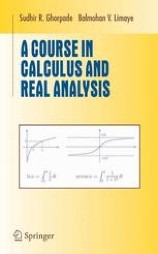
This book provides a self-contained and rigorous introduction to calculus of functions of one variable. The presentation and sequencing of topics emphasizes the structural development of calculus. At the same time, due importance is given to computational techniques and applications. The authors have strived to make a distinction between the intrinsic definition of a geometric notion and its analytic characterization. It highlight the fact that calculus provides a firm foundation to several concepts and results that are generally encountered in high school and accepted on faith. For example, one can find here a proof of the classical result that the ratio of the circumference of a circle to its diameter is the same for all circles. Also, this book helps get a clear understanding of the concept of an angle and the definitions of the logarithmic, exponential and trigonometric functions together with a proof of the fact that these are not algebraic functions. A number of topics that may have been inadequately covered in calculus courses and glossed over in real analysis courses are treated here in considerable detail. As such, this book provides a unified exposition of calculus and real analysis.
This book is unique in that it is more concise than most others; the material is treated in a streamlined fashion. This allows the lecturer to select the material for a one-semester course on a topic more easily. These initial chapters cover just the material for an introductory course on mathematical logic combined with the necessary material from set theory. Chapter 3 is partly of a descriptive nature, providing a view towards decision problems, automated theorem proving, non-standard models and related subjects. The other chapters contain material on logic programming for computer scientists, model theory, recursion theory, Gödel's Incompleteness Theorems, and applications of mathematical logic. Philosophical and foundational problems of mathematics are discussed where appropriate.

This book helps readers combine history, politics, and ethics to address the most pressing problem facing the world today: environmental survival. In A Climate of Justice, Marvin Brown connects the environmental crisis to basic questions of economic, social, and racial justice. Brown shows how our current social climate maintains systemic injustices, and he uncovers resources for change through a civic ethics of repair and reciprocity.
Shortly after its inauguration in 1985 the Birla Science Centre, Hyderabad, India, started a series of lectures by Nobel Laureates and other scientists of international renown, usually in Physics and Astronomy, sometimes in Life Sciences and Chemistry. The present collection mostly consists of lectures on frontier topics. The transcript of each lecture is preceded by a short biography of the Nobel Laureate/Scientist in question.

سوريا - اتستراد درعا - غباغب
+963-15 2050 - 15 860 380 /1/2/3 - 11 662 3900