



الصفحة 79
الصفحة 79
Analysis of Computer and Communication Networks
Analysis of Computer and Communication Networks presents the academic and research communities with mathematical theory and techniques necessary for analyzing and modeling high-performance global networks, such as the Internet.

Analysis II : Differential and Integral Calculus, Fourier Series, Holomorphic Functions
Functions in R and C, including the theory of Fourier series, Fourier integrals and part of that of holomorphic functions.It is suitable for both teaching and self-study. In his familiar, personal style, the author emphasizes ideas over calculations and, avoiding the condensed style frequently found in textbooks, explains these ideas without parsimony of words.
Analysis II
As with the first, the second volume contains substantially more material than can be covered in a one-semester course. Such courses may omit many beautiful and well-grounded applications which connect broadly to many areas of mathematics. We of course hope that students will pursue this material independently; teachers may find it useful for undergraduate seminars. For an overview of the material presented, consult the table of contents and the chapter introductions. As before, we stress that doing the numerous exercises is indispensable for understanding the subject matter, and they also round out and amplify the main text. In writing this volume, we are indebted to the help of many.

Analysis I
Logical thinking, the analysis of complex relationships, the recognition of und- lying simple structures which are common to a multitude of problems — these are the skills which are needed to do mathematics, and their development is the main goal of mathematics education. Of course, these skills cannot be learned ‘in a vacuum’. Only a continuous struggle with concrete problems and a striving for deep understanding leads to success. A good measure of abstraction is needed to allow one to concentrate on the essential, without being distracted by appearances and irrelevancies. The present book strives for clarity and transparency. Right from the beg- ning, it requires from the reader a willingness to deal with abstract concepts, as well as a considerable measure of self-initiative. For these e?orts, the reader will be richly rewarded in his or her mathematical thinking abilities, and will possess the foundation needed for a deeper penetration into mathematics and its applications.

Analysis by Its History
This book presents first-year calculus roughly in the order in which it first was discovered. The first two chapters show how the ancient calculations of practical problems led to infinite series, differential and integral calculus and to differential equations. The establishment of mathematical rigour for these subjects in the 19th century for one and several variables is treated in chapters III and IV. The text is complemented by a large number of examples, calculations and mathematical pictures and will provide stimulating and enjoyable reading for students, teachers, as well as researchers.
Analysis and Synthesis of Logics : How to Cut and Paste Reasoning Systems
Starting with simple examples showing the relevance of cutting and pasting logics, the monograph develops a mathematical theory of combining and decomposing logics, ranging from propositional and first-order based logics to higher-order based logics as well as to non-truth functional logics. The theory covers mechanisms for combining semantic structures and deductive systems either of the same or different nature (for instance, two Hilbert calculi or a Hilbert calculus and a tableau calculus). The important issue of preservation of properties is extensively addressed. For instance, sufficient conditions are provided for a combined logic to be sound and complete when the original component logics are known to be sound and complete.

Analysis and Simulation of Fluid Dynamics
This volume collects the contributions of a Conference held in June 2005, at the laboratoire Paul Painlev́ e (UMR CNRS 8524) in Lille, France. The meeting was intended to review hot topics and future trends in ?uid dynamics.

Analysis and Simulation of Contact Problems
Contact mechanics was and is an important branch in mechanics which covers a broad field of theoretical, numerical and experimental investigations. In this carefully edited book the reader will obtain a state-of-the-art overview on formulation, mathematical analysis and numerical solution procedures of contact problems. The contributions collected in this volume summarize the lectures presented during the 4th Contact Mechanics International Symposium (CMIS) held in Hannover, Germany, 2005, by leading scientists in the area of contact mechanics.
Analysis and Probability : Wavelets, Signals, Fractals
This book, combining analysis and tools from mathematical probability, focuses on a systematic and novel presentation of recent trends in pure and applied mathematics: the emergence of three fields, wavelets, signals and fractals. The unity of basis constructions and their expansions is emphasized as the starting point for the development of bases that are computationally efficient for use in several areas from wavelets to fractals.the book brings together tools from engineering and math, especially from signal- and image processing, and from harmonic analysis and operator theory. The presentation is aimed at graduate students, as well as users from a diverse spectrum of applications.
Analysis and Numerics for Conservation Laws
The physical and chemical mechanisms as well as the sizes of these processes are quite different. So are the motivations for studying them scientifically.The super- 8 nova is a thermo-nuclear explosion on a scale of 10 cm. Astrophysicists try to understand them in order to get insight into fundamental properties of the universe. In hows around airfoils of commercial airliners at the scale of 3 10 cm shock waves occur that influence the stability of the wings as well as fuel consumption in ight. This requires appropriate design of the shape and structure of airfoils by engineers. Knocking occurs in combustion, a chemical 1 process, and must be avoided since it damages motors. The scale is 10 cm and these processes must be optimized for efficiency and environmental conside- tions. The common thread is that the underlying ?uid ?ows may at a certain scale of observation be described by basically the same type of hyperbolic s- tems of partial differential equations in divergence form, called conservation laws. Astrophysicists, engineers and mathematicians share a common interest in scientific progress on theory for these equations and the development of computational methods for solutions of the equations. Due to their wide applicability in modeling of continua. A substantial portion of mathematical research is related to the analysis and numerical approximation of solutions to such equations. Hyperbolic conservation laws in two or more space dimensions still poseone of the main challenges to modern mathematics.
Analysis and Algorithms for Service Parts Supply Chains
Services requiring parts has become a $1.5 trillion business annually worldwide, creating a tremendous incentive to manage the logistics of these parts efficiently by making planning and operational decisions in a rational and rigorous manner. This book provides a broad overview of modeling approaches and solution methodologies for addressing service parts inventory problems found in high-powered technology and aerospace applications. The focus in this work is on the management of high cost, low demand rate service parts found in multi-echelon settings. This unique book, with its breadth of topics and mathematical treatment, begins by first demonstrating the optimality of an order-up-to policy [or (s-1,s)] in certain environments. This policy is used in the real world and studied throughout the text. The fundamental mathematical building blocks for modeling and solving applications of stochastic process and optimization techniques to service parts management problems are summarized extensively. A wide range of exact and approximate mathematical models of multi-echelon systems is developed and used in practice to estimate future inventory investment and part repair requirements.

Analysing Ecological Data
This book provides a practical introduction to analysing ecological data using real data sets collected as part of postgraduate ecological studies or research projects. The first part of the book gives a largely non-mathematical introduction to data exploration, univariate methods (including GAM and mixed modelling techniques), multivariate analysis, time series analysis (e.g. common trends) and spatial statistics. The second part provides 17 case studies, mainly written together with biologists who attended courses given by the first authors. The case studies include topics ranging from terrestrial ecology to marine biology.

Analyse asymptotique et couche limite = Asymptotic analysis and boundary layer
The aim of the book is to give teachers and students (from Bac + 4) in applied mathematics and fluid mechanics a teaching and learning tool illustrated by fifty problems accompanied by their detailed correction. This book presents a new method of asymptotic analysis for "boundary layer" problems. This is called MASC "Method of Complementary Successive Approximations". The first half of the book is devoted, in addition to the presentation of the MASC, to organize the knowledge necessary for the asymptotic analysis and to give the keys allowing the understanding of what is a problem called "boundary layer" and the methods allowing. to build an approximation. The second part is devoted to the application of MASC in fluid mechanics and to the comparison with the more traditional methods resulting from the famous MDAR, "Method of Connected Asymptotic Developments".
Analog Design Centering and Sizing
This book represents a compendium of fundamental problem formulations of analog design centering and sizing. It provides a differentiated knowledge about the tasks of analog design centering and sizing. In particular the worst-case problem will be formulated. It stands at the interface between process technology and design technology.Analog Design Centering and Sizing wants to point out that and how both process and design technology are required for its solution. The intention is to enable analog and mixed-signal designers to assess CAD solution methods that are presented to them. On the other side, the intention is to enable developers of analog CAD tools to formulate and develop solution approaches for analog design centering and sizing.The structure of Analog Design Centering and Sizing is geared towards a combination of a reference book and a textbook. The formulations of tasks and solution approaches by mathematical means makes the book suitable as well for students dealing with analog design and design methodology.

Analisi matematica II : Teoria ed esercizi con complementi in rete = Mathematical analysis 2 : Theory and exercises with online complements
Intends to support a second teaching of Mathematical Analysis according to the principles of the new Didactic Regulations. It is especially designed for those study courses (such as Engineering, Computer Science, Physics) in which the mathematical tool is a significant part of the training. The fundamental concepts and methods of the differential and integral calculus of several variables, the series of functions and the ordinary differential equations are presented with the primary objective of training the student in their operational but critical use. The didactic setting of the text follows the one used for ANALYSIS I. The method of presentation of the arguments allows a flexible and modular use of the text, in order to respond to the various possible didactic choices in the organization of a Mathematical Analysis course.
Analisi matematica I : Teoria ed esercizi con complementi in rete = Mathematical analysis I : Theory and exercises with online complements
Intends to support a first teaching of Mathematical Analysis according to the principles of the new Didactic Regulations. It is especially designed for Engineering, Computer Science, Physics. The text has three different levels of reading. An essential level allows the student to grasp the essential concepts of the subject and to familiarize himself with the related calculation techniques. An intermediate level provides justifications for the main findings and enriches the presentation with useful observations and complements. A third level of reading, based on numerous references to a virtual text available online, allows the more motivated and interested student to deepen his or her preparation on the subject. Numerous examples and exercises with solutions complete the text. The captivating 2-color graphics make this text a fundamental point of reference for the study of the discipline.
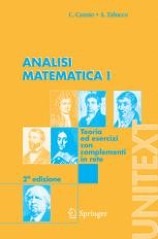
Analisi Matematica I : Teoria ed esercizi con complementi in rete
Il testo intende essere di supporto ad un primo insegnamento di Analisi Matematica secondo i principi dei nuovi Ordinamenti Didattici. È in particolare pensato per Ingegneria, Informatica, Fisica. Il testo presenta tre diversi livelli di lettura. Un livello essenziale permette allo studente di cogliere i concetti indispensabili della materia e di familiarizzarsi con le relative tecniche di calcolo. Un livello intermedio fornisce le giustificazioni dei principali risultati e arricchisce l'esposizione mediante utili osservazioni e complementi. Un terzo livello di lettura, basato su numerosi riferimenti ad un testo virtuale disponibile in rete, permette all'allievo più motivato ed interessato di approfondire la sua preparazione sulla materia. Completano il testo numerosi esempi ed esercizi con soluzioni. La grafica accattivante, a 2 colori, fa di questo testo un punto di riferimento fondamentale per lo studio della disciplina.

An Undergraduate Primer in Algebraic Geometry
This book consists of two parts. The first is devoted to an introduction to basic concepts in algebraic geometry: affine and projective varieties, some of their main attributes and examples. The second part is devoted to the theory of curves: local properties, affine and projective plane curves, resolution of singularities, linear equivalence of divisors and linear series, Riemann–Roch and Riemann–Hurwitz Theorems.The approach in this book is purely algebraic. The main tool is commutative algebra, from which the needed results are recalled, in most cases with proofs. The prerequisites consist of the knowledge of basics in affine and projective geometry, basic algebraic concepts regarding rings, modules, fields, linear algebra, basic notions in the theory of categories, and some elementary point–set topology.
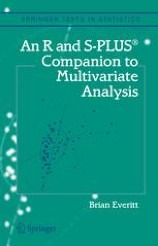
An R and S-Plus® Companion to Multivariate Analysis
Most data sets collected by researchers are multivariate, and in the majority of cases the variables need to be examined simultaneously to get the most informative results. This requires the use of one or other of the many methods of multivariate analysis, and the use of a suitable software package such as S-PLUS or R. In this book the core multivariate methodology is covered along with some basic theory for each method described. The necessary R and S-PLUS code is given for each analysis in the book, with any differences between the two highlighted.
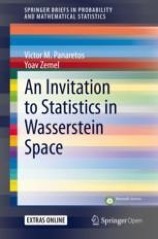
An Invitation to Statistics in Wasserstein Space
This book presents the key aspects of statistics in Wasserstein spaces, i.e. statistics in the space of probability measures when endowed with the geometry of optimal transportation.
