



الصفحة 7
الصفحة 7

Coping with Water Deficiency : From Research to Policymaking
In line with the Water Framework Directive, this book stresses the need for an Integrated Water Resources Management (IWRM) approach to balance the competing demands on water-domestic, agricultural, industrial, tourism and environmental/ecological- and promote economically efficient, socially equitable and environmentally sustainable water use in selected regions from Southern Europe, the Mediterranean and the developing world. Results from the research projects covered by this book, demonstrate that effective water management tools and decisions-making practices, are needed in order to complement integrated interventions for increasing the availability of supply and/or managing the growing demand for scarce water supplies. Further, the book attempts to bridge the gap between ideas and actions endorsed at the research-oriented environmental debate, and their translation into policy making structures and programs in developed and developing countries.

Coordination, organizations, institutions, and norms in agent system III ; COIN 2007 International Workshops COIN@AAMAS 2007, Honolulu, HI, USA, May 14, 2007 COIN@MALLOW 2007, Durham, UK, September 3-4, 2007 Revised Selected Papers
This book constitutes the refereed post-workshop proceedings of the International Workshop on Coordination, Organization, Institutions and Norms in Agent Systems, COIN 2007.

Control Theory Tutorial : Basic Concepts Illustrated by Software Examples
Introduces the basic principles of control theory in a concise self-study guide. It complements the classic texts by emphasizing the simple conceptual unity of the subject. A novice can quickly see how and why the different parts fit together. The concepts build slowly and naturally one after another, until the reader soon has a view of the whole. Each concept is illustrated by detailed examples and graphics. The full software code for each example is available, providing the basis for experimenting with various assumptions, learning how to write programs for control analysis, and setting the stage for future research projects. The topics focus on robustness, design trade-offs, and optimality. Most of the book develops classical linear theory. The last part of the book considers robustness with respect to nonlinearity and explicitly nonlinear extensions, as well as advanced topics such as adaptive control and model predictive control.

Continental Scientific Drilling : A Decade of Progress, and Challenges for the Future
Scientific drilling is an indispensable tool of modern Earth science - search, as it provides the only means of obtaining direct information on processes operating at depth. Drilling allows for the determination of - situ properties of solid materials and fluids and permits testing of hypot- ses and models derived from surface observations. In addition, drill holes may be used as a natural laboratory for experiments and as observatories for long-term monitoring of on-going active processes. Earth drilling, therefore, plays a critical role in scientific research directed towards - proved understanding of the workings of our planet and has a key role in solving urgent socio-economic problems. As a rule, drilling projects are an integral component of major geosci- tific research programs, comprising comprehensive pre-site investigations, accompanying laboratory studies, the drilling phase itself, and consecutive measurements and tests in the drill hole. Such drilling programs are costly and thus only realizable to a limited extent. International cost sharing, the optimal utilization of all available resources, the incorporation of inter- tional leading experts, and the application of the existing know-how, as well as the selection of an optimal drilling location (“World Geological Site”), are thus essential elements of an international scientific drilling p- gram.

Contaminated rivers : A geomorphological-geochemical approach to site assessment and remediation
The geomorphological, surficial and geochemical processes and conditions of rivers require a tailored set of strategies and programs to successfully clean up contaminated river reaches. The primary purpose of this book is not only to provide students and professionals with an introductory understanding of fluvial geomorphic principles but also to explain using a process oriented approach how these geomorphic principles can be integrated with geochemical data to cost-effectively characterize, assess and remediate contaminated river systems. Numerous case studies from North America and many other parts of the world are included.

Consumer perception of food attributes
Objectives of this book is to summarize recent empirical findings from scholarly works on how consumers value food credence attributes. Such knowledge would benefit producers, processors, retailers, and policy makers. Another objective of this book is to discuss the effectiveness of the programs that have been introduced to strengthen the relationship between producers and consumers. Many programs have been developed to more effectively inform consumers regarding food production processes.

Concurrency, Graphs and Models : Essays Dedicated to Ugo Montanari on the Occasion of His 65th Birthday
The volume consists of seven sections, six of which are dedicated to the main research areas to which Ugo Montanari has contributed: Graph Transformation; Constraint and Logic Programming; Software Engineering; Concurrency; Models of Computation; and Software Verification.

CONCUR 2008 - Concurrency Theory ; 19th International Conference, CONCUR 2008, Toronto, Canada, August 19-22, 2008. Proceedings
This book constitutes the refereed proceedings of the 19th International Conference on Concurrency Theory, CONCUR 2008, held in Toronto, Canada, August 19-22, 2008.

Conception optimale de structures = Optimal structural design
Optimal Structural Design deals with all aspects of shape optimization, parametric, geometric and topological, and gives a large place to numerical algorithms, gradient methods and stochastic methods (with an original contribution by Marc Schoenauer for this last point). In particular, most of the structural optimization algorithms have been implemented in the FreeFem ++ finite element software and the programs are freely available on the web. Optimal structural design is devoted to structural or shape optimization and is intended for a mixed audience of applied mathematicians and mechanicians. It discusses parametric, geometric and topology optimization and gives deterministic and stochastic numerical algorithms (implemented in the FreeFem ++ finite element software).

Computer Science Logic ; 22nd International Workshop, CSL 2008 , 17th Annual Conference of the EACSL, Bertinoro, Italy, September 16-19, 2008. Proceedings
This book constitutes the refereed proceedings of the 22nd International Workshop on Computer Science Logic, CSL 2008, held as the 17th Annual Conference of the EACSL in Bertinoro, Italy, in September 2008.

Computer safety, reliability, and security ; 27th International Conference, SAFECOMP 2008 Newcastle upon Tyne, UK, September 22-25, 2008 Proceedings
This book constitutes the refereed proceedings of the 27th International Conference on Computer Safety, Reliability, and Security, SAFECOMP 2008, held in Newcastle upon Tyne, UK, in September 2008.

Computer graphics and geometric modelling : Implementation & algorithms
Possibly the most comprehensive overview of computer graphics as seen in the context of geometric modelling, this two volume work covers implementation and theory in a thorough and systematic fashion. Computer Graphics and Geometric Modelling: Implementation and Algorithms, covers the computer graphics part of the field of geometric modelling and includes all the standard computer graphics topics. The first part deals with basic concepts and algorithms and the main steps involved in displaying photorealistic images on a computer. The second part covers curves and surfaces and a number of more advanced geometric modelling topics including intersection algorithms, distance algorithms, polygonizing curves and surfaces, trimmed surfaces, implicit curves and surfaces, offset curves and surfaces, curvature, geodesics, blending etc. The third part touches on some aspects of computational geometry and a few special topics such as interval analysis and finite element methods. The volume includes two companion programs.

Computer Aided Verification; 31st International Conference, CAV 2019, New York City, NY, USA, July 15-18, 2019, Proceedings, Part II
The volume cover logics, decision procedures; and solvers; numerical programs; verification; distributed systems and networks; verification and invariants; and concurrency.

Computer Aided Verification ; 33rd International Conference, CAV 2021, Virtual Event, July 20–23, 2021, Proceedings, Part II
This two-volume set LNCS 12759 and 12760 constitutes the refereed proceedings of the 33rd International Conference on Computer Aided Verification, CAV 2021, held virtually in July 2021. The 63 full papers presented together with 16 tool papers and 5 invited papers were carefully reviewed and selected from 290 submissions. The papers were organized in the following topical sections: Part I: invited papers; AI verification; concurrency and blockchain; hybrid and cyber-physical systems; security; and synthesis. Part II: complexity and termination; decision procedures and solvers; hardware and model checking; logical foundations; and software verification.

Computer Aided Verification ; 33rd International Conference, CAV 2021, Virtual Event, July 20–23, 2021, Proceedings, Part I
This two-volume set LNCS 12759 and 12760 constitutes the refereed proceedings of the 33rd International Conference on Computer Aided Verification, CAV 2021, held virtually in July 2021. The 63 full papers presented together with 16 tool papers and 5 invited papers were carefully reviewed and selected from 290 submissions. The papers were organized in the following topical sections: Part I: invited papers; AI verification; concurrency and blockchain; hybrid and cyber-physical systems; security; and synthesis. Part II: complexity and termination; decision procedures and solvers; hardware and model checking; logical foundations; and software verification.
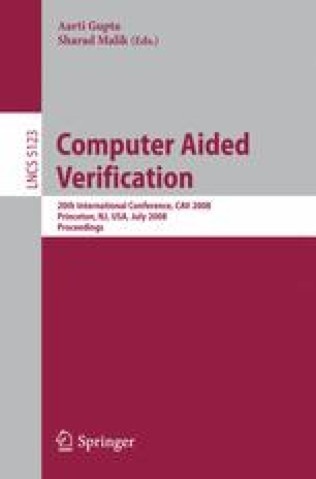
Computer Aided Verification ; 20th International Conference, CAV 2008 Princeton, NJ, USA, July 7-14, 2008 Proceedings
This book constitutes the refereed proceedings of the 20th International Conference on Computer Aided Verification, CAV 2008, held in Princeton, NJ, USA, in July 2008.

Computational Fluid Dynamics for Engineers
This book introduces a wide range of Computational Fluid Dynamics (CFD) methods used in the aerospace industry to solve engineering problems. Its format is arranged so that students and practicing engineers can understand the fundamental principles used in CFD, with sample computer programs for the solution of model problems. The emphasis is on two-dimensional equations in order to present the material in a modest sized book. Source codes for selected problems are given so that the reader can understand how those methods are implemented in FORTRAN and C languages, while exercises provide more hands-on experience.

Computational Electromagnetics
Computational Electromagnetics is a young and growing discipline, expanding as a result of the steadily increasing demand for software for the design and analysis of electrical devices. This book introduces three of the most popular numerical methods for simulating electromagnetic fields: the finite difference method, the finite element method and the method of moments. In particular it focuses on how these methods are used to obtain valid approximations to the solutions of Maxwell's equations, using, for example, "staggered grids" and "edge elements." The main goal of the book is to make the reader aware of different sources of errors in numerical computations, and also to provide the tools for assessing the accuracy of numerical methods and their solutions. To reach this goal, convergence analysis, extrapolation, von Neumann stability analysis, and dispersion analysis are introduced and used frequently throughout the book. Another major goal of the book is to provide students with enough practical understanding of the methods so they are able to write simple programs on their own. To achieve this, the book contains several MATLAB programs and detailed description of practical issues such as assembly of finite element matrices and handling of unstructured meshes.

Command-Line Rust : A Project-Based Primer for Writing Rust CLIs
Rather than focusing on the language as a whole, this guide teaches Rust using a single small, complete, focused program in each chapter. Author Ken Youens-Clark shows you how to start, write, and test each of these programs to create a finished product. You'll learn how to handle errors in Rust, read and write files, and use regular expressions, Rust types, structs, and more.

Cloud-Based Benchmarking of Medical Image Analysis
Presents the VISCERAL project benchmarks for analysis and retrieval of 3D medical images (CT and MRI) on a large scale, which used an innovative cloud-based evaluation approach where the image data were stored centrally on a cloud infrastructure and participants placed their programs in virtual machines on the cloud. The book presents the points of view of both the organizers of the VISCERAL benchmarks and the participants.
