



الصفحة 7
الصفحة 7
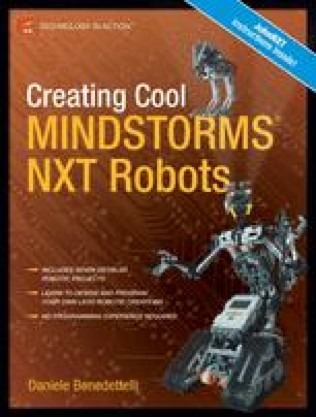
Creating Cool MINDSTORMS® NXT Robots
Build and program MINDSTORM NXT robots with Daniele Benedettelli, one of the world's most respected NXT robot builders. He shows you how to build and program them from scratch, starting with the simplest robots and progressing in difficulty to a total of seven award–winning robots! You can download all the code, along with low–resolution videos that show how your robot works when it's finished. You don't need to be a programmer to develop these cool robots, because all the code is provided, but advanced developers will enjoy seeing the secrets of Benedettelli's code and techniques revealed.

Coordination, organizations, institutions, and norms in agent systems II ; AAMAS 2006 and ECAI 2006 International Workshops, COIN 2006 Hakodate, Japan, May 9, 2006 Riva del Garda, Italy, August 28, 2006, Revised Selected Papers
In recent years, social and organizational aspects of agency have become major research topics in MAS. Recent applications of MAS on Web services, grid c- puting and ubiquitous computing highlight the need for using these aspects in order to ensure social order within such environments. Openness, heterogeneity, and scalability of MAS, in turn, pose new demands on traditional MAS int- action models and bring forward the need to look into the environment where agents interact and at di?erent ways of constraining or regulating interactions.it provide theoretically demanding and interdisciplinary research questions at d- ferent levels of abstraction.

Coordination, organizations, institutions, and norms in agent system III ; COIN 2007 International Workshops COIN@AAMAS 2007, Honolulu, HI, USA, May 14, 2007 COIN@MALLOW 2007, Durham, UK, September 3-4, 2007 Revised Selected Papers
This book constitutes the refereed post-workshop proceedings of the International Workshop on Coordination, Organization, Institutions and Norms in Agent Systems, COIN 2007.

Cooperative Control : A Post-Workshop Vol., 2003 Block Island Workshop on Cooperative Control
This carefully edited book presents how natural groupings such as fish schools, bird flocks, deer herds etc. coordinate themselves and move so flawlessly, often without an apparent leader or any form of centralized control. It shows how the underlying principles of cooperative control may be used for groups of mobile autonomous agents to help enable a large group of autonomous robotic vehicles in the air, on land or sea or underwater, to collectively accomplish useful tasks such as distributed, adaptive scientific data gathering, search and rescue, or reconnaissance.

Conviviality at the Crossroads : The Poetics and Politics of Everyday Encounters
Conviviality has lately become a catchword not only in academia but also among political activists. This open access book discusses conviviality in relation to the adjoining concepts cosmopolitanism and creolisation. The urgency of today’s global predicament is not only an argument for the revival of all three concepts, but also a reason to bring them into dialogue. Ivan Illich envisioned a post-industrial convivial society of ‘autonomous individuals and primary groups’ (Illich 1973), which resembles present-day manifestations of ‘convivialism’. Paul Gilroy refashioned conviviality as a substitute for cosmopolitanism, denoting an ability to be ‘at ease’ in contexts of diversity (Gilroy 2004)

Control problems for conservation laws with traffic applications: modeling, analysis, and numerical methods
Conservation and balance laws on networks have been the subject of much research interest given their wide range of applications to real-world processes, particularly traffic flow. This open access monograph is the first to investigate different types of control problems for conservation laws that arise in the modeling of vehicular traffic. Four types of control problems are discussed - boundary, decentralized, distributed, and Lagrangian control - corresponding to, respectively, entrance points and tolls, traffic signals at junctions, variable speed limits, and the use of autonomy and communication. Because conservation laws are strictly connected to Hamilton-Jacobi equations, control of the latter is also considered.

Contributions to Ubiquitous Computing
This book puts the larger vision of ubiquitous computing in the context of today’s mobile and distributed computing systems and presents innovative solutions at all system layers ranging from hardware over vertical and horizontal infrastructure services and novel middleware techniques to various types of application software. Some chapters address core properties of ubiquitous applications including mobility, self-healing and self-organisation of both technical and social-technical systems. Other contributions deal with common facilities like secure e-payment or semantic web techniques and business solutions like wireless asset management or e- maintenance. Distributed systems management with self-monitoring capabilities, Internet congestion control, and novel security solutions coping with denial of service attacks against mobile agent systems and software- and hardware-based data encryption methods are further topics addressed.

Constructing Ambient Intelligence ; AmI 2007 Workshops Darmstadt, Germany, November 7-10, 2007 Revised Papers
This book constitutes the refereed proceedings of the workshops of the First European Conference on Ambient Intelligence, AmI 2007, held in Darmstadt, Germany, in November 2007.

Computer vision and machine learning for intelligent sensing systems
Offers a selection of high-quality research articles that tackle the major difficulties in computer vision and machine learning for intelligent sensing systems from both theoretical and practical standpoints. This publication includes intelligent sensing techniques, twelve foundational investigations into sense-making methods, and discusses particular uses of intelligent sensing systems in autonomous driving and virtual reality.

Computer vision : Algorithms and applications
Explores the variety of techniques used to analyze and interpret images. It also describes challenging real-world applications where vision is being successfully used, both in specialized applications such as image search and autonomous navigation, as well as for fun, consumer-level tasks that students can apply to their own personal photos and videos. Suitable for an upper-level undergraduate or graduate-level course in computer science or engineering, this textbook focuses on basic techniques that work under real-world conditions and encourages students to push their creative boundaries. Its design and exposition also make it eminently suitable as a unique reference to the fundamental techniques and current research literature in computer vision.

Computer aided verification ; 30th International Conference, CAV 2018, Held as Part of the Federated Logic Conference, FloC 2018, Oxford, UK, July 14-17, 2018, Proceedings, Part II
Constitutes the refereed proceedings of the 30th International Conference on Computer Aided Verification, CAV 2018, held in Oxford, UK, in July 2018.The 52 full and 13 tool papers presented together with 3 invited papers and 2 tutorials were carefully reviewed and selected from 215 submissions. The papers cover a wide range of topics and techniques, from algorithmic and logical foundations of verication to practical applications in distributed, networked, cyber-physical, and autonomous systems. They are organized in topical sections on model checking, program analysis using polyhedra, synthesis, learning, runtime verification, hybrid and timed systems, tools, probabilistic systems, static analysis, theory and security, SAT, SMT and decisions procedures, concurrency, and CPS, hardware, industrial applications.

Computer Aided Verification ; 30th International Conference, CAV 2018, Held as Part of the Federated Logic Conference, FloC 2018, Oxford, UK, July 14-17, 2018, Proceedings, Part I
This open access two-volume set LNCS 10980 and 10981 constitutes the refereed proceedings of the 30th International Conference on Computer Aided Verification, CAV 2018, held in Oxford, UK, in July 2018. The papers cover a wide range of topics and techniques, from algorithmic and logical foundations of verication to practical applications in distributed, networked, cyber-physical, and autonomous systems. They are organized in topical sections on model checking, program analysis using polyhedra, synthesis, learning, runtime verification, hybrid and timed systems, tools, probabilistic systems, static analysis, theory and security, SAT, SMT and decisions procedures, concurrency, and CPS, hardware, industrial applications.

Computer Aided Systems Theory – EUROCAST 2005 ; 10th International Conference on Computer Aided Systems Theory, Las Palmas de Gran Canaria, Spain, February 7-11, 2005, Revised Selected Papers
The concept of CAST, computer aided systems Theory, was introduced by F. Pichler of Linz in the late 1980s to include those computer theoretical and practical developments used as tools to solve problems in system science. It was considered as the third component (the other two being CAD and CAM) that would provide for a complete picture of the path from computer and systems sciences to practical developments in science and engineering. Selected papers were published as Springer Lecture Notes in Computer Science vols. 410, 585, 763, 1030, 1333, 1728, 2178 and 2809 and in several special issues of Cybernetics and Systems: an lnternational

Computational logic in multi-agent systems ; Vol. 3900 ; 6th International Workshop, CLIMA VI, London, UK, June 27-29, 2005, Revised Selected and Invited Papers
The book presents 14 revised full technical papers, 4 contest papers, and 7 invited papers together with 1 invited article are organized in topical sections on foundational aspects of agency, agent programming, agent interaction and normative systems, the first CLIMA contest, and on the project report of the SOCS project.

Computational Logic in Multi-Agent Systems ; 7th International Workshop, CLIMA VII, Hakodate, Japan, May 8-9, 2006, Revised Selected and Invited Papers
This book constitutes the thoroughly refereed post-proceedings of the 7th International Workshop on Computational Logic for Multi-Agent Systems. It was an associated event of AAMAS 2006, the main international conference on autonomous agents and multi-agent systems.

Computational intelligence for remote sensing
This book is a composition of different points of view regarding the application of Computational Intelligence techniques and methods to Remote Sensing data and applications. The book covers a broad range of topics, starting from the hardware design of hyperspectral sensors, and data handling problems, namely data compression and watermarking issues, as well as autonomous web services.

Computational intelligence and bioinformatics ; International conference on intelligent computing, ICIC 2006, Kunming, China, August 16-19, 2006, Proceedings, Part III
The International Conference on Intelligent Computing (ICIC) was formed to provide an annual forum dedicated to the emerging and challenging topics in artificial intelligence, machine learning, bioinformatics, and computational biology, etc. It aims to bring together researchers and practitioners from both academia and industry to share ideas, problems and solutions related to the multifaceted aspects of intelligent computing.the theme for this conference was “Emerging Intelligent Computing Technology and Applications”. Papers related to this theme were especially solicited, including theories, methodologies, and applications in science and technology.

Collaborating against child abuse : Exploring the Nordic Barnahus model
This edited collection explores the background and implementation of the Nordic Barnahus (or 'Children's House') model – recognised as one of the most important reforms related to children who are the victims of crime in the Nordic region. This book discusses both its potential to affect change and the challenges facing it. The model was introduced as a response to a growing recognition of the need for more integrated and child-centred services for children exposed to violence and sexual abuse. In the Barnahus structure, different professions work together to ensure that victimized children receive help and treatment and that their legal rights are met. This original study is organised into four broad themes: child-friendliness, support and treatment; the forensic child investigative interview; children’s rights perspectives; and interagency collaboration and professional autonomy.

Cognitive Vision Systems : Sampling the Spectrum of Approaches
This volume is a post-event proceedings volume and contains selected papers based on the presentations given, and the lively discussions that ensued, during a seminar held in Dagstuhl Castle, Germany, in October 2003. Co-sponsored by ECVision, the cognitive vision network of excellence, it was organized to further strengthen cooperation between research groups from different countries, and scientists active in related areas were invited from around the world.
Managing Virtualization of Networks and Services ; 18th IFIP/IEEE International Workshop on Distributed Systems: Operations and Management, DSOM 2007, San José, CA, USA, October 29-31, 2007, Proceedings
This volume of the Lecture Notes in Computer Science series contains all papers th accepted for presentation at the 18 IFIP/IEEE International Workshop on Distributed Systems: Operations and Management (DSOM 2007), which was held in the heart of Silicon Valley, San Jose, California, USA, on October 29–31, 2007.
