



الصفحة 54
الصفحة 54

Computational linguistics and intelligent text processing ; 8th International Conference, CICLing 2007, Mexico City, Mexico, February 18-24, 2007, Proceedings
This book cover all current issues in computational linguistics research and present intelligent text processing applications. The papers are organized in topical sections on: lexical resources, corpus-based knowledge acquisition, morphology and part-of-speech tagging, named entity recognition, temporal expression treatment, word segmentation, sentence splitting, chunking, grammar formalisms and syntax, word sense disambiguation and discrimination and semantics.

Computational linguistics and intelligent text processing ; Vol. 3406 ; 6th International Conference, CICLing 2005, Mexico City, Mexico, February 13-19, 2005, Proceedings
This book constitutes the refereed proceedings of the 6th International Conference on Computational Linguistics and Intelligent Text Processing, CICLing 2005, held in Mexico City, Mexico in February 2005. An approach that involves natural language analysis techniques for the treatment of software system functional requirements is described in this book. This approach is used as the basis for a process developed to generate sequence diagrams automatically from the textual specification of use cases. This facility has been integrated in the Requirements Engineering Phase of OO-Method, an automatic production environment of software. For this purpose, a translator that is based on natural language parser is used. The translator provides grammatical information to each use case sentence and it identifies the corresponding interaction. The automatic transformation is conceived and specified following an orientation that is based on models and patterns. The results of the validation of the transformation patterns are presented.

Computational Intelligence in Multimedia Processing : Recent Advances
This book presents a large number of interesting applications to intelligent multimedia processing of various Computational Intelligence techniques, such as rough sets, Neural Networks; Fuzzy Logic; Evolutionary Computing; Artificial Immune Systems; Swarm Intelligence; Reinforcement Learning and evolutionary computation.

Computational intelligence : Principles, techniques and applications
The book Computational Intelligence: Principles, Techniques and Applications presents both theories and applications of Computational Intelligence in a clear, precise and highly comprehensive style. The textbook addresses the fundamental aspects of Fuzzy Sets and Logic, Neural Networks, Evolutionary Computing and Belief Networks. The application areas include Fuzzy Databases, Fuzzy Control, Image Understanding, Expert Systems, Object Recognition, Criminal Investigation, Telecommunication Networks and Intelligent Robots. The book contains many numerical examples and homework problems with sufficient hints so that the students can solve them on their own. Emerging areas of Computational Intelligence such as artificial life, particle swarm optimization, artificial immune systems, fuzzy chaos theory, rough sets and granular computing have also been addressed with examples in this book. The book ends with a discussion on a number of open- ended research problems in Computational Intelligence. Graduate students interested to pursue their research in this subject will greatly be benefited with these problems.

Computational formalism : Art history and machine learning
"Computational Formalism investigates examples of art historical analysis in the fields of computer and information sciences, and frames this research in the context of art historiography. The use of machine learning to analyze art images has ushered in a renewed interest in formalism in art history, but these new techniques create new critical challenges for the field"

Computational Electronic Circuits : Simulation and Analysis with MATLAB®
This textbook teaches in one, coherent presentation the three distinct topics of analysis of electronic circuits, mathematical numerical algorithms and coding in a software such as MATLAB®. By combining the capabilities of circuit simulators and mathematical software, the author teaches key concepts of circuit analysis and algorithms, using a modern approach. The DC, Transient, AC, Noise and behavioral analyses are implemented in MATLAB to study the complete characteristics of a variety of electronic circuits, such as amplifiers, rectifiers, hysteresis circuits, harmonic traps and passes, polyphaser filters, directional couplers, electro-static discharge and piezoelectric crystals. This book teaches basic and advanced circuit analysis, by incorporating algorithms and simulations that teach readers how to develop their own simulators and fully characterize and design electronic circuits.

Computational Chemistry and Molecular Modeling : Principles and Applications
The gap between introductory level textbooks and highly specialized monographs is filled by this modern textbook. It provides in one comprehensive volume the in-depth theoretical background for molecular modeling and detailed descriptions of the applications in chemistry and related fields like drug design, molecular sciences, biomedical, polymer and materials engineering. Special chapters on basic mathematics and the use of respective software tools are included.

Commercial law : principles and policy
Innovative textbook that examines core principles of commercial law and the social and political context in which they develop.

Comets : Nature, Dynamics, Origin, and their Cosmogonical Relevance
The book covers the most recent ideas about the nature and dynamics of comets, including a thorough discussion on Oort cloud dynamics which has not received due attention in other books on the subject. It also discusses the most relevant aspects of the physics and chemistry of comet nuclei, highlighting their importance as relics of the protoplanetary disk and, perhaps, as carriers of water and organics that permitted the development of life on Earth. The book contains several tables with useful data, and an ample bibliography covering the most recent work as well as some historical key contributions to the subject. It may be suitable as a textbook for graduate students with some basic knowledge of celestial mechanics and astrophysics, as well as a consult book for comet researchers, or researchers from other related fields willing to start working on comets, or get an updated view of the subject.

Combustion : Physical and Chemical Fundamentals, Modeling and Simulation, Experiments, Pollutant Formation
The actual fourth edition presents a completely restructured book: Mathematical Formulae and derivations as well as the space-consuming reaction mechanisms have been replaced from the text to appendix. A new chapter discusses the impact of combustion processes on the earth’s atmosphere, the chapter on auto-ignition is extended to combustion in Otto- and Diesel-engines, and the chapters on heterogeneous combustion and on soot formation appear heavily revised.

Combinatorics of Coxeter Groups
Coxeter groups are of central importance in several areas of algebra, geometry, and combinatorics. This clear and rigorous exposition focuses on the combinatorial aspects of Coxeter groups, such as reduced expressions, partial order of group elements, enumeration, associated graphs and combinatorial cell complexes, and connections with combinatorial representation theory. While Coxeter groups have already been exposited from algebraic and geometric perspectives, this text is the first one to focus mainly on the combinatorial aspects of Coxeter groups. The first part of the book provides a self-contained introduction to combinatorial Coxeter group theory. The emphasis here is on the combinatorics of reduced decompositions, Bruhat order, weak order, and some aspects of root systems. The second part deals with more advanced topics, such as Kazhdan-Lusztig polynomials and representations, enumeration, and combinatorial descriptions of the classical finite and affine Weyl groups. A wide variety of exercises, ranging from easy to quite difficult are also included.

Combinatorics and Graph Theory
This book covers a wide variety of topics in combinatorics and graph theory. It includes results and problems that cross subdisciplines, emphasizing relationships between different areas of mathematics. In addition, recent results appear in the text, illustrating the fact that mathematics is a living discipline.

Combinatorial pattern matching ; Vol. 3537 ; 16th Annual Symposium, CPM 2005, Jeju Island, Korea, June 19-22, 2005, Proceedings
This volume presents the proceedings of The 16th Annual Symposium on Combinatorial Pattern Matching was heldon Jeju Island, Korea on June 19–22, 2005. the Program Committee accepted 37 of the submissionsto be presented at the conference. This collection of papers offers original research contributionsin combinatorial pattern matching and its applications.In addition to the selected papers

Combinatorial pattern matching ; 18th Annual Symposium, CPM 2007, London, Canada, July 9-11, 2007, Proceedings
This book presented original research contri- tions on computational pattern matching and analysis, data compression and compressed text processing, sufix arrays and trees, and computational biology. Combinatorial Pattern Matching addresses issues of searching and matching strings and more complicated patterns such as trees, regular expressions, graphs, point sets, and arrays.The goal is to derive non-trivial combinatorial properties of such structures and to exploit these properties in order to either achieve superior performance for the corresponding computational problems or pinpoint conditions under which searches cannot be performed eficiently.

Combinatorial Optimization : Theory and Algorithms
Places special emphasis on theoretical results and algorithms with provably good performance, in contrast to heuristics. It has arisen as the basis of several courses on combinatorial optimization and more special topics at graduate level. It contains complete but concise proofs, also for many deep results, some of which did not appear in a textbook before. Many very recent topics are covered as well, and many references are provided. Thus this book represents the state of the art of combinatorial optimization.

Combinatorial image analysis ; 10th International Workshop, IWCIA 2004, Auckland, New Zealand, December 1-3, 2004, Proceedings
This volume presents the proceedings of the 10th International Workshop on Combinatorial Image Analysis,held 2004, in Auckland, New Zealand. For this workshop we received 86 submitted papers from 23 countries. We selected 55 papers for the conference. completed the program. Conference papers are presented in this volume under the following topical part titles: discrete tomography (3 papers), combinatorics and computational models (6), combinatorial algorithms (6), combinatorial mathematics (4), d- ital topology (7), digital geometry (7), approximation of digital sets by curves and surfaces (5), algebraic approaches (5), fuzzy image analysis (2), image s- mentation (6), and matching and recognition (7). These subjects are dealt with in the context of digital image analysis or computer vision.
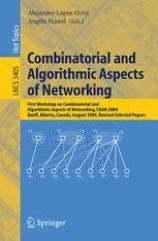
Combinatorial and algorithmic aspects of networking ; Vol.3405 ; 1st Workshop on combinatorial and algorithmic aspects of networking, CAAN 2004, Banff, Alberta, Canada, August 5-7, 2004, Revised Selected Papers
The Internet is a massive global network of over 700 million users and it is addingusers at the rate of 300,000 per day. This large, distributed, and everchangingnetwork poses a challenge to researchers: How does one study, model, or under-stand such a decentralized, constantly evolving entity? The workshop Combi-natorial and Algorithmic Aspects of Networking and the Internet (CAAN 2004)provided a forum for the exchange of ideas on these topics. and among thepapers were some new and surprising results as well as some introductions tothe foundations of the field.The workshop program featured 12 peer-reviewed papers bracketed by Topics covered by the talks ranged from the Web graph to game theoryto string matching, all in the context of large-scale networks. This volume collectstogether the talks delivered at the workshop along with a number of survey articlesto round out the presentation and give a comprehensive introduction to the topic.
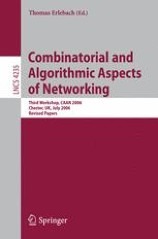
Combinatorial and Algorithmic Aspects of Networking (vol. # 4235) ; Third Workshop, CAAN 2006, Chester, UK, July 2, 2006, Revised Papers
This book constitutes the thoroughly refereed post-proceedings of the Third Workshop on Combinatorial and Algorithmic Aspects of Networking, held in Chester, UK in July 2006, co-located with the 13th Colloquium on Structural Information and Communication Complexity, SIROCCO 2006.The 10 revised full papers and one invited lecture cover a range from the Web graph to game theory to string matching, all in the context of large-scale networks.

Combinatorial Algebraic Topology
Combinatorial algebraic topology is a fascinating and dynamic field at the crossroads of algebraic topology and discrete mathematics. This volume is the first comprehensive treatment of the subject in book form. The first part of the book constitutes a swift walk through the main tools of algebraic topology, including Stiefel-Whitney characteristic classes, which are needed for the later parts. Readers - graduate students and working mathematicians alike - will probably find particularly useful the second part, which contains an in-depth discussion of the major research techniques of combinatorial algebraic topology. Our presentation of standard topics is quite different from that of existing texts. In addition, several new themes, such as spectral sequences, are included.

Column Generation
Column Generation is an insightful overview of the state of the art in integer programming column generation and its many applications. The volume begins with "A Primer in Column Generation" which outlines the theory and ideas necessary to solve large-scale practical problems, illustrated with a variety of examples. Other chapters follow this introduction on "Shortest Path Problems with Resource Constraints," "Vehicle Routing Problem with Time Window," "Branch-and-Price Heuristics," "Cutting Stock Problems," each dealing with methodological aspects of the field. Three chapters deal with transportation applications: "Large-scale Models in the Airline Industry," "Robust Inventory Ship Routing by Column Generation," and "Ship Scheduling with Recurring Visits and Visit Separation Requirements." Production is the focus of another three chapters: "Combining Column Generation and Lagrangian Relaxation," "Dantzig-Wolfe Decomposition for Job Shop Scheduling," and "Applying Column Generation to Machine Scheduling." The final chapter by François Vanderbeck, "Implementing Mixed Integer Column Generation," reviews how to set-up the Dantzig-Wolfe reformulation, adapt standard MIP techniques to the column generation context (branching, preprocessing, primal heuristics), and deal with specific column generation issues (initialization, stabilization, column management strategies).
