



الصفحة 52
الصفحة 52
BioPaceMaking
The development of a bio-engineered pacemaker is of substantial clinical and also scientific interest because it promises to overcome several limitations of electronic pacemakers. Moreover it may answer the longstanding question of whether the complex structure of the sinus node is indeed a prerequisite for reliable pacemaking, or simpler structures might work as well. This book gives an overview of the current state-of-the-art of creating a bio-engineered pacemaker. It shows the approaches to develop of genetic and cell-based engineering methods suitable to implement them with safety and stability. It also illuminates the problems that need to be solved before bio-pacemaking can be considered for clinical use.
Biometrics, Computer Security Systems and Artificial Intelligence Applications
This book presents the most recent achievements in some fascinating and rapidly developing fields within Computer Science. The scientific works presented in this book have been partitioned into three topical groups: Image Analysis and Biometrics, Computer Security Systems, and Artificial Intelligence and Applications. Image Analysis and Biometrics is the branch of Computer Science dealing with the very difficult task of artificial, visual perception of objects and surroundings, as well as the problems connected with it. Computer Security and Safety is at present a very important and intensively investigated branch of Computer Science because of the menacing activity of hackers and computer viruses.
Biology and Control Theory : Current Challenges
Creating some links between control feedback and biology modeling communities based on similarities in modeling, observing and perceiving alive structures, and analyzing interconnections between biological structures and subsystems was the main objective of this volume. The idea of this book was conceived in the context mentioned above with the objective to help in claiming many of the problems for control researchers, starting discussions and opening interactive debates between the control and biology communities, and, finally, to alert graduate students to the many interesting ideas at the frontier between control feedback theory and biology.
Bioinspired optimization methods and their applications ; 9th International conference, BIOMA 2020, Brussels, Belgium, November 19–20, 2020, Proceedings
This book constitutes the refereed proceedings of the 9th International Conference on Bioinspired Optimization Methods and Their Applications, BIOMA 2020, held in Brussels, Belgium, in November 2020. The 24 full papers presented in this book were carefully reviewed and selected from 68 submissions. The papers in this BIOMA proceedings specialized in bioinspired algorithms as a means for solving the optimization problems and came in two categories: theoretical studies and methodology advancements on the one hand, and algorithm adjustments and their applications on the other.

Bioinformatics technologies
Solving modern biological problems requires advanced computational methods. Bioinformatics evolved from the active interaction of two fast-developing disciplines, biology and information technology. The central issue of this emerging field is the transformation of often distributed and unstructured biological data into meaningful information. This book describes the application of well-established concepts and techniques from areas like data mining, machine learning, database technologies, and visualization techniques to problems like protein data analysis, genome analysis and sequence databases. Chen has collected contributions from leading researchers in each area. The chapters can be read independently, as each offers a complete overview of its specific area, or, combined, this monograph is a comprehensive treatment that will appeal to students, researchers, and R&D professionals in industry who need a state-of-the-art introduction into this challenging and exciting young field.
Bioinformatics : Problem Solving Paradigms
This book highlights basic paradigms of problem analysis and algorithm design in the context of core bioinformatics problems. Mathematically demanding themes are put across to the reader by properly chosen representations with the aid of lots of illustrations.
Bioinformatics
In this textbook present mathematical models in bioinformatics and they describe the biological problems that inspire the computer science tools used to handle the enormous data sets involved. The first part of the book covers the mathematical and computational methods, while the practical applications are presented in the second part. The mathematical presentation is descriptive and avoids unnecessary formalism, and yet remains clear and precise. Emphasis is laid on motivation through biological problems and cross applications. Each of the four chapters in the first part is accompanied by exercises and problems to support an understanding of the techniques presented. Each of the six chapters of the second part is devoted to some specific application domain: sequence alignment, molecular phylogenetics and coalescence theory, genomics, proteomics, RNA, and DNA microarrays. Each chapter concludes with a problems and projects section, to deepen the reader's understanding and to allow for the design of derived methods. Many of the projects involve publicly available software and/or Web-based bioinformatics depositories. Finally, the book closes with a thorough bibliography, reaching from classic research results to very recent findings, providing many pointers for future research.Overall, this volume is ideally suited for a senior undergraduate or graduate course on bioinformatics, with a strong focus on its mathematical and computer science background.

Biofuels, Solar and Wind as Renewable Energy Systems : Benefits and Risks
With shortages of fossil energy, especially oil and natural gas, and heavy biomass energy use occurring in both developed and developing countries, a major focus has developed worldwide on renewable energy systems. Renewable energy systems include wind power, biomass, photovoltaics, hydropower, solar thermal, thermal ponds, and biogas. Currently, a heavy focus is on biofuels made from crops, such as corn, sugarcane, and soybeans, for use as renewable energy sources. Wood and crop residues also are being used as fuel. Though it may seem beneficial to use renewable plant materials for biofuel, the use of crop residues and other biomass for biofuels raises many concerns about major environmental problems, including food shortages and serious destruction of vital soil resources.

Bioethics in a Small World
Bioethics has addressed many of the issues that arise in the context of globalisation. This book presents the results of a conference the Europaische Akademie held in 2003 which developed its thesis in open discussions of foundational and applied problems of bioethics from an interdisciplinary and international perspective.

Binary Quadratic Forms: An Algorithmic Approach
This book deals with algorithmic problems concerning binary quadratic forms 2 2 f(X,Y)= aX +bXY +cY with integer coe?cients a, b, c, the mathem- ical theories that permit the solution of these problems, and applications to cryptography.
Big Data : Conceptual Analysis and Applications
The book is devoted to the analysis of big data in order to extract from these data hidden patterns necessary for making decisions about the rational behavior of complex systems with the different nature that generate this data. To solve these problems, a group of new methods and tools is used, based on the self-organization of computational processes, the use of crisp and fuzzy cluster analysis methods, hybrid neural-fuzzy networks, and others. The book solves various practical problems. In particular, for the tasks of 3D image recognition and automatic speech recognition large-scale neural networks with applications for Deep Learning systems were used.

Bézier and Splines in image processing and machine vision
Digital image processing and machine vision have grown considerably during the last few decades. Of the various techniques, developed so far splines play a positive and significant role in many of them. This book deals with various image processing and machine vision problems efficiently with splines.
Beginning C# 2008 : From novice to professional
This book is for anyone who wants to write good C# code—even if you have never programmed before. Writing good code can be a challenge—there are so many options, especially in a .NET language like C#. If you want to really get the best from a programming language, you need to know which features work best in which situations, and understand their strengths and weaknesses. It is this understanding that makes the difference between coding and coding well. Beginning C# 2008: From Novice to Professional, Second Edition has been written to teach you how to use the C# programming language to solve problems. From the earliest chapters and the first introductory concepts, you'll be looking at real–world programming challenges and learning how C# can be used to overcome them.
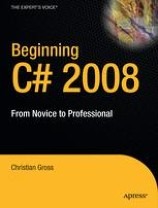
Beginning C# 2008 : From novice to professional
This book is for anyone who wants to write good C# 2008 code—even if you have never programmed before. Beginning C# 2008 has been written to teach you how to use the C# programming language to solve problems. Christian Gross is dedicated to helping his readers understand every detail of Beginning C# 2008.

Beetle conservation
Interest in beetle conservation has long been evident, with many papers treating these abundant, ecologically important and popular insects. However, this issue of Journal of Insect Conservation is the first to be dedicated entirely to beetles, and contains a number of papers, predominantly from outside western Europe, to demonstrate the variety and scope of problems and conservation concerns that surround these insects. A short introductory perspective is followed by eight original contributions, in which beetles from many parts of the world are considered, and in which some major threats to their wellbeing are evaluated.
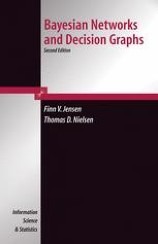
Bayesian Networks and Decision Graphs
Probabilistic graphical models and decision graphs are powerful modeling tools for reasoning and decision making under uncertainty. As modeling languages they allow a natural specification of problem domains with inherent uncertainty, and from a computational perspective they support efficient algorithms for automatic construction and query answering. This includes belief updating, finding the most probable explanation for the observed evidence, detecting conflicts in the evidence entered into the network, determining optimal strategies, analyzing for relevance, and performing sensitivity analysis. The book introduces probabilistic graphical models and decision graphs, including Bayesian networks and influence diagrams.It contians two parts. The first part focuses on probabilistic graphical models. Compared with the previous book, the new edition also includes a thorough description of recent extensions to the Bayesian network modeling language, advances in exact and approximate belief updating algorithms, and methods for learning both the structure and the parameters of a Bayesian network. The second part deals with decision graphs, and in addition to the frameworks described in the previous edition, it also introduces Markov decision processes and partially ordered decision problems.

Basics of fluid mechanics and introduction to computational fluid dynamics
Brings together the theoretical basics of fluid dynamics with a systemaic overview of the appropriate numerical and computational methods for solving the problems presented in the book. Also, effective codes for a majority of the examples are included.
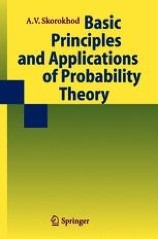
Basic principles and applications of probability theory
This introductory chapter discusses such notions as determinism, chaos and randomness, p- dictibility and unpredictibility, some initial approaches to formalizing r- domness and it surveys certain problems that can be solved by probability theory. This will perhaps give one an idea to what extent the theory can - swer questions arising in speci?c random occurrences and the character of the answers provided by the theory. 1. 1 The Nature of Randomness The phrase “by chance” has no single meaning in ordinary language. For instance, it may mean unpremeditated, nonobligatory, unexpected, and so on. Its opposite sense is simpler: “not by chance” signi?es obliged to or bound to (happen). In philosophy, necessity counteracts randomness. Necessity signi?es conforming to law – it can be expressed by an exact law. The basic laws of mechanics, physics and astronomy can be formulated in terms of precise quantitativerelationswhichmustholdwithironcladnecessity.
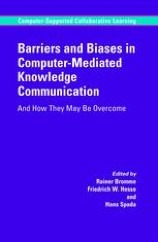
Barriers and Biases in Computer-Mediated Knowledge Communication : And How They May Be Overcome
This books deals with computer-mediated cooperation and communication scenarios in teaching and learning situations, leisure activities (e.g. laypersons looking for expert information on the internet), and net-based communication at work. Such scenarios will become increasingly important. But the successful use of such computer-mediated settings is not trivial. Cooperative learning and work itself requires special skills and strategies. And the technical settings with sometimes restricted, sometimes new possibilities for communication add problems on top of the cooperation itself. What are the barriers in computer-mediated communication for cooperative learning and work? Which are the most relevant biases in computer-mediated information processing? Based on empirical research the contributors from psychology, education and computer sciences offer different perspectives on the nature and causes of such barriers.

Azaheterocycles Based on -, ß-Unsaturated Carbonyls
Devoted to heterocyclizations of aliphatic and aromatic, -unsaturated carbonyls with various binucleophiles leading to three-, five-, six and seven-membered partially hydrogenated nitrogen-containing heterocycles. During the last decade interest in these classes of organic c- pounds has been experiencing a scientific renaissance owing to their significant role in biological processes in living cells and diverse effects on physiological activities. In addition, such compounds are also more prevalent from the vi- point of ''classical'' problems of organic chemistry, among them reactivity, chemo- and regioselectivity, tautomerism, conformational analysis and features of their electronic structure. The character of these problems in the case of partially hydrogenated heterocycles differs sufficiently from that for hetero- omatized and perhydrogenated heterocyclic compounds and investigations in this field very often lead to interesting and unusual results. Extensively characterized cyclocondensations of, -unsaturated carbonyls, their synthetic equivalents and their precursors are the most widespread, facile and generally valid pathway to dihydroazaheterocycles.
