



الصفحة 51
الصفحة 51
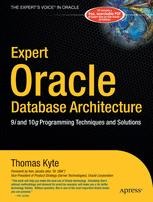
Expert Oracle Database Architecture : 9i and 10g Programming Techniques and Solutions
This is a defining book on the Oracle database for any developer or database administrator who works with Oracle-driven database applications. Tom Kyte has a simple philosophy: you can treat Oracle as a black box and just stick data into it or you can understand how it works and exploit it as a powerful computing environment. If you choose the latter, then you will find that there are few information management problems that you cannot solve quickly and elegantly. Expert Oracle Database Architecture is the first of a three-book series that completely explores and defines the Oracle database. It covers all of the most important Oracle architecture features, including: Files, memory structures and processes / Locking and latching / Transactions, concurrency and multi-versioning / Tables and Indexes / Datatypes / Partitioning and parallelism Each feature is taught in a proof-by-example manner, not only discussing what it is, but also how it works, how to implement software using it, and the common pitfalls associated with it.

Expert Oracle Database 10g Administration
This book covers the new 10g management and performance tools and provides essential primers on Unix, Linux and Windows NT administration and on core SQL and PL/SQL programming techniques. And it provides everything the new and aspring Oracle database administrator needs to build and administer complex Oracle 10g databases.

Expert Clouds and Applications ; Proceedings of ICOECA 2021
Features original papers from International Conference on Expert Clouds and Applications (ICOECA 2021), organized by GITAM School of Technology, Bangalore, India during February 18–19, 2021. It covers new research insights on artificial intelligence, big data, cloud computing, sustainability, and knowledge-based expert systems. The book discusses innovative research from all aspects including theoretical, practical, and experimental domains that pertain to the expert systems, sustainable clouds, and artificial intelligence technologies.

Experimental vibration analysis for civil structures : Testing, sensing, monitoring, and control
Covers a wide range of topics in the areas of vibration testing, instrumentation, and analysis of civil engineering and critical infrastructure. It explains how recent research, development, and applications in experimental vibration analysis of civil engineering structures have progressed significantly due to advancements in the fields of sensor and testing technologies, instrumentation, data acquisition systems, computer technology, computational modeling and simulation of large and complex civil infrastructure systems. The book also examines how cutting-edge artificial intelligence and data analytics can be applied to infrastructure systems.

Experimental Glycoscience : Glycobiology
The aim of this book is to provide experimental protocols covering many aspects of glycobiology, glycotechnology, and chemistry: biochemistry, molecular and cellular biology, genetics, physiology, and medicine. The protocols are all self-contained descriptions of the equipment and reagents needed, followed by details of the experimental procedure.

Experimental Glycoscience : Glycobiology
The aim of this book is to provide experimental protocols covering many aspects of glycobiology, glycotechnology, and chemistry: biochemistry, molecular and cellular biology, genetics, physiology, and medicine. The protocols are all self-contained descriptions of the equipment and reagents needed, followed by details of the experimental procedure.

Expanding Horizons in Bioethics
What are the resources and needs, the strengths and the vulnerabilities of patients, of society, or of nature? How do we evaluate the societal potential of scientific discovery? It is fairly well assured that we are influencing the terms of existence of many inhabitants of this planet, from flora to fauna to humans. Moreover, history has shown that while technologies can be used neutrally, they can be (and have been) used to the great benefit – or the great detriment – of human life and the fate of the world as a whole. How various types of knowledge and technological ability will be deployed is up to us, individually and collectively. How such information and ability should be deployed, and for what reasons, are questions at the core of bioethical inquiry. These are the "expanding horizons in bioethics" to which this volume refers. This volume is comprised of fourteen essays. It is a rare gathering of scholarly opinion, featuring well-known experts from a diversity of disciplines. The topics addressed are of immediate concern to the public. The essays ask questions about human nature, genetic technologies, reproductive rights, human subjects research, and environmental issues – all in provocative and challenging new ways. Yet the themes that emerge throughout the volume are of enduring interest to anyone concerned about the interactions of scientific development, ethics, and society. This volume is of interest to students and teachers of bioethics and related topics, as well as to professionals working in these disciplines.

Exosomes based drug delivery strategies for brain disorders
Provides a comprehensive overview of the role of exosomes in brain diseases, including stroke, multiple sclerosis, Parkinson's disease, Alzheimer's disease, epilepsy, and depression. It covers the basics of exosome biogenesis, composition, and synthesis, as well as the therapeutic potential of exosomes in brain disorders. The correlation between exosomes and neuroinflammation, the challenges of using exosomes as a novel carrier, and engineered exosomes to deliver therapeutic protein are covered well in this book. Use of radiolabelled exosomes as a diagnostic tool and the toxicity studies of exosomes with potential overcome approaches. It is an essential resource for researchers, clinicians, and healthcare professionals working in the field of exosome research, especially on its applications in brain disorders.

Exoplanets : Detection, Formation, Properties, Habitability
This edited, multi-author volume will be an invaluable introduction and reference to all key aspects in the field of exoplanet research. The reviews cover: Detection methods and properties of known exoplanets, Detection of extrasolar planets by gravitational microlensing. The formation and evolution of terrestrial planets in protoplanetary and debris disks. The brown dwarf-exoplanet connection. Formation, migration mechanisms and properties of hot Jupiters. Dynamics of multiple exoplanet systems. Doppler exoplanet surveys. Searching for exoplanets in the stellar graveyard. Formation and habitability of extra solar planets in multiple star systems. Exoplanet habitats and the possibilities for life. Moons of exoplanets: habitats for life.

Exercises in Modules and Rings
This Problem Book offers a compendium of 639 exercises of varying degrees of difficulty in the subject of modules and rings at the graduate level. The material covered includes projective, injective, and flat modules, homological and uniform dimensions, noncommutative localizations and Goldie’s theorems, maximal rings of quotients, Frobenius and quasi-Frobenius rings, as well as Morita’s classical theory of category dualities and equivalences. Each of the nineteen sections begins with an introduction giving the general background and the theoretical basis for the problems that follow. All exercises are solved in full detail; many are accompanied by pertinent historical and bibliographical information, or a commentary on possible improvements, generalizations, and latent connections to other problems.

Exercises in Environmental Physics
Exercises in Environmental Physics covers the essential topics in university courses in environmental physics including: Energy and the environment / Fluid mechanics / Evapotranspiration, soil physics and groundwater hydrology / Pollution / Ocean and atmospheric physics / The planet in space This is the first book specifically devoted to exercises on the application of physics to describe the environment including the human impact. It is a valuable tool for students to develop skills in the manipulation of physical concepts and methods while learning environmental science. The exercises are drawn from the author's teaching experience and the need for stimulating practice problems in various environmental physics courses. A chapter on mathematical methods used in the book supplements the material.

Exchange traded funds : Structure, regulation and application of a new fund class
The organization of traditional mutual funds as Exchange Traded Funds (ETFs) produced revolutionary changes in the fund industry. These changes, and the subsequent events to which they led, have greatly - creased the practical way of trading funds. Traditional mutual fund m- kets were fragmented, and transactions were both costly and from time to time difficult to arrange. Investments in emerging markets for example were anything but efficient. As a consequence of establishing ETF funds market segments, the efficiency of transactions has been broadly increased as well as transaction costs dramatically reduced. All this changed in the early Nineties with the introduction of the first ETF for the purpose of trading funds. Exchange Traded Funds – Structure, Regulation and Application of a New Fund Class is a comprehensive summary of articles covering all aspects of the Exchange Traded Fund industry.The present book is divided into four parts: The opening part, containing ETFs – A Leading Financial Innovation and From Continent to Sectors: Challenges and Uses of ETFs in Europe, is - signed to give the reader broad insight into the industry, developments and trends. Further, the article Spiders: Where Are the Bugs? examine the characteristics and performance of these instruments from an academic point of view.

Excel PivotTables Recipe Book : A Problem-Solution Approach
Excel Pivot Tables Recipe Book: A Problem-Solution Approach is for anyone who uses Excel frequently. This book follows a problem-solution format that covers the entire breadth of situations you might encounter when working with PivotTables—from planning and creating, to formatting and extracting data, to maximizing performance and troubleshooting. The author presents tips and techniques in this collection of recipes that cannot be found in Excel's Help section, and she carefully explains the most confusing features of PivotTables.

Excel 2007 PivotTables Recipes : A Problem-Solution Approach
You'll find this book when facing any new or difficult problem in PivotTables, covering the entire breadth of situations you could ever encounter, from planning and creating, to formatting and extracting data, to maximizing performance and troubleshooting.

Evolving Connectionist Systems : The Knowledge Engineering Approach
Evolving Connectionist Systems is aimed at all those interested in developing and using intelligent computational models and systems to solve challenging real world problems in computer science, engineering, bioinformatics and neuroinformatics. The book challenges scientists and practitioners with open questions about future creation of new information models inspired by Nature. This edition includes new methods for adaptive, knowledge-based learning, such as online incremental feature selection, spiking neural networks, transductive neuro-fuzzy inference, adaptive data and model integration, cellular automata and artificial life systems, particle swarm optimisation, ensembles of evolving systems, and quantum inspired neural networks. New applications to gene and protein interaction modelling, brain data analysis and brain model creation, computational neuro-genetic modelling, adaptive speech, image and multimodal recognition, language modelling, adaptive robotics, modelling dynamic financial and socio-economic systems, and ecological modelling, are covered. An important new feature of the book is the attempt to connect different structural and functional levels of a complex, intelligent system, looking for inspiration from functional relationships in natural systems, such as the genetic and the brain activity.

Evolutionary Synthesis of Pattern Recognition Systems
Evolutionary Synthesis of Pattern Recognition Systems presents novel effective approaches based on evolutionary computational techniques, such as genetic programming (GP), linear genetic programming (LGP), coevolutionary genetic programming (CGP) and genetic algorithms (GA) to automate the synthesis and analysis of object detection and recognition systems. The book’s concepts, principles, and methodologies will enable readers to automatically build robust and flexible systems—in a systematic manner—that can provide human-competitive performance and reduce the cost of designing and maintaining these systems. Its content covers all key aspects of object recognition: object detection, feature selection, feature discovery, object recognition, domain knowledge. Basic knowledge of programming and data structures, and some calculus, is presupposed.ing the book’s novel ideas

Evolutionary Genomics : Statistical and Computational Methods
This book addresses the challenge of analyzing and understanding the evolutionary dynamics of complex biological systems at the genomic level, and elaborates on some promising strategies that would bring us closer to uncovering of the vital relationships between genotype and phenotype. After a few educational primers, the book continues with sections on sequence homology and alignment, phylogenetic methods to study genome evolution, methodologies for evaluating selective pressures on genomic sequences as well as genomic evolution in light of protein domain architecture and transposable elements, population genomics and other omics, and discussions of current bottlenecks in handling and analyzing genomic data. Written for the highly successful Methods in Molecular Biology series, chapters include the kind of detail and expert implementation advice that lead to the best results.

Evolutionary Equations : Picard's Theorem for Partial Differential Equations, and Applications
This book provides a solution theory for time-dependent partial differential equations, which classically have not been accessible by a unified method. Instead of using sophisticated techniques and methods, the approach is elementary in the sense that only Hilbert space methods and some basic theory of complex analysis are required. Nevertheless, key properties of solutions can be recovered in an elegant manner.

Evolutionary computation, machine learning and data mining in bioinformatics ; 6th European Conference, EvoBIO 2008, Naples, Italy, March 26-28, 2008. Proceedings
The feld of bioinformatics has two main objectives: the creation and main- nance of biological databases, and the discovery of knowledge from life sciences data in order to unravel the mysteries of biological function, leading to new drugs and therapies for human disease. Life sciences data come in the form of biological sequences, structures, pathways, or literature. One major aspect of discovering biological knowledge is to search, predict, or model specifc infortioninagivendatasetinorderto generate new in teresting knowledge.Computer science methods such as evolutionary computation, machine learning, and data mining all have a great deal to ofer the feld of bioinformatics.

Evolutionary computation, machine learning and data mining in bioinformatics ; 5th European Conference, EvoBIO 2007, Valencia, Spain, April 11-13, 2007, Proceedings
This book Covers brings together experts in computer science with experts in bioinformatics and the biological sciences. It presents contributions on fundamental and theoretical issues along with papers dealing with different applications areas.
