



الصفحة 49
الصفحة 49

Finite element analysis in geotechnical engineering : Vol.2 : Application
Provides the reader with a detailed insight into the use of the finite element method in geotechnical engineering. As specialist knowledge required to perform geotechnical finite element analysis is not normally part of a single engineering degree course, this lucid work will prove invaluable. It brings together essential information presented in a manner understandable to most engineers. Volume 2 concentrates on its practical applications.

Finite element analysis for design engineers
Finite Element Analysis (FEA) has been widely implemented by the automotive industry as a productivity tool for design engineers to reduce both development time and cost. This essential work serves as a guide for FEA as a design tool and addresses the specific needs of design engineers to improve productivity.

Finite Element Analysis for Civil Engineering with DIANA Software
Introduces readers to the finite element analysis software DIANA (DIsplacement ANAlyzer) and its applications in civil engineering. Developed by TNO Corporation in the 1970s, DIANA is frequently used in civil engineering and engineering mechanics. This book presents a simplified overview of the basic background theory to help beginners master the software quickly. It also discusses GUI operation and the command console in Python language, and includes examples involving classical modeling operations to help readers review each section.

Finite element analysis for building assessment : Advanced use and practical recommendations
Existing structures represent a heterogeneous category in the global built environment as often characterized by the presence of archaic materials, damage and disconnections, uncommon construction techniques and subsequent interventions throughout the building history. In this scenario, the common linear elastic analysis approach adopted for new buildings is incapable of an accurate estimation of structural capacity, leading to overconservative results, invasive structural strengthening, added intervention costs, excessive interference to building users and possible losses in terms of aesthetics or heritage values. For a rational and sustainable use of the resources, this book deals with advanced numerical simulations, adopting a practical approach to introduce the fundamentals of Finite Element Method, nonlinear solution procedures and constitutive material models.

Finite element analysis and design of steel and steel–concrete composite bridges
The book’s eight chapters begin with an overview of the various forms of modern steel and steel-concrete composite bridges, current design codes (American, British, and Eurocodes), nonlinear material behavior of the bridge components, and applied loads and stability of steel and steel-concrete composite bridges. This is followed by self-contained chapters concerning design examples of steel and steel-concrete composite bridge components as well as finite element modeling of the bridges and their components. The final chapter focuses on finite element analysis and the design of composite highway bridges with profiled steel sheeting.

Finding the limits of the limes : Modelling demography, economy and transport on the edge of the Roman Empire
This book demonstrates the application of simulation modelling and network analysis techniques. The book shows the added value of state-of-the-art computer modelling techniques and bridges computational and conventional approaches. Topics that will be of particular interest to archaeologists are the question of (forced) surplus production, the demographic and economic effects of the Roman occupation on the local population, and the structuring of transport networks and settlement patterns. For modellers, issues of sensitivity analysis and validation of modelling results are specifically addressed. This book will appeal to students and researchers working in the computational humanities and social sciences, in particular, archaeology and ancient history.

Financial statements : Analysis, reporting and valuation
Through a mixture of concepts and examples, the second edition of this book demystifies the variety of elements of financial accounting and uncovers the need-to-know information for certification in this field. This book covers the two aspects of financial statement analysis, namely quantitative and non-quantitative analysis. Unique to the second edition, the book will also cover Non-GAA- metrics and valuation accounting.

Financial statement analysis : Basis for management advice
Key topics covered include: valuation techniques, effect ratios, DuPont system for analyzing profitability, causal analysis. how to conduct a financial statement analysis, users of financial statements, forecasting sustainable growth, and bankruptcy prediction models

Financial statement analysis : A practitioner's guide
This fully revised and up-to-date 5th Edition offers fresh information that will help you to evaluate financial statements in today's volatile markets and uncertain economy. The declining connection between GAAP earnings and stock prices has introduced a need to discriminate between instructive and misleading non-GAAP alternatives. This book integrates the alternatives and provides guidance on understanding the extent to which non-GAAP reports, particularly from US companies, may be biased.

Financial Privacy : An International Comparison of Credit Reporting Systems
This book provides the first in-depth analysis of the economics and regulation of financial privacy. It is an international comparison of credit reporting systems in the United States and in European countries. On the theoretical level the book explains competition in information markets, especially in markets for goods made of highly personal and sensitive information. It reviews the microeconomics of information and privacy and discusses the economic incentives to disclose or to conceal information. The book also focuses on the institutions of credit reporting, the history of credit reporting agencies and the regulation of privacy and credit reporting on both sides of the Atlantic as well as internationally. Finally, on the empirical level, it reviews the microeconomic and potential macroeconomic effects of credit reporting in the credit markets of countries around the world.

Financial modeling and valuation : A practical guide to investment banking and private equity
Built around an in-depth case study of global retail leader Amazon, this fully updated Second Edition shows you how to analyze the financial standing of a company using the methods of Wall Street professionals. Step-by-step, you will learn to build the core three statements—income statement, cash flow statement, and balance sheet—as well as the three major supporting schedules required for complete company valuation and analysis.

Financial management for technology start-ups : How to power growth, track performance and drive innovation
Develops the financial intelligence you need to communicate effectively with investors, implement business strategies and pinpoint emerging pathways for profit / Outlines how to analyze your performance and undertake risk-return assessments to tactically grow your start-up / Offers proven methods for tracking your start-up's progress to ensure that growth is maintained and continuous / Analysis of financial statements directly from start-ups, new case studies on companies that have scaled up, focus on new digital technologies and market opportunities for start-ups, information on new players and potential future tech start-ups

Financial management and risk analysis strategies for business sustainability
Financial Management and Risk Analysis Strategies for Business Sustainability proposes a series of practical and theoretical perspectives on how the business world has to evolve to adapt to the new situation the world has reached due to undeniable climate change forcing businesses to redefine their productive processes and internal organization. Topics highlighted include financial management procedures, corporate social responsibility, risk analysis, financial literacy, and innovation in sustainability and sustainable development. areas.
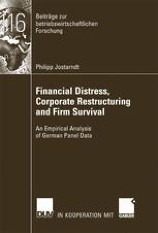
Financial Distress, Corporate Restructuring and Firm Survival : An Empirical Analysis of German Panel Data
Philipp Jostarndt analyzes the anatomy of financial distress for a large sample of German corporations. He studies distress-induced changes in ownership and control, success factors in distressed equity infusions, and firms’ choice between in- and out-of-court debt restructurings. Moreover, he conducts a survival analysis to examine the determinants of survival, acquisition, and bankruptcy as alternative paths to exit financial distress. He includes both the firm perspective as well as the market valuations of the undertaken restructurings and, where applicable, relates the findings to the microstructure of Germany’s revised bankruptcy legislation.
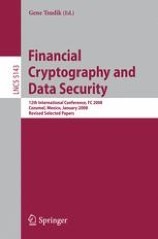
Financial cryptography and data security ; 12th International Conference, FC 2008, Cozumel, Mexico, January 28-31, 2008. Revised Selected Papers
This book constitutes the thoroughly refereed post-conference proceedings of the 12th International Conference on Financial Cryptography and Data Security, FC 2008, held in Cozumel, Mexico, in January 2008.The 16 revised full papers and 9 revised short papers presented together with 5 poster papers, 2 panel reports, and 1 invited lecture were carefully reviewed and selected from 86 submissions. The papers are organized in topical sections on attacks and counter measures, protocols, theory, hardware, chips and tags, signatures and encryption, as well as anonymity and e-cash.

Financial Compensation for Victims of Catastrophes : A Comparative Legal Approach
Some countries have created a specific fund solution; others follow a generous ad hoc approach whereby large amounts of compensation are made available on an ex post basis. This book shall pay attention to all of these seemingly quite different solutions. Experts from different countries report on the way catastrophes are dealt with in their particular jurisdiction from the angle of tort law, social security, insurance or alternative compensation mechanisms such as compensation funds. Various possible remedies for victims are critically discussed; attention is also paid to the economic analysis of law.

Financial Analysis of Mergers and Acquisitions : Understanding Financial Statements and accounting Rules with Case Studies
Helps its readers better analyze M&A transactions using information provided in financial statements. Covering accounting and reporting of consolidations, goodwill, non-controlling interests, step acquisitions, spin-offs, equity carve-outs, joint ventures, leveraged buyouts, disposal of subsidiaries, special purpose entities, and taxes, it focuses on the link between underlying economic events and the information in financial statements and how this link affects the assessment of corporate performance. The first part of the book provides description of the accounting rules governing M&A transactions, while the second part includes cases of M&A transactions. Each case focuses on a different element of an M&A transaction, and it is followed by a detailed solution with a complete analysis. Unlike other books in this field, this textbook focuses exclusively on accounting and financial analysis for graduate and upper undergraduate level courses in financial analysis, corporate finance, and financial accounting.

Financial accounting
Financial Accounting 11e successfully implements a real-world, single focus company approach in every chapter. The companies chosen are engaging and the decision-making focus shows the relevance of financial accounting regardless of if a student has chosen to major in accounting. Libby/Libby/Hodge believes in the building-block approach to teaching transaction analysis.

Filtering Theory : With Applications to Fault Detection, Isolation, and Estimation
The focus of this book is on filtering for linear processes, and its primary goal is to design filters from a class of linear stable unbiased filters that yield an estimation error with the lowest root-mean-square (RMS) norm. Various hierarchical classes of filtering problems are defined based on the availability of statistical knowledge regarding noise, disturbances, and other uncertainties. An important characteristic of the approach employed in this work for several aspects of filter analysis and design is structural in nature, revealing an inherent freedom to incorporate other classical secondary engineering constraints—such as placement of filter poles at desired locations—in filter design. Such a structural approach requires an understanding of powerful tools that then may be used in several engineering applications besides filtering.
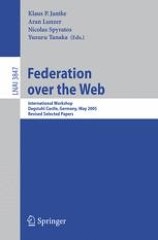
Federation over the Web ; International Workshop, Dagstuhl Castle, Germany, May 1-6, 2005, Revised Selected Papers
The lives of people all around the world, especially in industrialized nations, continue to be changed by the presence and growth of the Internet. Its in?uence is felt at scales ranging from private lifestyles to national economies, boosting thepaceatwhichmoderninformationandcommunicationtechnologiesin?uence personal choices along with business processes and scienti?c endeavors. In addition to its billions of HTML pages, the Web can now be seen as an open repository of computing resources. These resources provide access to computational services as well as data repositories, through a rapidly growing variety of Web applications and Web services.
