



الصفحة 47
الصفحة 47

Computational and Information Science ; 1st International Symposium, CIS 2004, Shanghai, China, December 16-18, 2004, Proceedings
this book present the proceedings of The 2004 International Symposium on Computational and Information Sciences (CIS 2004) aimed at bringing researchers in the area of computational and - formation sciences together to exchange new ideas and to explore new ground. The goal of the conference was to push the application of modern computing technologies to science, engineering, and information technologies to a new level of sophistication and understanding.

Computation and the humanities : Towards an oral history of digital humanities
This book addresses the application of computing to cultural heritage and the discipline of Digital Humanities that formed around it. Digital Humanities research is transforming how the Human record can be transmitted, shaped, understood, questioned and imagined and it has been ongoing for more than 70 years. However, we have no comprehensive histories of its research trajectory or its disciplinary development. The authors make a first contribution towards remedying this by uncovering, documenting, and analysing a number of the social, intellectual and creative processes that helped to shape this research from the 1950s until the present day.

COMPSTAT 2008 ; Proceedings in Computational Statistics
Presents methodological developments in Applied/Computational Statistics. This work covers a range of topics including Advances on Statistical Computing Environments, Methods for Classification and Clustering, Computation for Graphical Models and Bayes Nets, Computational Econometrics, and, Computational Statistics and Data Mining.

COMPSTAT 2006 - Proceedings in Computational Statistics ; 17th Symposium Held in Rome, Italy, 2006
International Association for Statistical Computing The International Association for Statistical Computing (IASC) is a Section of the International Statistical Institute.The objectives of the Association are to foster world-wide interest in effective statistical computing and to - change technical knowledge through international contacts and meetings - tween statisticians, computing professionals, organizations, institutions, g- ernments and the general public.

Composition of embedded systems : Scientific and industrial issues ; 13th Monterey Workshop 2006 Paris, France, October 16-18, 2006 Revised Selected Papers
This book discussed a range of challenges in embedded systems design that require further major advances in software and systems composition technology. The papers are organized in topical sections on model driven develo.
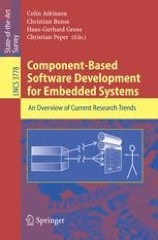
Component-Based Software Development for Embedded Systems : An Overview of Current Research Trends
Embedded systems are ubiquitous. They appear in cell phones, microwave ovens, refrigerators, consumer electronics, cars, and jets. Some of these embedded s- tems are safety- or security-critical such as in medical equipment, nuclear plants, and X-by-wire control systems in naval, ground and aerospace transportation - hicles. With the continuing shift from hardware to software, embedded systems are increasingly dominated by embedded software. Embedded software is complex. Its engineering inherently involves a mul- disciplinary interplay with the physics of the embedding system or environment. Embedded software also comes in ever larger quantity and diversity. The next generation of premium automobiles will carry around one gigabyte of binary code. The proposed US DDX submarine is e?ectively a ?oating embedded so- ware system, comprising 30 billion lines of code written in over 100 programming languages. Embedded software is expensive. Cost estimates are quoted at around US$15– 30 per line (from commencement to shipping). In the defense realm, costs can range up to $100, while for highly critical applications, such as the Space Shuttle, the cost per line approximates $1,000. In view of the exponential increase in complexity, the projected costs of future embedded software are staggering.

Component models and systems for grid applications ; Proceedings of the Workshop on Component Models and Systems for Grid Applications held June 26, 2004 in Saint Malo, France.
This first volume of the CoreGRID series addresses such vital issues as the architecture of the Grid, the way software will influence the development of the Grid, and the practical applications of Grid technologies for individuals and businesses alike. Part I of the book, Application-Oriented Designs, focuses on development methodology and how it may contribute to a more component-based use of the Grid. Middleware Architecture, the second part, examines portable Grid engines, hierarchical infrastructures, interoperability, as well as workflow modeling environments. The final part of the book, Communication Frameworks, looks at dynamic self-adaptation, collective operations, and higher-order components. With Component Models and Systems for Grid Applications, editors Vladimir Getov and Thilo Kielmann offer the computing professional and the computing researcher the most informative, up-to-date, and forward-looking thoughts on the fast-growing field of Grid studies.

Complex, Intelligent, and Software Intensive Systems ; Proceedings of the 13th International Conference on Complex, Intelligent, and Software Intensive Systems (CISIS-2019)
This book presents scientific interactions between the three interwoven and challenging areas of research and development of future ICT-enabled applications: software, complex systems and intelligent systems.
Complex Computing-Networks : Brain-like and Wave-oriented Electrodynamic Algorithms
This book uniquely combines new advances in the electromagnetic and the circuits&systems theory. It integrates both fields regarding computational aspects of common interest. Emphasized subjects are those methods which mimic brain-like and electrodynamic behaviour; among these are cellular neural networks, chaos and chaotic dynamics, attractor-based computation and stream ciphers.

Communicating sequential processes : The first 25 years : Symposium on the Occasion of 25 Years of CSP, London, UK, July 7-8, 2004. Revised Invited Papers
This volume, like the symposium CSP25 which gave rise to it, commemorates the semi-jubilee of Communicating Sequential Processes. 1 Tony Hoare’s paper “Communicating Sequential Processes” is today widely regarded as one of the most in?uential papers in computer science. To comm- orate it, an event was organized under the auspices of BCS-FACS (the British Computer Society’s Formal Aspects of Computing Science specialist group). CSP25 was one of a series of such events organized to highlight the use of formal methods, emphasize their relevance to modern computing and promote their wider application.

Clear Blogging : How People Blogging Are Changing the World and How You Can Join Them
Clear Blogging sets out to answer in non-technical terms what blogging has to offer, and why and how you should blog. Clear Blogging will show you why blogging has shaken up mainstream media, and how a blogger can end up on CNN.
Classification and Modeling with Linguistic Information Granules : Advanced Approaches to Linguistic Data Mining
Many approaches have already been proposed for classification and modeling in the literature. These approaches are usually based on mathematical mod els. Computer systems can easily handle mathematical models even when they are complicated and nonlinear (e.g., neural networks). On the other hand, it is not always easy for human users to intuitively understand mathe matical models even when they are simple and linear. This is because human information processing is based mainly on linguistic knowledge while com puter systems are designed to handle symbolic and numerical information. A large part of our daily communication is based on words. We learn from various media such as books, newspapers, magazines, TV, and the Inter net through words. We also communicate with others through words. While words play a central role in human information processing, linguistic models are not often used in the fields of classification and modeling. If there is no goal other than the maximization of accuracy in classification and modeling, mathematical models may always be preferred to linguistic models. On the other hand, linguistic models may be chosen if emphasis is placed on interpretability.

Classification - the ubiquitous challenge ; Proceedings of the 28th annual conference of the Gesellschaft für Klassifikation e.V., University of Dortmund, March 9-11, 2004
This volume contains revised versions of selected papers presented duringthe 28th Annual Conference of the Gesellschaft f ̈ur Klassifikation (GfKl), theGerman Classification Society. contributed papers by authors from 18countries were presented at the conference in 52 parallel sessions representingthe whole field addressed by the title of the conference “Classification: TheUbiquitous Challenge”. Among these 52 sessions the VOC organized sessionson Mixture Modelling, Optimal Scaling, Multiway Methods, and Psychomet-rics with 18 papers. Overall, presentation of the papers in this volume is arranged in the fol-lowing parts:I. (Semi-)Plenary PresentationsII. Classification and Data AnalysisIII. Applications, andIV. Contest: Social Milieus in Dortmund

Chinese Computational Linguistics ; 19th China National Conference, CCL 2020, Hainan, China, October 30 – November 1, 2020, Proceedings
This book constitutes the proceedings of the 19th China National Conference on Computational Linguistics, CCL 2020, held in Hainan, China, in October/November 2020. The 32 full and 2 short papers presented in this volume were carefully reviewed and selected from 99 submissions. They were organized in topical sections named: fundamental theory and methods of computational linguistics; information retrieval, dialogue and question answering; text generation and summarization; knowledge graph and information extraction; machine translation and multilingual information processing; minority language information processing; language resource and evaluation; social computing and sentiment analysis; and NLP applications.

Charting a new course : Natural language processing and information retrieval : Essays in Honour of Karen Spärck Jones
This book celebrates the life and work of Karen Spärck Jones in her seventieth year. she is one of the major figures of 20th century and early 21st Century computing and information processing. It book consists of fifteen new and original chapters written by leading international authorities reviewing the state of the art and her influence in the areas in which Karen Spärck Jones has been active. Although she has a publication record which goes back over forty years, it is clear even the very early work reviewed in the book can be read with profit by those working on recent developments in information processing like bioinformatics and the semantic web.

Charged Particle Traps : Physics and Techniques of Charged Particle Field Confinement
This book provides an introduction and guide to modern advances in charged particle (and antiparticle) confinement by electromagnetic fields. Confinement in different trap geometries, the influence of trap imperfections, classical and quantum mechanical description of the trapped particle motion, different methods of ion cooling to low temperatures, and non-neutral plasma properties (including Coulomb crystals) are the main subjects. They form the basis of such applications of charged particle traps as high-resolution optical and microwave spectroscopy, mass spectrometry, atomic clocks, and, potentially, quantum computing.

Chaos and fractals : New frontiers of science
Covers the central ideas and concepts of chaos and fractals as well as many related topics including: the Mandelbrot set, Julia sets, cellular automata, L-systems, percolation and strange attractors.
Challenges and Solutions for Sustainable Smart City Development
Discusses advances in smart and sustainable development of smart environments. The authors discuss the challenges faced in developing sustainable smart applications and provide potential solutions. The solutions are aimed at improving reliability and security with the goal of affordability, safety, and durability. Topics include health care applications, sustainable smart transportation systems, intelligent sustainable wearable electronics, and sustainable smart building and alert systems. Authors are from both industry and academia and present research from around the world. Addresses problems and solutions for sustainable development of smart cities; Includes applications such as healthcare, transportation, wearables, security, and more ; Relevant for scientist and researchers working on real time smart city development.

Central European Functional Programming School ; 1st Central European Summer School, CEFP 2005, Budapest, Hungary, July 4-15, 2005, Revised Selected Lectures
This volume presents eight carefully revised texts of selected lectures given by leading researchers of the field at the first Central European Functional Programming School, CEFP 2005, held in Budapest, Hungary, in July 2005. The eight revised full papers presented were carefully selected during two rounds of reviewing and improvement for inclusion in the book. The lectures cover a wide range of topics such as new programming language concepts for subtyping.

Cellular Automaton Modeling of Biological Pattern Formation: Characterization, Applications, and Analysis
This book focuses on a challenging application field of cellular automata: pattern formation in biological systems, such as the growth of microorganisms, dynamics of cellular tissue and tumors, and formation of pigment cell patterns. These phenomena, resulting from complex cellular interactions, cannot be deduced solely from experimental analysis, but can be more easily examined using mathematical models, in particular, cellular automaton models.
