



الصفحة 40
الصفحة 40

Condition Monitoring and Control for Intelligent Manufacturing
Manufacturing systems and processes are becoming increasingly complex, making more rational decision-making in process control a necessity. The book presents a wide and comprehensive review of the key areas of research in machine condition monitoring and control, before focusing on an in-depth treatment of each important technique, from multi-domain signal processing for defect diagnosis to web-based information delivery for real-time control.

Concurrency, Graphs and Models : Essays Dedicated to Ugo Montanari on the Occasion of His 65th Birthday
The volume consists of seven sections, six of which are dedicated to the main research areas to which Ugo Montanari has contributed: Graph Transformation; Constraint and Logic Programming; Software Engineering; Concurrency; Models of Computation; and Software Verification.

Conceptual Structures: Knowledge Architectures for Smart Applications ; 15th International Conference on Conceptual Structures, ICCS 2007, Sheffield, UK, July 22-27, 2007, Proceedings
Conceptual structures focus on the representation and analysis of concepts, events, actions and objects with applications in - search,softwareengineering,manufacturing and business.The book covers computer science, information technology,artificial int- ligence, philosophy and a variety of applied disciplines to explore novel ways that information technologies can be leveraged to assist human reasoning and interaction for tangible business or social benefits. Conceptual structures can be used to augment human intelligence by facilitating knowledge integration, desion making, the creation of intelligent software systems and the exploration of implicit structures.

Conceptual Structures : Knowledge Visualization and Reasoning; 16th International Conference on Conceptual Structures, ICCS 2008 Toulouse, France, July 7-11, 2008 Proceedings
This book constitutes the refereed proceedings of the 16th International Conference on Conceptual Structures, ICCS 2008, held in Toulouse, France, in July 2008.

Conceptual Modeling - ER 2007 ; 26th International Conference on Conceptual Modeling, Auckland, New Zealand, November 5-9, 2007, Proceedings
Conceptual modeling is fundamental to the development of complex systems, because it provides the key communication means between systems developers, end-users and customers.Conceptua lmodeling provides languages,methods and tools to understand and represent the application domain;to elicitate,concepalize and formalize system requirements and user needs;to communicate systems designs to all stakeholders; to formally verify and validate system designs on high levels of abstractions; and to minimize ambiguities in system development. Initially, conceptual modeling mainly addressed data-intensive information s- tems and contributed to data modeling and database application engineering. The area of conceptual modeling has now matured to encompass all kinds of application areas such as e-applications (including e-business and e-learning), web-based systems (including the semantic web and ubiquitous systems), life science and geographic applications.

Conceptual Modeling - ER 2005
Conceptual modeling is fundamental to any domain where one must cope with complex real-world situations and systems because it fosters communication - tween technology experts and those who would bene?t from the application of those technologies. Conceptual modeling is the key mechanism for und- standing and representing the domains of information system and database - gineering but also increasingly for other domains including the new “virtual” e-environmentsandtheinformationsystemsthatsupportthem.Theimportance of conceptual modeling in software engineering is evidenced by recent interest in “model-drivenarchitecture”and“extremenon-programming”.Conceptualm- eling also plays a prominent rolein various technical disciplines and in the social sciences. The Annual International Conference on Conceptual Modeling (referred to as the ER Conference) provides a central forum for presenting and discussing current research and applications in which conceptual modeling is the major emphasis.

Computing and Combinatorics ; Vol. 4112 ; 12th Annual International Conference, COCOON 2006, Taipei, Taiwan, August 15-18, 2006, Proceedings
The papers are organized in topical sections on computational economics, finance, and management, graph algorithms, computational complexity and computability, quantum computing, computational biology and medicine, computational geometry, graph theory, and more.

Computing and combinatorics ; Vol. 3595 ; 11th Annual International Conference, COCOON 2005, Kunming, China, August 16-19, 2005, Proceedings
The papers in this volume were presented at theEleventh Annual InternationalComputing and Combinatorics Conference(COCOON 2005), The topics cover most aspects of theoretical computerscience and combinatorics related to computing.Submissions to the conference this year were conducted electronically. A totalof 353 papers were submitted, of which 96 were accepted.

Computing and Combinatorics ; 14th Annual International Conference, COCOON 2008 Dalian, China, June 27-29, 2008 Proceedings
The refereed proceedings of the 14th Annual International Computing and Combinatorics Conference, COCOON 2008, held in Dalian, China, in June 2008.
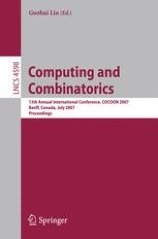
Computing and Combinatorics ; 13th Annual International Conference, COCOON 2007, Banff, Canada, July 16-19, 2007, Proceedings
The Book covers most aspects of theoretical computer scienceand combinatorics related to computing.It exploring research, development, and novel applications of computing and combinatorics.

Computers and Games ; 6th International Conference, CG 2008, Beijing, China, September 29 - October 1, 2008. Proceedings
This book constitutes the refereed proceedings of the 6th International Conference on Computers and Games, CG 2008, held in Beijing, China, in September/October 2008 co-located with the 13th Computer Olympiad and the 16th World Computer-Chess Championship.

Computer-aided Systems in Public Transport
This proceedings volume consists of selected papers presented at the Ninth Int- national Conference on Computer-Aided Scheduling of Public Transport (CASPT 2004), which was held at the Hilton San Diego Resort and Conference Center in San Diego, California, USA, from August 9-11, 2004. The CASPT 2004 conference is the continuation of a series of international workshops and conferences prese- ing recent research and progress in computer-aided scheduling in public transport.

Computer Vision Systems ; 2nd International Workshop, ICVS 2001 Vancouver, Canada, July 7-8, 2001 Proceedings
Computer Vision has reached a level of maturity that allows us not only to p- form research on individual methods and system components but also to build fully integrated computer vision systems of signi cant complexity. This opens a number of new problems related to system architecture, methods for system synthesis and veri cation, active vision systems, control of perception and - tion, knowledge and system representation, context modeling, cue integration, etc. By focusing on methods and concepts for the construction of fully integrated vision systems, ICVS aims to bring together researchers interested in computer vision systems. Similar to the previous event in Las Palmas, ICVS 2001 was organized as a single-track workshop consisting of high-quality.
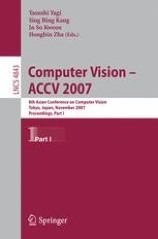
Computer Vision – ACCV 2007 ; 8th Asian Conference on Computer Vision, Tokyo, Japan, November 18-22, 2007, Proceedings, Part I
Contains sections on shape and texture, fitting, calbration, detection, image and video processing, applications, face and gesture, tracking, camera networks, and face/gesture/action detection and recognition. This book also covers learning, motion and tracking, retrival and search, and human pose estimation.

Computer Supported Cooperative Work in Design III ; 10th International Conference, CSCWD 2006, Nanjing, China, May 3-5, 2006, Revised Selected Papers
The design of complex artifacts and systems requires the cooperation of multidiscip- nary design teams using multiple commercial and proprietary engineering software tools (e.g., CAD, modeling, simulation, visualization, and optimization), engineering databases, and knowledge-based systems. Individuals or individual groups of mult- isciplinary design teams usually work in parallel and separately with various en- neering software tools which are located at different sites. In addition, individual members may be working on different versions of a design or viewing the design from different perspectives, at different levels of detail. In order to accomplish the work, it is necessary to have effective and efficient c- laborative design environments. Such environments should not only automate in- vidual tasks, in the manner of traditional computer-aided engineering tools, but also enable individual members to share information, collaborate, and coordinate their activities within the context of a design project. CSCW (computer-supported coope- tive work) in design is concerned with the development of such environments.

Computer Supported Cooperative Work in Design I
The design of complex artifacts and systems requires the cooperation of multidisciplinary design teams using multiple commercial and non-commercial engineering tools such as CAD tools, modeling, simulation and optimization software, engineering databases, and knowledge-based systems. Individuals or individual groups of multidisciplinary design teams usually work in parallel and separately with various engineering tools, which are located on different sites, often for quite a long time. At any moment, individual members may be working on different versions of a design or viewing the design from various perspectives, at different levels of detail. In order to meet these requirements, it is necessary to have effective and efficient collaborative design environments. These environments should not only automate individual tasks, in the manner of traditional computer-aided engineering tools, but also enable individual members to share information, collaborate and coordinate their activities within the context of a design project. CSCW (computer-supported cooperative work) in design is concerned with the development of such environments.

Computer Simulations of Liquid Crystals and Polymers ; Proceedings of the NATO Advanced Research Workshop on Computational Methods for Polymers and Liquid Crystalline Polymers, Erice, Italy. 16-22 July 2003
Liquid crystals, polymers and polymer liquid crystals are soft condensed matter systems of major technological and scientific interest. An understanding of the macroscopic properties of these complex systems and of their many and interesting peculiarities at the molecular level can nowadays only be attained using computer simulations and statistical mechanical theories. Both in the Liquid Crystal and Polymer fields a considerable amount of simulation work has been done in the last few years with various classes of models at different special resolutions, ranging from atomistic to molecular and coarse-grained lattice models. Each of the two fields has developed its own set of tools and specialized procedures and the book aims to provide a state of the art review of the computer simulation studies of polymers and liquid crystals. This is of great importance in view of a potential cross-fertilization between these connected areas which is particularly apparent for a number of experimental systems like, e.g. polymer liquid crystals and anisotropic gels where the different fields necessarily merge. An effort has been made to assess the possibilities of a coherent description of the themes that have developed independently, and to compare and extend the theoretical and computational techniques put forward in the different areas.

Computer science logic ; Vol. 4207 ; 20th International Workshop, CSL 2006, 15th Annual Conference of the EACSL, Szeged, Hungary, September 25-29, 2006, Proceedings
Coverage includes automated deduction and interactive theorem proving, constructive mathematics and type theory, equational logic and term rewriting, automata and formal logics, modal and temporal logic, model checking, finite model theory, and more.

Computer Science Logic ; Vol. 3634
This book constitutes the refereed proceedings of the 19th International Workshop on Computer Science Logic, CSL 2005, held as the 14th Annual Conference of the EACSL in Oxford, UK in August 2005. The 33 revised full papers presented together with 4 invited contributions were carefully reviewed and selected from 108 papers submitted. All current aspects of logic in computer science are addressed ranging from mathematical logic and logical foundations to methodological issues and applications of logics in various computing contexts. The volume is organized in topical sections on semantics and logics, type theory and lambda calculus, linear logic and ludics, constraints, finite models, decidability and complexity, verification and model checking, constructive reasoning and computational mathematics, and implicit computational complexity and rewriting.

Computer Science Logic ; 22nd International Workshop, CSL 2008 , 17th Annual Conference of the EACSL, Bertinoro, Italy, September 16-19, 2008. Proceedings
This book constitutes the refereed proceedings of the 22nd International Workshop on Computer Science Logic, CSL 2008, held as the 17th Annual Conference of the EACSL in Bertinoro, Italy, in September 2008.
