



الصفحة 4
الصفحة 4
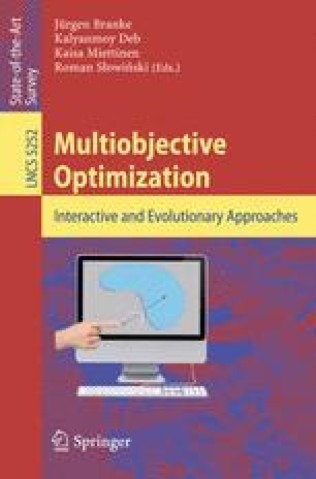
Multiobjective Optimization : Interactive and Evolutionary Approaches
Multiobjective optimization deals with solving problems having not only one, but multiple, often conflicting, criteria. Such problems can arise in practically every field of science, engineering and business, and the need for efficient and reliable solution methods is increasing. The task is challenging due to the fact that, instead of a single optimal solution, multiobjective optimization results in a number of solutions with different trade-offs among criteria, also known as Pareto optimal or efficient solutions. Hence, a decision maker is needed to provide additional preference information and to identify the most satisfactory solution. Depending on the paradigm used, such information may be introduced before, during, or after the optimization process. Clearly, research and application in multiobjective optimization involve expertise in optimization as well as in decision support.

Multi-Objective Machine Learning
This monograph presents a selected collection of research work on multi-objective approach to machine learning, including multi-objective feature selection, multi-objective model selection in training multi-layer perceptrons, radial-basis-function networks, support vector machines, decision trees, and intelligent systems.
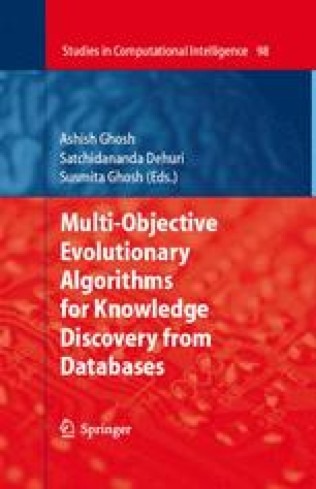
Multi-Objective Evolutionary Algorithms for Knowledge Discovery from Databases
The present volume provides a collection of seven articles containing new and high quality research results demonstrating the significance of Multi-objective Evolutionary Algorithms (MOEA) for data mining tasks in Knowledge Discovery from Databases (KDD). These articles are written by leading experts around the world. It is shown how the different MOEAs can be utilized, both in individual and integrated manner, in various ways to efficiently mine data from large databases.
Multiobjective Evolutionary Algorithms and Applications
Multiobjective Evolutionary Algorithms and Applications provides comprehensive treatment on the design of multiobjective evolutionary algorithms and their applications in domains covering areas such as control and scheduling. Emphasizing both the theoretical developments and the practical implementation of multiobjective evolutionary algorithms, a profound mathematical knowledge is not required. Written for a wide readership, engineers, researchers, senior undergraduates and graduate students interested in the field of evolutionary algorithms and multiobjective optimization with some basic knowledge of evolutionary computation will find this book a useful addition to their book case.

Multimedia Services in Intelligent Environments : Advanced Tools and Methodologies
This book presents a sample of recent research results in multimedia services. Besides the introductory chapter, this book includes fourteen additional chapters. Nine of these chapters cover various aspects of data processing in multimedia services in intelligent environments, such as storage, recognition and classification, transmission, information retrieval, and information securing. Four additional chapters present multimedia services in noise and hearing monitoring and measuring, augmented reality, automated lecture rooms and rights management and licensing. Finally, the last chapter is devoted to an intelligent recommender service in scientific digital libraries.

Multimedia security : Algorithm development, analysis and applications (algorithms for intelligent systems)
Provides an insight about various techniques used in multimedia security and identifies its progress in both technological and algorithmic perspectives. In the contemporary world, digitization offers an effective mechanism to process, preserve and transfer all types of information. The incredible progresses in computing and communication technologies augmented by economic feasibility have revolutionized the world. The availability of efficient algorithms together with inexpensive digital recording and storage peripherals have created a multimedia era bringing conveniences to people in sharing the digital data that includes images, audio and video. The ever-increasing pace, at which the multimedia and communication technology is growing, has also made it possible to combine, replicate and distribute the content faster and easier, thereby empowering mankind by having a wealth of information at their disposal.

Multilevel Synthesis : From the Group to the Individual
This book presents a historical panorama of the evolution of demographic thought from its eighteenth-century origins up to the present day, and uses it to demonstrate how the multilevel approach can resolve some of the contradictions that have become apparent and achieve a synthesis of the different approaches employed. Part one guides the reader from period analysis to multilevel analysis, examining longitudinal and event history analysis on the way. Part two is a detailed account of multilevel analysis, its methods, and the relevant mathematical models notably as regards the type of variables being used. Numerous examples, examined across successive sections, make the book clear and easy to follow.

Multidisciplinary Methods for Analysis, Optimization and Control of Complex Systems
Consists of lecture notes of a summer school named after the late Jacques Louis Lions. The summer school was designed to alert both Academia and Industry to the increasing role of multidisciplinary methods and tools for the design of complex products in various areas of socio-economic interest.

Multi-Agent Systems and Applications IV ; 4th International Central and Eastern European Conference on Multi-Agent Systems, CEEMAS 2005, Budapest, Hungary, September 15-17, 2005, Proceedings
In the very competitive field of agent oriented conferences and workshops nowadays (such as AAMAS, WI/IAT, EUMAS, CIA, MATES) the special profile of CEEMAS is that it is trying to bridge the gap between applied research achievements and theoretical research activities. Our ambition is to provide a forum for presenting theoretical research with an evident application potential, implemented application prototypes and their properties, as well as industrial case studies of successful (but also unsuccessful) agent technology deployments. This is why the CEEMAS proceedings volume provides a collection of research and application papers. The technical research paper section of the proceedings (see pages 11–499) contains pure research papers as well as research results in application settings while the application papers section (see pages 500–530) contains papers focused on application aspects. The goal is to demonstrate the real life value and commercial reality of multi-agent systems as well as to foster communication between academia and industry in this field.

MSC Maximal Stress Cooperation
In 1996 my book ‘The Nature of Cultures’ appeared in Vi- na and New York. It describes cultures as systems which are controlled by MSC and decorum. While MSC is a neologism meaning ‘maximal stress cooperation’ decorum is a very old term. It is as old as Western culture itself, and is furthermore, the translation of the even older Greek word ‘prepon’. Decorum and prepon mean ‘to be suitable, to be fitting’. It is all about the fitting of cultural medial contents to elementary cultural behavioural types and behavioural phases. These behavioural units are subject to a type of ranking system in which that which is essential is sorted from that which less essential. - corum then means – the representations of the media must ‘fit’ the ranking of the cultural behaviour. It is MSC which assumes the top position in this ranking. In 1996 and the two previous years when I was working on my book ‘The Nature of Cultures’ less than 5 years had passed since the Iron Curtain had been lifted. Many believed at that time that with ending of the Cold War, which was more or less de facto peace anyway, that a new and better age of peace was dawning.

Mr Hopkins Men : Cambridge Reform and British Mathematics in the 19th Century
Tells the story of Hopkins and the education and subsequent careers of his top "wranglers", many of whom went on to have illustrious careers as bishops, judges, politicians, scientists or educators. It draws on first-hand accounts of life at Cambridge to give the reader a glimpse inside its colleges, and it charts the evolution of the curriculum and the slow, often reluctant, reforms that led to Cambridge’s dominance of British higher education. It surveys the scientific achievements of the time and considers the disproportionate contributions made by Scottish and Irish alumni in establishing a research community. Gradually, Cambridge was transformed from a near-moribund institution into a world-renowned centre for the mathematical and physical sciences.

Motivational Aspects of Prejudice and Racism
Motivational Aspects of Prejudice and Racism examines the cognitive processes as well as the motivational forces that create and sustain social hierarchies based on racial categories. A panel of top scholars analyzes the subtle and explicit manifestations of bias within and across racial groups, while refuting the idea that race has lost its power as a social concept. Chapter authors review the evolution of the psychological understanding of racism and its effects, pinpoint emerging trends in racism research, and illuminate the experience of prejudice from minority group members’ perspectives. Well-known psychosocial phenomena as the cross-race identification effect, social identity, and majority culture members' conflicting attitudes regarding race, are explored, with the underlying ideologies that nurture them. The volume concludes with a realistic assessment of the future, and possible elimination, of racism. Readers are challenged to re-think self and social identities and self-concepts—particularly relevant ideas as America grows more diverse, and potentially more divided.

Morphometrics with R
The R language and environment offers a single platform to perform a multitude of analyses from the acquisition of data to the production of static and interactive graphs. This offers an ideal environment to analyze shape variation and shape change. This open-source language is accessible for novices and for experienced users. Adopting R gives the user and developer several advantages for performing morphometrics: evolvability, adaptability, interactivity, a single and comprehensive platform, possibility of interfacing with other languages and software, custom analyses, and graphs. The book explains how to use R for morphometrics and provides a series of examples of codes and displays covering approaches ranging from traditional morphometrics to modern statistical shape analysis such as the analysis of landmark data, Thin Plate Splines, and Fourier analysis of outlines.

Morphology, Molecules, Evolution and Phylogeny in Polychaeta and Related Taxa; Proceedings of two ISSI Workshops, 18–22 October 1999 and 15–19 May 2000, Bern, Switzerland
Recently, evidence has been accumulated which shows that some of the groups formerly regarded as independent "phyla" such as Pogonophora (now recognized as Siboglinidae), Echiura, Myzostomida and perhaps Sipuncula, are most probably nothing else than greatly modified Annelida. The extreme morphological diversity found especially in Polychaeta displays the plasticity of a simple segmented organisation that basically is nothing else but a serial repetition of identical units. Thus, annelids are highly important to our understanding of fundamental questions about morphological and adaptive diversity, as well as clarifying evolutionary changes and phylogenetic relationships. The book aims to summarize our knowledge on Polychaetes polychaetes and their allies and gives an overview of recent advances gained by studies that employed conventional and modern methods plus, increasingly and importantly, the use of molecular markers and computer-assisted kinship analyses. It also reflects the state of art in polychaete sciences and presents new questions and controversies. As such it will significantly influence the direction of research on Polychaeta and their related taxa.

Monitoring, Security, and Rescue Techniques in Multiagent Systems
This volume contains extended and improved versions of selected contributions presented at the International Workshop "Monitoring, Security and Rescue Techniques in Multiagent Systems".

Molecular Mechanisms of Plant and Microbe Coexistence
Molecular Mechanisms of Plant and Microbe Coexistence presents studies on the complex and manifold interactions of plants and microbes at the population, genomics and proteomics level. The role of soil microbial diversity in enhancing plant health and plant microbe beneficial symbioses is discussed. Microbial communities are shown in the light of evolution. Main topics include genome coexistence and the functional genomics and proteomics of plant-associated microbes, which could form the basis for new environmentally benign strategies to combat infectious plant diseases and regulate plant growth. Further chapters focus on the role of signaling during the different stages of plant microbe coexistence, in symbiotic or pathogenic relationships, in quorum sensing and plant viral infections. Methods for studying the interactions in the root zone complement the book, which will certainly be of relevance in the practical application to agriculture, food security and for maintaining the balance of our ecosystems.

Molecular Mechanisms of Exocytosis
This book, written by recognized experts in the field aims at clarifying for a non-specialist audience the role of the key players in the exocytotic process not only in neuronal and endocrine cells but also in a variety of other relevant cell systems. The book represents a unique collection of up-to-date reviews that will introduce researchers and students to the forefront of this rapidly moving and fascinating field.

Molecular genetics, structures, mechanisms, and functions : Principles of gene manipulation and genomics ; Vol.1
Provides an overview of the future of genetic engineering and delves into the role of biotechnology and its applications in genetic engineering. It discusses the tools of recombinant technology, which have brought about revolution in our understanding of various complex biological phenomena. Chapters cover mutagenesis, construction, and sequencing of DNA libraries along with applications of genetic engineering for improving health, preventing genetic diseases, enhancing food resources, managing environmental bioremediation, and more. Topics include genetic engineering tools for restriction enzymes and vectors, gene and cell division, mutation detection and screening in plants, population genetics, sexuality in bacteria, and more. Several chapters focus on the tools of recombinant technology, such as restriction enzymes, vectors, etc., that have paved the way for creating organisms of choice and opened new horizons in the field of medicine, agriculture, and industry for human welfare.

Molecular genetics, structures, mechanisms, and functions : Applications and exploring the nucleus ; Vol.2
Continues the coverage of generic engineering, dealing with the concept of genes, their relationship with chromosomes, and their functional manifestation to the benefit of organisms at large and for human in particular. Topics include Mendel’s Laws of Inheritance, which explains the inheritance of traits visible through generations; , genome diversity and evolution genetic protein synthesis, recombination and evolution of DNA, transposable elements in genetics, chromosomal aberrations, and more. The volume also addresses genetic engineering in agricultural science for increased crop yields, to reduce costs for food or drug production, to reduce the need for pesticides, to enhance crop quality, etc.

Molecular evolutionary models in drug discovery
Explores the application of evolutionary molecular models in drug discovery in which secondary metabolites play a fundamental role. Secondary metabolites are not produced in isolation, they are the result of the interaction of genes, metabolism and the environment. The book examines the role of secondary metabolites as leads in drug discovery and on the development of a rational bioprospecting model for new medicines based on the evolution of secondary metabolism. These evolutionary models are part of biological systems and are the most reliable expression of the functioning of living beings.
