



الصفحة 37
الصفحة 37

Combinatorial Optimization : Theory and Algorithms
Places special emphasis on theoretical results and algorithms with provably good performance, in contrast to heuristics. It has arisen as the basis of several courses on combinatorial optimization and more special topics at graduate level. It contains complete but concise proofs, also for many deep results, some of which did not appear in a textbook before. Many very recent topics are covered as well, and many references are provided. Thus this book represents the state of the art of combinatorial optimization.

Combinatorial Commutative Algebra
Combinatorial commutative algebra is an active area of research with thriving connections to other fields of pure and applied mathematics. This book provides a self-contained introduction to the subject, with an emphasis on combinatorial techniques for multigraded polynomial rings, semigroup algebras, and determinantal rings. The eighteen chapters cover a broad spectrum of topics, ranging from homological invariants of monomial ideals and their polyhedral resolutions, to hands-on tools for studying algebraic varieties with group actions, such as toric varieties, flag varieties, quiver loci, and Hilbert schemes. Over 100 figures, 250 exercises, and pointers to the literature make this book appealing to both graduate students and researchers.

Combinatorial Algebraic Topology
Combinatorial algebraic topology is a fascinating and dynamic field at the crossroads of algebraic topology and discrete mathematics. This volume is the first comprehensive treatment of the subject in book form. The first part of the book constitutes a swift walk through the main tools of algebraic topology, including Stiefel-Whitney characteristic classes, which are needed for the later parts. Readers - graduate students and working mathematicians alike - will probably find particularly useful the second part, which contains an in-depth discussion of the major research techniques of combinatorial algebraic topology. Our presentation of standard topics is quite different from that of existing texts. In addition, several new themes, such as spectral sequences, are included.

Collecting spatial data : Optimum design of experiments for random fields
The book is concerned with the statistical theory for locating spatial sensors. It bridges the gap between spatial statistics and optimum design theory. The revised edition contains additional material on design for detecting spatial dependence and for estimating parametrized covariance functions.

Codici correttori : Un'introduzione = Correction codes : An introduction
The objective of the theory of desire is that of studying the method to communicate in an affidable way, purely in the presence of disturbance. This is if it is an indispensable instrument for the realization of digital communication systems and, pertanto, the suo studio riveste notevole of practical interest. In this testo testo, destined to studenti dei corsi di laurea di primo (II / III anno) and secondo livello in mathematics, physics or engineering, I come to introduce the famiglie classiche di codici correttori di errore and if it shows how this possano essere concretely applicable per I will communicate; If I present inoltre anche alcune family of covetousness of più recent scoperta, currently oggetto di intense attività di ricerca.

Codici cifrati: Arne Beurling e la crittografia nella II guerra mondiale = Cipher codes : Arne Beurling and cryptography in world war II
The story of the German codebreaking is told in detail for the first time and has all the makings of a thriller, but with elements that make it an excellent introduction to the field of cryptography, as well as a vibrant and human portrait of the society of the time: a desperate wartime situation, political and espionage intrigue, the sometimes incomprehensible yet always fascinating genius of the main architect of its success — mathematician Arne Beurling—the difficulties and tricks of the trade, but also the systematic and obscure work of a crowd of codebreakers who treat their situation as if it were a normal job. The author, Bengt Beckman, was for years, after the war, head of the cryptanalysis department of the Swedish intelligence agency.

Codes : An Introduction to Information Communication and Cryptography
Information is an important feature of the modern world. Mathematical techniques underlie the devices that we use to handle it, for example, mobile phones, digital cameras, and personal computers. This book is an integrated introduction to the mathematics of coding, that is, replacing information expressed in symbols, such as a natural language or a sequence of bits, by another message using (possibly) different symbols. There are three main reasons for doing this: economy, reliability, and security, and each is covered in detail. Only a modest mathematical background is assumed, the mathematical theory being introduced at a level that enables the basic problems to be stated carefully, but without unnecessary abstraction.

Cluster Analysis for Data Mining and System Identification
Presents new approaches to data mining and system identification, and new techniques and tools are presented for the clustering, classification, regression and visualization of complex datasets.

Clinical Research Methods for Surgeons
The text addresses the clinical research questions facing 21st century surgeons, and provides clear direction on how to incorporate sophisticated research techniques into practice. In addition to the surgical generalist, this practical volume is specifically oriented to surgeons who treat unique diseases, yet have no single resource to facilitate clinical research in these specific areas. This comprehensive and easy-to-use guide encompasses the entire process of clinical study design, application, and assessment. Part One is aimed at the young surgeon about to engage in new studies, and gives a general overview of the infrastructure of clinical research. Parts Two and Three are geared towards experienced investigators interested in pursuing clinical research and surgeons reviewing the literature for practical application. Part Two focuses on study design and related statistical issues, while Part Three is concerned with measuring and assessing the outcome of clinical studies. Part Four presents topics of interest to the active investigator, such as quality of care and cost-effectiveness analyses. Clinical Research Methods for Surgeons is relevant to both beginning investigators and established researchers, and addresses the unique concerns of surgical diseases and acknowledges that they require special approaches to deal with clinical questions.
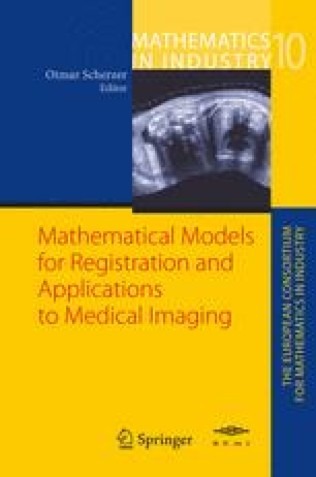
Mathematical Models for Registration and Applications to Medical Imaging
Image registration is an emerging topic in image processing with many applications in medical imaging, picture and movie processing. The classical problem of image registration is concerned with ?nding an appropriate transformation between two data sets. This fuzzy de?nition of registration requires a mathematical modeling and in particular a mathematical speci?cation of the terms appropriate transformations and correlation between data sets. Depending on the type of application, typically Euler, rigid, plastic, elastic deformations are considered. The variety of similarity p measures ranges from a simpleL distance between the pixel values of the data to mutual information or entropy distances. This goal of this book is to highlight by some experts in industry and medicine relevant and emerging image registration applications and to show new emerging mathematical technologies in these areas. Currently, many registration application are solved based on variational prin- ple requiring sophisticated analysis, such as calculus of variations and the theory of partial differential equations, to name but a few. Due to the numerical compl- ity of registration problems ef?cient numerical realization are required. Concepts like multi-level solver for partial differential equations, non-convex optimization, and so on play an important role. Mathematical and numerical issues in the area of registration are discussed by some of the experts in this volume.

Mathematical Modelling of Biosystems
This volume is an interdisciplinary book, which introduces, in a very readable way, state of the art research in the fundamental topics of mathematical modelling of Biosystems. These topics include: the study of Biological Growth and its mechanisms, the coupling of pattern to form via theorems of Differential Geometry, the human immunodeficiency virus dynamics, the inverse folding problem and the possibility of analysing true protein backbone flexibility, the Biclustering techniques for the organization of microarray data, the analytical approach to the modelling of biomolecular structure via Steiner trees, the action of biocides on resistance mechanisms of mutated and phenotypic bacteria strains, a description of the fundamental processes for the distribution and abundances of species towards a unified theory of Ecology, and a special introduction to Protein Physics aiming to explain the all-or-none first order phase transitions from native to denatured states.
Mathematical Modeling, Simulation, Visualization and e-Learning ; Proceedings of an International Workshop held at Rockefeller Foundation' s Bellagio Conference Center, Milan, Italy, 2006
This book is a collection of articles written by some of the most prominent leading applied mathematicians, as well as articles from young and promising scientists from Africa, Asia and Europe. The common objective of these articles is to present an important issue which is currently widely discussed in scientific investigation with major human, economic or ecological implications. One main feature of the series, which the current book exemplifies, is that each article is as deep as an expert lecture but is also self-contained, so that even isolated scientists with limited resources can profit greatly from it. Another feature of this book is that each article is meant to present a collection of open questions which can fuel undergraduate or graduate research activities even in smaller or more isolated scientific communities.
Mathematical modeling of the human brain : From magnetic resonance images to finite element simulation
This book bridges common tools in medical imaging and neuroscience with the numerical solution of brain modelling PDEs. The connection between these areas is established through the use of two existing tools, FreeSurfer and FEniCS, and one novel tool, the SVM-Tk, developed for this book. The reader will learn the basics of magnetic resonance imaging and quickly proceed to generating their first FEniCS brain meshes from T1-weighted images.
Mathematical Modeling of Complex Biological Systems : A Kinetic Theory Approach
Describes the evolution of several socio-biological systems using mathematical kinetic theory. Specifically, it deals with modeling and simulations of biological systems—comprised of large populations of interacting cells—whose dynamics follow the rules of mechanics as well as rules governed by their own ability to organize movement and biological functions. The authors propose a new biological model for the analysis of competition between cells of an aggressive host and cells of a corresponding immune system.Because the microscopic description of a biological system is far more complex than that of a physical system of inert matter, a higher level of analysis is needed to deal with such complexity. Mathematical models using kinetic theory may represent a way to deal with such complexity, allowing for an understanding of phenomena of nonequilibrium statistical mechanics not described by the traditional macroscopic approach. The proposed models are related to the generalized Boltzmann equation and describe the population dynamics of several interacting elements (kinetic population models).The particular models proposed by the authors are based on a framework related to a system of integro-differential equations, defining the evolution of the distribution function over the microscopic state of each element in a given system. Macroscopic information on the behavior of the system is obtained from suitable moments of the distribution function over the microscopic states of the elements involved.
Mathematical Modeling of Biological Systems ; Vol. II : Epidemiology, Evolution and Ecology,Immunology, Neural Systems and the Brain, and Innovative Mathematical Methods
This two-volume, interdisciplinary work is a unified presentation of a broad range of state-of-the-art topics in the rapidly growing field of mathematical modeling in the biological sciences. Highlighted throughout both works are mathematical and computational approaches to examine central problems in the life sciences, ranging from the organizational principles of individual cells to the dynamics of large populations.
Mathematical Modeling of Biological Systems ; Vol. I : Cellular Biophysics, Regulatory Networks, Development, Biomedicine, and Data Analysis
This two-volume, interdisciplinary work is a unified presentation of a broad range of state-of-the-art topics in the rapidly growing field of mathematical modeling in the biological sciences. Highlighted throughout both works are mathematical and computational approaches to examine central problems in the life sciences, ranging from the organizational principles of individual cells to the dynamics of large populations.
Mathematical Modeling for the Life Sciences
Proposing a wide range of mathematical models that are currently used in life sciences may be regarded as a challenge, and that is precisely the challenge that this book takes up. Of course this panoramic study does not claim to offer a detailed and exhaustive view of the many interactions between mathematical models and life sciences. This textbook provides a general overview of realistic mathematical models in life sciences, considering both deterministic and stochastic models and covering dynamical systems, game theory, stochastic processes and statistical methods. Each mathematical model is explained and illustrated individually with an appropriate biological example. Finally three appendices on ordinary differential equations, evolution equations, and probability are added to make it possible to read this book independently of other literature.
Mathematical Methods in Robust Control of Linear Stochastic Systems
Linear stochastic systems are successfully used to provide mathematical models for real processes in fields such as aerospace engineering, communications, manufacturing, finance and economy. This monograph presents a useful methodology for the control of such stochastic systems with a focus on robust stabilization in the mean square, linear quadratic control, the disturbance attenuation problem, and robust stabilization with respect to dynamic and parametric uncertainty.

Mathematical methods and modelling in hydrocarbon exploration and production
Hydrocarbon exploration and production incorporate great technology challenges for the oil and gas industry. In order to meet the world's future demand for oil and gas, further technological advance is needed, which in turn requires research across multiple disciplines, including mathematics, geophysics, geology, petroleum engineering, signal processing, and computer science. This book addresses important aspects and fundamental concepts in hydrocarbon exploration and production. Moreover, new developments and recent advances in the relevant research areas are discussed, whereby special emphasis is placed on mathematical methods and modelling. The book reflects the multi-disciplinary character of the hydrocarbon production workflow, ranging from seismic data imaging, seismic analysis and interpretation and geological model building, to numerical reservoir simulation. Various challenges concerning the production workflow are discussed in detail.

Mathematical Masterpieces : Further Chronicles by the Explorers
Experience the discovery of mathematics by reading the original work of some of the greatest minds throughout history. Here are the stories of four mathematical adventures, including the Bernoulli numbers as the passage between discrete and continuous phenomena, the search for numerical solutions to equations throughout time, the discovery of curvature and geometric space, and the quest for patterns in prime numbers. Each story is told through the words of the pioneers of mathematical thought. Particular advantages of the historical approach include providing context to mathematical inquiry, perspective to proposed conceptual solutions, and a glimpse into the direction research has taken.
