



الصفحة 36
الصفحة 36
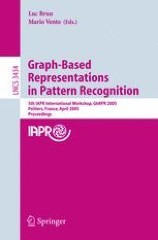
Graph-based representations in pattern recognition ; 5th IAPR International Workshop, GbRPR 2005, Poitiers, France, April 11-13, 2005, Proceedings
Many vision problems have to deal with di?erent entities (regions, lines, line junctions, etc.) and their relationships. These entities together with their re- tionships may be encoded using graphs or hypergraphs. The structural inf- mation encoded by graphs allows computer vision algorithms to address both the features of the di?erent entities and the structural or topological relati- ships between them. Moreover, turning a computer vision problem into a graph problem allows one to access the full arsenal of graph algorithms developed in computer science. The Technical Committee (TC15, http://www.iapr.org/tcs.html) of the IAPR (International Association for Pattern Recognition) has been funded in order to federate and to encourage research work in these ?elds. Among its - tivities, TC15 encourages the organization of special graph sessions at many computer vision conferences and organizes the biennial workshop GbR.

Gradients in a Tropical Mountain Ecosystem of Ecuador
This volume addresses a multitude of ecologically relevant aspects: macro- and microclimate; physics, chemistry and biology of soils; water relations, matter turnover and nutrient availability; plant growth and biomass partitioning; floral composition and plant life forms; vegetation structure and dynamics; organismic interactions, diversity and population biology of birds, moths and microarthropods; forest management, and reforestation with indigenous species; ethnobotanical and social aspects. New hypotheses are presented with regard to biodiversity and ecosystem functioning, as well as sustainable management of an ecosystem in a biodiversity hotspot.

GPCRs : From Deorphanization to Lead Structure Identification
The book highlights the following topics: Structure of GPCRs, Design of GPCR Ligands, GPCR Signalling, Deorphanization and Assay Development. All chapters are written by leading experts in the field, discussing the most recent state of the art. They give insight into the approaches taken by industry and academia to address GPCRs and depict how mature this target class-oriented research has become in the last decade. The book reflects the actual trends in the fast-emerging field of GPCR research in academia and industry.

Government and Research : Thirty Years of Evolution
This revised and augmented version updates the original text for current policy concerns and takes account of changes in science policy studies, whilst preserving its essential themes. It contains a succinct account of where matters now stand as well as an extended analysis of the themes that continue to dominate research and science policy.

Governing the Sustainable Development Goals : Quantification in Global Public Policy
This book conceptualises the Sustainable Development Goals as epistemic infrastructures that connect numbers, networks and governing paradigms.The book approaches quantification not merely as a tool for governing, but rather as a broader epistemic system through which global public policy is produced. This book focuses on the role of international organisations in shaping and implementing the 2030 Agenda and demonstrates how the SDGs have transformed and accelerated trends in quantification.

Governing knowledge : A study of continuity and change in higher education : A Festschrift in Honour of Maurice Kogan
In this book, an international group of leading higher education researchers draw on a wealth of social theory and comparative, empirical research to analyse current developments and their implications. Different contributions focus on different levels of higher education, the system, the institution and the academic practitioner, in different national and international contexts. However, strong common themes bind these contributions together. They include not only the significance of massification, globalisation, neo-liberalism and managerialism for the governance of higher education, its knowledge and values, but also the complexities of change processes, the importance of context and history and the strength of the stabilities that remain.

Governance of Communication Networks : Connecting Societies and Markets with IT
The articles collected in this book shed light on several aspects that are crucial for the success of global communication networks: they range from an appropriate framework for regulation and suitable strategies of firms that act as international players, to the inclusion of customers in defining product and service strategies, and from problems of access to advanced technology and networks for all groups in society regardless of their social status or geographical location to the role of new technologies in facilitating universal communication.

Governance as a trialogue
Focusing specifically on water, this book talks about the core elements of governance, and analyses the linkages between key variables in an effort to increase our understanding of what makes governance good. It is useful for any professional tasked with the responsibility of implementing Integrated Environmental and Water Resource Management.

Governance : Systemic foundation and framework
Instead of yet another theory on good governance, this book presents a substantiation of contemporary notions. It builds on the theoretical foundations for taking an overall perspective on social contexts and culminates in a systemic framework that captures social structures based on first principles of viability and sustainability. The framework at hand enables applicants to view social contexts holistically while at the same time envisioning a rich picture of what leverages the implementation of social purposes beyond the boxes of the professional disciplines: social structures can be assessed, strengths and weaknesses identified and measures arrived at. Ultimately, the required structures can be tailor-made to align forces for a joint implementation of purposes. Conventional static hierarchies can be deployed into dynamic social organisms capable of developing and adapting continuously according to the opportunities and challenges faced.

Good work : How to build a career that makes a difference in the world
Packed with useful tools and exercises, this step-by-step guide will help you figure out your passion and purpose, and how to effectively harness it to make real and positive change - on the world, and on your career. Whether you want to battle climate change, promote diversity and inclusion, work in sustainability - or if you're not sure, but just want to leave things a little better at the end of every work day - let this book support you in turning that passion into action.

Good laboratory practice : The why and the how
The GLP regulations have developed from rules on how to exactly document the planning, conduct and reporting of toxicity studies to a quality system for the management of a multitude of study types, from the simple determination of a physical/chemical parameter to the most complex field studies or ecotoxicology studies. At the same time the term “Good Laboratory Practice” has become somewhat of a slogan with the aim to characterise any reliably conducted laboratory work.

Goliath strikes back : How traditional retailers are winning back customers from ecommerce startups
Goliath Strikes Back: How Traditional Retailers Are Winning Back Customers from Ecommerce Startups expands on this current industry shift in one of the most accessible, intriguing business books in recent times. Each chapter covers a different industry, as diverse and eclectic as consumer electronics, newspapers, groceries, logistics, and more. By looking at how traditional retailers are facing off against internet startups, you can gauge the landscape and form your own strategies.

Glycoscience : Chemistry and Chemical Biology I-III
Glycostructures play a pivotal and crucial role in a myriad of organisms and important systems in biology, physiology, medicine, bioengineering and technology. Within recent years tools have been developed to promote the understanding of their highly complex functions and the associated chemistry and chemical biology, however, many facts still remain undiscovered.

Glycopeptides and Glycoproteins : Synthesis, Structure, and Application
Their structure, biosynthesis, and mode of action are summarized in the fth chapter. The last chapter covers current methods for the determination of high-resolution structures of glycopeptides and glycoproteins mainly based onNMRspectroscopy, X-raycrystallography,and molecular modeling.This series presents critical reviews of the present position and future trends in modern chemical research Short and concise reports on chemistry.

Glutamate Receptors in Peripheral Tissue : Excitatory Transmission Outside the CNS
The book is divided into three sections— Part I is on general concepts and concentrates on the distribution and cell-specific localiza tion of glutamate receptors, their transporters, and the pharmacology in peripheral tissues and organs. Part II emphasizes the presence and implications of these receptors in specific target tissues, organs, and systems, including liver, lungs, endocrine tissues, bone, immune system, etc. Part III focuses on glutamate receptors in plants to illustrate their presence beyond the animal kingdom.

Globalization and Regional Economic Modeling
Globalization is affecting regional economies in a broad spectrum of aspects, from labor market conditions and development policies to climate change. To understand better how this works, we need both conceptual and methodological contributions. We need new schemes to organize our thinking, direct our attention, and frame thought experiments on the basis of which guidance may be offered. And we need methodological innovations that enable us to carry out studies and thought experiments at levels of spatial and temporal resolution and formal complexity adequate to capture and account for the phenomena that characterize globalization. The chapters of this volume, written by an international cast of eminent regional scientists, represent contributions of both types, in many cases introducing and demonstrating the use of new tools for analyzing and understanding enormous changes underway in regional economies around the world.

Globalization and culture at work : Exploring their combined glocality
Behaviour at work can no longer be stereotyped as global or local – modern or traditional – with very little in-between. Instead work behaviour is a complex interplay between Global and Local values. It takes place in a Glocality. Thus individual achievement co-exists with group aspirations, pay diversity takes place in a social context, teamwork reflects cultural narrative, and labour mobility is bound by community bias. Globalization and Culture at Work: Exploring their Combined Glocality breaks new ground by exploring such glocalities, and the implications they create for managing human potential better. The volume is essential reading for researchers, managers, culturalists and consultants of work behaviour alike.

Globalisation, Poverty and Conflict : A Critical 'Development' Reader
Is ‘development’ passé? Is it merely a by-product or a ‘trickle down’ effect of economic growth, spurred by globalisation? Will poverty simply diminish with increased global markets? This state-of-the-art critical ‘development’ reader deals with these and related questions. Globalisation, Poverty and Conflict examines the inter-relationships between globalisation, poverty and conflict. It complements current debates in the field of development studies and, in an era in which development fatigue seems to have become more profound than ever before, it brings the importance of development once again to the forefront. Achieving the Millennium Development Goals by 2015 is a concrete target which many governments have agreed to work towards.Whether these goals can be realised is another issue. Nonetheless, the Millennium Development Goals have brought more focused attention to development in the past few years and renewed debate about the relationships between the process of globalisation and widespread poverty and the emergence of violent conflicts. The authors in this edited volume discuss these inter-related and highly controversial topical elements of development in a number of chapters organised around three sets of issues: (1) globalisation, inequality and poverty; (2) governance, civil society and poverty; and (3) resource degradation, institutions and conflict. The contributions represent current thinking on (and practice of) development policy, poverty reduction, the need for multi-level democratic institutions, and the containing and prevention of conflicts. The authors confront the predominant mainstream ideas on ‘development’ and propose alternatives.

Global Specification and Validation of Embedded Systems : Integrating Heterogeneous Components
Global modelling and validation is required to master the design of systems made of heterogeneous components. These systems are now omnipresent in our life, and they may be found in several domains such as communications (ex. mobile terminals, optical switches), health (e.g. cardiac stimulators, cochlear implants), transportation (ex. automotive and aeronautical), etc. The main difficulties for their design are modelling and validation of the interactions between different components (hardware, software, analogue, RF, optical and micro-mechanical).

Global Pathways to Education : Cultural Spheres, Networks, and International Organizations
The research presented in this volume is a wide-ranging analysis and explanation of the dynamics of emergence, diffusion, and change in relation to state education systems. The chapters offer an empirical investigation into whether the global diffusion of Western-rational educational content and organizational forms occurs as expected by neoinstitutionalist theory, or whether culturally specific developmental paths dominate in different parts of the world.
