



الصفحة 32
الصفحة 32

AI sign language translator
People with disabilities are facing a lot of difficulties every day. Whether it is in social life, work or education environment, or in communication. The effect of assistive technologies in enhancing people with disabilities was huge. Assistive technologies refer to the term of products or related systems that are used to help people with disabilities to maintain or improve functioning and thereby promote well-being. These technologies allow people with difficulties to be more productive in life. Assistive technologies could be in many forms such as wheelchairs, communication products or other forms. In the communication products, many efforts have been made to develop systems or devices that assist individuals who have difficulty understanding and producing speech.
AI in marketing, sales and service : How marketers without a data science degree can use AI, big data and bots
Shows you: how customer and market potential can be automatically identified and profiled; how media planning can be intelligently automated and optimized with AI and Big Data; how (chat)bots and digital assistants can make communication between companies and consumers more efficient and smarter; how you can optimize Customer Journeys based on Algorithmics and AI; and how to conduct market research in more efficient and smarter way.
AI in learning : Designing the future
AI (artificial intelligence) is predicted to radically change teaching and learning in both schools and industry causing radical disruption of work. AI can support well-being initiatives and lifelong learning but educational institutions and companies need to take the changing technology into account. Moving towards AI supported by digital tools requires a dramatic shift in the concept of learning, expertise and the businesses built off of it. Based on the latest research on AI and how it is changing learning and education, this book will focus on the enormous opportunities to expand educational settings with AI for learning in and beyond the traditional classroom. This book also introduces ethical challenges related to learning and education, while connecting human learning and machine learning.
AI in drug discovery
Constitutes the refereed proceedings of the First international workshop on ai in Drug Discovery, AIDD 2024, held as a part of the 33rd International Conference on Artificial Neural Networks, ICANN 2024, in Lugano, Switzerland, on September 19, 2024. These papers focus on various aspects of the rapidly evolving field of Artificial Intelligence (AI)-driven drug discovery in chemistry, including Big Data and advanced Machine Learning, eXplainable AI (XAI), Chemoinformatics, Use of deep learning to predict molecular properties, Modeling and prediction of chemical reaction data and Generative models.
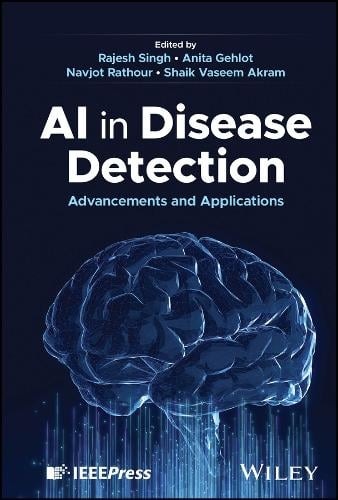
AI in disease detection : Advancements and applications
Discusses the integration of artificial intelligence to revolutionize disease detection approaches, with case studies of AI in disease detection as well as insight into the opportunities and challenges of AI in healthcare as a whole. The book explores a wide range of individual AI components such as computer vision, natural language processing, and machine learning as well as the development and implementation of AI systems for efficient practices in data collection, model training, and clinical validation.
AI in banking : Practical applications and case studies
Delves into the application of AI from theory to practice, offering detailed insights into AI project design and code implementation across eleven business scenarios in four major sectors: retail banking, e-banking, bank credit, and tech operations. it provides hands-on examples of various technologies, including automatic machine learning, integrated learning, graph computation, recommendation systems, causal inference, generative adversarial networks, supervised learning, unsupervised learning, computer vision, reinforcement learning, fuzzy control, automatic control, speech recognition, semantic understanding, bayesian networks, edge computing, and more. this book stands as a rare and practical guide to AI projects in the banking industry.
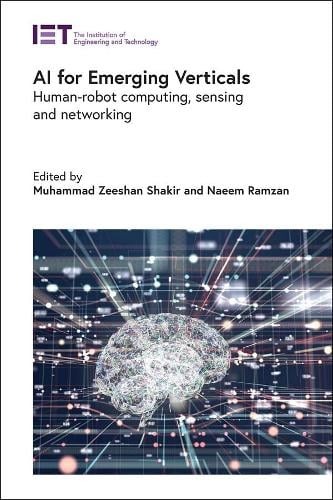
AI For Emerging Verticals : Human-robot computing, sensing and networking
Artificial intelligence (AI) and machine learning (ML) will play a major role. By adopting AI software and services, businesses can create predictive strategies, enhance their capabilities, better interact with customers, and streamline their business processes. Explores novel concepts and cutting-edge research and developments towards designing these fully automated advanced digital systems. Fostered by technological advances in artificial intelligence and machine learning, such systems potentially have a wide range of applications in robotics, human computing, sensing and networking. The chapters focus on models and theoretical approaches to guarantee automation in large multi-scale implementations of AI and ML systems; protocol designs to ensure AI systems meet key requirements for future services such as latency; and optimisation algorithms to leverage the trusted distributed and efficient complex architectures.
AI and UX : Why artificial intelligence needs user experience
Great effort has been put forth to continuously make AI “smarter.” But, will smarter always equal more successful AI? It is not just about getting a product to market, but about getting the product into a user’s hands in a form that will be embraced. This demands examining the product from the perspective of the user. Authors Gavin Lew and Robert Schumacher have written AI and UX to examine just how product managers and designers can best strike this balance. From exploring the history of the parallel journeys of AI and UX, to investigating past product examples and failures, to practical expert knowledge on how to best execute a positive user experience, AI and UX examines all angles of how AI can best be developed within a UX framework.
AI and IoT for smart city applications
Provides a valuable combination of relevant research works on developing smart city ecosystem from the artificial intelligence (AI) and Internet of things (IoT) perspective. The technical research works presented here are focused on a number of aspects of smart cities: smart mobility, smart living, smart environment, smart citizens, smart government, and smart waste management systems as well as related technologies and concepts. This edited book offers critical insight to the key underlying research themes within smart cities, highlighting the limitations of current developments and potential future directions.

AI 2020 : Advances in artificial intelligence ; 33rd Australasian Joint Conference, AI 2020, Canberra, ACT, Australia, November 29–30, 2020, Proceedings
Constitutes the proceedings of the 33rd Australasian Joint Conference on Artificial Intelligence, AI 2020, held in Canberra, ACT, Australia, in November 2020.* The 36 full papers presented in this volume were carefully reviewed and selected from 57 submissions. The paper were organized in topical sections named: applications; evolutionary computation; fairness and ethics; games and swarms; and machine learning.
AI 2008 : Advances in artificial intelligence ; 21st Australasian Joint Conference on Artificial Intelligence Auckland, New Zealand, December 1-5, 2008. Proceedings
This book constitutes the refereed proceedings of the 21th Australasian Joint Conference on Artificial Intelligence, AI 2008, held in Auckland, New Zealand, in December 2008.
AI 2007: Advances in artificial intelligence ; 20th Australian Joint Conference on Artificial Intelligence, Gold Coast, Australia, December 2-6, 2007, Proceedings
The book is organized in topical sections on machine learning, neural networks, evolutionary computing, constraint satisfaction, satisfiability, automated reasoning, knowledge discovery, robotics, social intelligence, ontologies and semanti.
AI 2006 : Advances in artificial intelligence ; 19th Australian Joint Conference on Artificial Intelligence, Hobart, Australia, December 4-8, 2006, Proceedings
This volume contains the proceedings of the 19th Australian Joint Conference on Artificial Intelligence (AI 2006) held at Hobart, Australia. AI 2006 received a record number of submissions, a total of 689 submissions from 35 countries. The papers in this volume give an indication of recent advances in artificial int- ligence. The topics covered include Machine Learning, Robotics, AI Applications, Planning, Agents, Data Mining and Knowledge Discovery, Cognition and User Interface, Vision and Image Processing, Information Retrieval and Search, AI in the Web, Knowledge Representation, Knowledge-Based Systems, and Neural Networks.

AI 2005 : Advances in artificial intelligence ; 18th Australian joint conference on artificial intelligence, Sydney, Australia, December 5-9, 2005, proceedings
The 18th Australian Joint Conference on Artificial Intelligence (AI 2005) was held at the University of Technology, Sydney (UTS), Sydney, Australia from 5 to 9 December 2005. AI 2005 attracted a historical record number of submissions, a total of 535 papers. This volume of the proceedings contains the abstracts of three keynote speeches and all the full and short papers. The full papers were categorized into three broad sections, namely: AI foundations and technologies, computational intelligence, and AI in specialized domains. AI 2005 also hosted several tutorials and workshops, providing an interacting mode for specialists and scholars from Australia and other countries.
Aging, shaking, and cracking of infrastructures : From mechanics to concrete dams and nuclear structures
Focuses on the safety assessment of existing structures subjected to multi-hazard scenarios through advanced numerical methods. Whereas the focus is on concrete dams and nuclear containment structures, the presented methodologies can also be applied to other large-scale ones. This book is composed of seven sections: Fundamentals: theoretical coverage of solid mechnics, plasticity, fracture mechanics, creep, / seismology, dynamic analysis, probability and statistics / Damage: that can affect concrete structures, such as cracking of concrete, AAR, chloride ingress, and rebar corrosion, / Finite Element: formulation for both linear and nonlinear analysis including stress, heat and fracture mechanics, / Engineering Models: for soil/fluid-structure interaction, uncertainty quantification, probablilistic and random finite element analysis, machine learning, performance based earthquake engineering, ground motion intensity measures, seismic hazard analysis, capacity/fragility functions and damage indeces, / Applications to dams through potential failure mode analyses, risk-informed decision making, deterministic and probabilistic examples, / Applications to nuclear structures through modeling issues, aging management programs, critical review of some analyses, / Other applications and case studies: massive RC structures and bridges, detailed assessment of a nuclear containment structure evaluation for license renewal.

Aggregation functions : A guide for practitioners
Aggregation of information is of primary importance in the construction of knowledge based systems in various domains, ranging from medicine, economics, and engineering to decision-making processes, artificial intelligence, robotics, and machine learning. This book gives a broad introduction into the topic of aggregation functions, and provides a concise account of the properties and the main classes of such functions, including classical means, medians, ordered weighted averaging functions, Choquet and Sugeno integrals, triangular norms, conorms and copulas, uninorms, nullnorms, and symmetric sums. It also presents some state-of-the-art techniques, many graphical illustrations and new interpolatory aggregation functions. A particular attention is paid to identification and construction of aggregation functions from application specific requirements and empirical data. This book provides scientists, IT specialists and system architects with a self-contained easy-to-use guide, as well as examples of computer code and a software package. It will facilitate construction of decision support, expert, recommender, control and many other intelligent systems.
Agent-oriented information systems II ; 6th International bi-conference workshop, AOIS 2004, Riga, Latvia, June 8, 2004 and New York, NY, USA, July 20, 2004, revised selected papers
Information systems have become the backbone of all kinds of organizations - day. In almost every sector – manufacturing, education, health care, government and businesses large and small – information systems are relied upon for - eryday work, communication, information gathering and decision-making. Yet, the in?exibilities in current technologies and methods have also resulted in poor performance, incompatibilities and obstacles to change. As many organizations are reinventing themselves to meet the challenges of global competition and e-commerce, there is increasing pressure to develop and deploy new technologies that are ?exible, robust and responsive to rapid and unexpected change. Agent concepts hold great promise for responding to the new realities of - formation systems. They o?er higher-level abstractions and mechanisms which address issues such as knowledge representation and reasoning, communication, coordination, cooperation among heterogeneous and autonomous parties, p- ception, commitments, goals, beliefs, intentions, etc., all of which need conc- tual modelling. On the one hand, the concrete implementation of these concepts can lead to advanced functionalities.
Advancing Computational Intelligence Techniques for Security Systems Design
Security systems have become an integral part of the building and large complex setups, and intervention of the computational intelligence (CI) paradigm plays an important role in security system architecture. This book covers both theoretical contributions and practical applications in security system design by applying the Internet of Things (IoT) and CI. It further explains the application of IoT in the design of modern security systems and how IoT blended with computational intel- ligence can make any security system improved and realizable. Focuses on the computational intelligence techniques of security system design / Covers applications and algorithms of discussed computational intelligence techniques / Includes convergence-based and enterprise integrated security systems with their applications / Explains emerging laws, policies, and tools affecting the landscape of cyber security / Discusses application of sensors toward the design of security systems

Advances in web mining and web usage analysis ; 8th International workshop on knowledge discovery on the web, WebKDD 2006 Philadelphia, USA, August 20, 2006 Revised Papers
The discipline of data mining delivers methodologies and tools for the an- ysis of large data volumes and the extraction of comprehensible and non-trivial insights from them. Web mining, a much younger discipline, concentrates on the analysisofdata pertinentto the Web.Web mining methods areappliedonusage data and Web site content; they strive to improve our understanding of how the Web is used, to enhance usability and to promote mutual satisfaction between e-business venues and their potential customers.Many ofthe infancy problems in Web mining have been solvedby now, but the tremendous potential for new and improved uses, as well as misuses, of the Web are leading to new challenges.

Advances in Visual Information Systems ; 9th International Conference, VISUAL 2007 Shanghai, China, June 28-29, 2007 Revised Selected Papers
The visual information systems paradigm continues to evolve, and the unrelenting exponential growth in the amount of digital visual data underlines the escalating importance of how such data are effectively managed and deployed.It covered image and video retrieval, visual biometrics, intelligent visual information processing, visual data mining, ubiquitous and mobile visual information systems, visual semantics, 2D/3D graphical visual data retrieval and applications of visual information systems.
