



الصفحة 31
الصفحة 31
Markov Processes, Brownian Motion, and Time Symmetry
The book consists of two parts. Part I,This part introduces strong Markov processes and their potential theory. In particular,it studies Brownian motion, and shows how it generates classical potential theory.Part II, focus on the effects of time reversal, duality, and time-symmetry on potential theory. Certain theorems in Part I are re-proved in Part II under slightly weaker hypotheses. The volume is very useful for people who wish to learn Markov processes but it seems to the reviewer that it is also of great interest to specialists in this area who could derive much stimulus from it. One can be convinced that it will receive wide circulation." (Mathematical Reviews)
Markets, Games, and Strategic Behavior : An Introduction to Experimental Economics
This is the perfect book for any undergraduate course in experimental economics or behavioral game theory. New material on topics such as matching, belief elicitation, repeated games, prospect theory, probabilistic choice, macro experiments, and statistical analysis Participatory experiments that connect behavioral theory and laboratory research Largely self-contained chapters that can each be covered in a single class Guidance for instructors on setting up classroom experiments, with either hand-run procedures or free online software End-of-chapter problems, including some conceptual-design questions, with hints or partial solutions provided
Market-Consistent Actuarial Valuation
It is a challenging task to read the balance sheet of an insurance company. This derives from the fact that different positions are often measured by different yardsticks. Assets, for example, are mostly valued at market prices whereas liabilities are often measured by established actuarial methods. Market-Consistent Actuarial Valuation presents powerful methods to measure liabilities and assets in the same way. The mathematical framework that leads to market-consistent values for insurance liabilities is explained in detail by the authors. Topics covered are Stochastic discounting, Valuation portfolio in life and non-life insurance, Asset and liability management, Financial risks, Insurance technical risks, and Solvency.

Marine resource damage assessment : Liability and compensation for environmental damage
MARE-DASM research focused on: (i) the estimation and distribution of marine contaminants in order to assess their long term effects (ecotoxicology); (ii) the integration of these result into a Biological Effects SubModel and a mathematical model assessing the risks associated with accidental spillage of oil at sea and the damage this can cause (modelling); (iii) the assessment of the willingness to pay for ecological damage, based on the Contingent Valuation Method (economics); (iv) the development and evaluation of measures to be taken in order to guarantee a sustainable use of the Belgian part of the North Sea, taking into account the economic and social interests and values (social economics); (v) the potential to develop technical and legal procedures that allow ecological damage to the marine environment to be evaluated and compensated, taking into account constraints in national and international liability legislation (legal).
Maple and Mathematica : A Problem Solving Approach for Mathematics
the history of mathematics there are many situations in which cal- lations were performed incorrectly for important practical applications. the history of computing the number began in Egypt and Babylon about 2000 years BC, since then many mathematicians have calculated (e. g. , Archimedes, Ptolemy, Vi` ete, etc. ). In modern mathematics there exist computers that can perform various mathematical operations for which humans are incapable. Therefore the computers can be used to verify the results obtained by humans, to discovery new results, to - prove the result sthatahumancanobtain without anytechnology
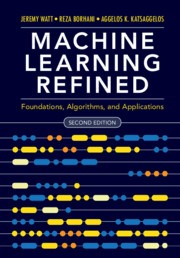
Machine Learning Refined : Foundations, Algorithms, and Applications
Provides students with the fundamental knowledge and practical tools needed to conduct research and build data-driven products. The authors prioritize geometric intuition and algorithmic thinking, and include detail on all the essential mathematical prerequisites, to offer a fresh and accessible way to learn. Practical applications are emphasized, with examples from disciplines including computer vision, natural language processing, economics, neuroscience, recommender systems, physics, and biology.
Machine Learning for Audio, Image and Video Analysis : Theory and Applications
The book is organized in four parts: The first focuses on technical aspects, basic mathematical notions and elementary machine learning techniques. The second provides an extensive survey of most relevant machine learning techniques for media processing, while the third part focuses on applications and shows how techniques are applied in actual problems. The fourth part contains detailed appendices that provide notions about the main mathematical instruments used throughout the text

Machine Learning and Knowledge Discovery in Databases ; European Conference, ECML PKDD 2008, Antwerp, Belgium, September 15-19, 2008, Proceedings, Part II
Constitutes the refereed proceedings of the joint conference on Machine Learning and Knowledge Discovery in Databases: ECML PKDD 2008, held in Antwerp, Belgium, in September 2008.The 100 papers presented in two volumes, together with 5 invited talks, were carefully reviewed and selected from 521 submissions. In addition to the regular papers the volume contains 14 abstracts of papers appearing in full version in the Machine Learning Journal and the Knowledge Discovery and Databases Journal of Springer.
Macchine matematiche : Dalla storia alla scuola = Mathematical Machines: From History to School
Presents the main mathematical machines for drawing curves, for applying geometrical transformations or for making classical perspectives.The publication constitutes an example of how history of mathematics may be useful for teaching today’s mathematics.
Loop Spaces, Characteristic Classes and Geometric Quantization
This book deals with the differential geometry of manifolds, loop spaces, line bundles and groupoids, and the relations of this geometry to mathematical physics. Various developments in mathematical physics (e.g., in knot theory, gauge theory, and topological quantum field theory) have led mathematicians and physicists to search for new geometric structures on manifolds and to seek a synthesis of ideas from geometry, topology and category theory. In this spirit, this book develops the differential geometry associated to the topology and obstruction theory of certain fiber bundles (more precisely, associated to grebes). The theory is a 3-dimensional analog of the familiar Kostant--Weil theory of line bundles. In particular the curvature now becomes a 3-form.
Long Memory in Economics
When applying the statistical theory of long range dependent (LRD) processes to economics, the strong complexity of macroeconomic and financial variables, compared to standard LRD processes, becomes apparent. In order to get a better understanding of the behaviour of some economic variables, the book assembles three different strands of long memory analysis: statistical literature on the properties of, and tests for, LRD processes; mathematical literature on the stochastic processes involved; models from economic theory providing plausible micro foundations for the occurence of long memory in economics. Each chapter of the book will give a comprehensive survey of the state of the art and the directions that future developments are likely to take. Taken as a whole the book provides an overview of LRD processes which is accessible to economists, econometricians and statisticians.

Logics in Artificial Intelligence ; 11th European Conference, JELIA 2008, Dresden, Germany, September 28-October 1, 2008. Proceedings
Constitutes the refereed proceedings of the 11th European Conference on Logics in Artificial Intelligence, JELIA 2008, held in Dresden, Germany, Liverpool, in September/October 2008.The 32 revised full papers presented together with 2 invited talks were carefully reviewed and selected from 98 submissions. The papers cover a broad range of topics including belief revision, description logics, non-monotonic reasoning, multi-agent systems, probabilistic logic, and temporal logic.

Logic-Based Program Synthesis and Transformation ; 17th International Symposium, LOPSTR 2007, Kongens Lyngby, Denmark, August 23-24, 2007, Revised Selected Papers
Contains a selectionofthe the paperspresentedatthe 17thInter- tional Symposium on Logic-Based Program Synthesis and Transformation, that was held in Kongens Lyngby, Denmark, August 23-24,2007. LOPSTR thus traditionally solicits papers in the areas of: specification, synthesis, verification, transformation, analysis, optimization, composition, security, reuse, applications andtools, component-baseds of tware development, software architectures, age- based software development and program refnement. Formal proceedings are produced only after the symposium, so that authors can incorporate this feed back in the published papers.
Logica Universalis : Towards a General Theory of Logic
Signifies the arrival of a new renaissance in logic, a new revival not only of logic, but of the vision of logic as a unifying tool for science as a whole, including mathematics, physics, cosmology, computer science and AI. The book and the vision behind it give logic, conceived as a scientific study of rationality, new unifying power, new perspectives, and new horizons.Universal Logic is not a new logic, but a general theory of logics, considered as mathematical structures. The name was introduced about ten years ago, but the subject is as old as the beginning of modern logic: Alfred Tarski and other Polish logicians such as Adolf Lindenbaum developed a general theory of logics at the end of the 1920s based on consequence operations and logical matrices. The subject was revived after the flowering of thousands of new logics during the last thirty years: there was a need for a systematic theory of logics to put some order in this chaotic multiplicity.

Logic, language, information and computation ; 15th International Workshop, WoLLIC 2008 Edinburgh, UK, July 1-4, 2008 Proceedings
The papers cover all pertinent subjects in computer science with particular interest in cross-disciplinary topics. Typical areas of interest are: foundations of computing and programming; novel computation models and paradigms; broad notions of proof and belief; formal methods in software and hardware development; logical approach to natural language and reasoning; logics of programs, actions and resources; foundational aspects of information organization, search, flow, sharing, and protection.
Logic Programming ; Vol. 3668 : 21st International Conference, ICLP 2005, Sitges, Spain, October 2-5, 2005, Proceedings
This volume contains the proceedings of the 21st International Conference on Logic Programming which was held in Sitges (Barcelona), Spain, from October 2nd to 5th, 2005. The conference was colocated with the International Conf- ence on ConstraintProgramming(CP 2005)and the following 6 post-conference workshops: – CICLOPS 2005: Colloquium on Implementation of Constraint and Logic Programming Systems – CSLP 2005: Constraint Solving and Language Processing – WCB 2005: Constraint Based Methods for Bioinformatics – WLPE 2005: Logic-Based Methods in Programming Environments – MoVeLog 2005: Mobile Code Safety and Program Veri?cation Using C- putational Logic Tools – CHR 2005: Constraint Handling Rules The conferencecoincided with a solareclipse

Logic programming ; 23rd International Conference, ICLP 2007, Porto, Portugal, September 8-13, 2007, Proceedings
The 22 revised full papers together with two invited talks, 15 poster presentations, and the abstracts of five doctoral consortium articles cover all issues of current research in logic programming, including theory, functional and constraint logic programming, program analysis, answer-set programming, semantics, and applications.

Logic Programming : 24th International Conference, ICLP 2008 Udine, Italy, December 9-13 2008 Proceedings
The 35 revised full papers together with 2 invited talks, 2 invited tutorials, 11 papers of the co-located first Workshop on Answer Set Programming and Other Computing Paradigms (ASPOCP 2008), as well as 26 poster presentations and the abstracts of 11 doctoral consortium articles were carefully reviewed and selected from 177 initial submissions. The papers cover all issues of current research in logic programming - they are organized in topical sections on applications, algorithms, systems, and implementations, semantics and foundations, analysis and transformations, CHRs and extensions, implementations and systems, answer set programming and extensions, as well as constraints and optimizations.

Logic for Programming, Artificial Intelligence, and Reasoning ; 15th International Conference, LPAR 2008, Doha, Qatar, November 22-27, 2008. Proceedings
This book constitutes the refereed proceedings of the 15th International Conference on Logic for Programming, Artificial Intelligence, and Reasoning, LPAR 2008, which took place in Doha, Qatar, during November 22-27, 2008.The 45 revised full papers presented together with 3 invited talks were carefully revised and selected from 153 submissions. The papers address all current issues in automated reasoning, computational logic, programming languages and their applications and are organized in topical sections on automata, linear arithmetic, verification knowledge representation, proof theory, quantified constraints, as well as modal and temporal logics.
Logic for Computer Scientists
This book introduces the notions and methods of formal logic from a computer science standpoint, covering propositional logic, predicate logic, and foundations of logic programming. It presents applications and themes of computer science research such as resolution, automated deduction, and logic programming in a rigorous but readable way.The style and scope of the work, rounded out by the inclusion of exercises, make this an excellent textbook for an advanced undergraduate course in logic for computer scientists.
