



الصفحة 30
الصفحة 30

Feasibility studies : An architect's guide
Details the benefits of a feasibility study. Once you’ve secured the commission, how do you ensure you’re following current best practice? Aimed at architects, it identifies the pitfalls involved in undertaking a feasibility study and explains how to set boundaries, organise the process and manage clients’ aspirations. By featuring recent live projects, alongside advice from successful architectural practices, it illustrates how a feasibility study can help achieve positive outcomes and avoid the dangers of a poorly defined brief and service proposal. Presenting the client’s, as well as the architect’s, perspective, this publication highlights why a feasibility study is a sensible way of establishing viability prior to committing to a full-service commission. It underlines the significance of ‘adding value’ as an architect.

FastSLAM : A Scalable Method for the Simultaneous Localization and Mapping Problem in Robotics
This monograph describes a new family of algorithms for the simultaneous localization and mapping problem in robotics (SLAM). SLAM addresses the problem of acquiring an environment map with a roving robot, while simultaneously localizing the robot relative to this map. This problem has received enormous attention in the robotics community in the past few years, reaching a peak of popularity on the occasion of the DARPA Grand Challenge in October 2005, which was won by the team headed by the authors. The FastSLAM family of algorithms applies particle filters to the SLAM Problem, which provides new insights into the data association problem that is paramount in SLAM. The FastSLAM-type algorithms have enabled robots to acquire maps of unprecedented size and accuracy, in a number of robot application domains and have been successfully applied in different dynamic environments, including the solution to the problem of people tracking.

Fast Simulation of Electro-Thermal MEMS : Efficient Dynamic Compact Models
Fast Simulation of Electro-Thermal MEMS provides the reader with a complete methodology and software environment for creating efficient dynamic compact models for electro-thermal MEMS devices. It supplies the basic knowledge and understanding for using model order reduction at the engineering level. Emphasis is placed on the application of the Arnoldi method for effective order reduction of thermal systems. This tutorial is written for MEMS engineers and is enriched with many case studies which equip readers with the know-how to facilitate the simulation of a specific problem.

Farming for Health : Green-Care Farming Across Europe and the United States of America
Farming for Health describes the utilization of agricultural farms, farm animals, plants and landscapes as a base for promoting human mental and physical health and social well-being. This book gives an overview of the development of ‘Farming for Health’ initiatives across Europe. This development is a logical result of the changing paradigms in the health-care sector and the demand for new social and financial impulses in agriculture and rural areas.

Farewell to the Internal Clock : A contribution in the field of chronobiology
Nearly everything making up what we call the “environment” of a plant has an infuence on the way it grows. Sunlight, te- perature, moisture contents of soil and atmosphere and vib- tions are all obvious examples of environmental components, and transient variations in their amount or intensity lead the plant to manifest more or less immediate responses. Small changes in carbon dioxide level in the atmosphere can even have effects, but these take a longer time to be registered – at least those that are visible, albeit at the microscopic level. Plants meet the challenges of the environment by means of acclimation. In this respect, plants are notable for the pl- ticity of their development. However, where morphological or physiological plasticity is no longer an option, the responses would be by means of adaptations as a result of genetic - lection or genetic “assimilation” (Waddington 1957).

Famine Early Warning Systems and Remote Sensing Data
This book describes the interdisciplinary work of USAID’s Famine Early Warning System Network (FEWS NET) and its in uence on how food security crises are identi ed, documented and the kind of responses that result. The book describes FEWS NET’s systems and methods for using satellite remote sensing to identify and describe how biophysical hazards impact the lives and livelihoods of the po- lation where they occur. It presents several illustrative case studies that will dem- strate the integration of both physical and social science disciplines in its work. FEWS NET’s operational needs have driven science in biophysical remote sensing applications through its collaboration with the US Geological Survey, the National Aeronautics and Space Administration, National Oceanographic and Atmospheric Administration, and US Department of Agriculture, as well as methodologies in the social science domain through its support of the US Agency for International - velopment, UN World Food Program and numerous international non-governmental organizations such as Save the Children, Oxfam and others. Because FEWS NET is an organization that must provide a global picture of food insecurity to decision makers, the information it relies on are by necessity - servable and able to be documented.

Failure rate modelling for reliability and risk
Failure Rate Modelling for Reliability and Risk focuses on reliability theory and, specifically, on the failure rate (the hazard rate, the force of mortality) modelling and its generalizations, on systems operating in a random environment and on repairable systems. The failure rate is one of the crucial probabilistic characteristics for a number of disciplines; including reliability, survival analysis, risk analysis and demography.

Extremes in Nature : An Approach Using Copulas
The study of the statistics of extreme events is an essential first step in the mitigation of natural catastrophies, that often cause severe economic losses worldwide. This book is about the theoretical and practical aspects of the statistics of Extreme Events in Nature. Most importantly, this is the first text in which Copulas are introduced and used in Geophysics. Several topics are fully original, and show how standard models and calculations can be improved by exploiting the opportunities offered by Copulas. In addition, new quantities useful for design and risk assessment are introduced. Practicioners in all research areas of Geosciences and extreme events (including Finance and Insurance, closely related to natural disasters) will definitely benefit from the new Copula-approach outlined in the book.

Extreme Weather Events and Public Health Responses
In February 2004, the WHO Regional Office for Europe and the European Environment Agency organized an expert meeting to exchange information and develop recommendations on public health and environmental responses to weather and climate extremes, floods, heat-waves and cold spells. The meeting was kindly hosted by the Ministry of Health of Slovakia. The meeting recommendations were adopted at the Fourth Ministerial Conference on Environment and Health, Budapest, Hungary, 2004.

Extreme Ocean Waves
The book details the vast progress that has been achieved in the understanding of the physical mechanisms of rogue wave phenomenon in recent years. The selected articles address such issues as the formation of freak waves due to modulation instability of nonlinear wave field, physical and statistical properties of rogue wave generation in deep water and in shallow water, various models of nonlinear water waves, special analysis of nonlinear resonances between water waves and the relation between observations and freak wave theories.

Extreme Hydrological Events : New Concepts for Security
This proceedings contains the papers which were presented at the NATO Advanced Research Workshop (ARW) on Extreme Hydrological Events: New Concepts for Security, which was held in Novosibirsk, Russia, from July 11-15, 2005. The workshop fell within the NATO priority research topic on Environmental Security, Disaster Forecast and Prevention. At the present time, the necessity of considerable deepening of our understanding about the nature of extreme and catastrophic natural and man-induced events, in particular hydrologic ones, becomes very topical, as well as the development of advanced methods for their prediction, including estimating probability of their occurrence and a risk related to them.

Extreme Conflict and Tropical Forests
At a time when the international community is devoting significant attention to the issue of governance as a key factor in global environmental decline, this book provides a timely insight into the relationships between extreme conflict, the international trade in forest products, and the social, economic and environmental condition of tropical forests and their human communities. Drawing on the expertise of both natural and social scientists, Extreme Conflict and Tropical Forests explores the underlying causes and the social and environmental consequences of conflict in tropical forest areas. Case studies from Africa, Asia and Latin America present a range of issues – from illicit crops and ‘conflict timber’ production, to the potential of peace parks for improving human security, social quality and biodiversity conservation.

Extinction governance, finance and accounting : Implementing a species protection action plan for the financial markets
The book presents plans, metrics, frameworks, mechanisms and financial innovations that can be, and are being, implemented through the financial markets in order to save and protect species, enhance biodiversity and, at the same time, preserve the financial markets and the business world.

Exploring Resilience : A Scientific Journey from Practice to Theory
Resilience has become an important topic on the safety research agenda and in organizational practice. Most empirical work on resilience has been descriptive, identifying characteristics of work and organizing activity which allow organizations to cope with unexpected situations. Fewer studies have developed testable models and theories that can be used to support interventions aiming to increase resilience and improve safety. In addition, the absent integration of different system levels from individuals, teams, organizations, regulatory bodies, and policy level in theory and practice imply that mechanisms through which resilience is linked across complex systems are not yet well understood. Scientific efforts have been made to develop constructs and models that present relationships; however, these cannot be characterized as sufficient for theory building. There is a need for taking a broader look at resilience practices as a foundation for developing a theoretical framework that can help improve safety in complex systems.
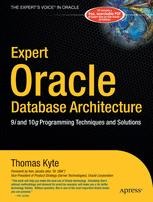
Expert Oracle Database Architecture : 9i and 10g Programming Techniques and Solutions
This is a defining book on the Oracle database for any developer or database administrator who works with Oracle-driven database applications. Tom Kyte has a simple philosophy: you can treat Oracle as a black box and just stick data into it or you can understand how it works and exploit it as a powerful computing environment. If you choose the latter, then you will find that there are few information management problems that you cannot solve quickly and elegantly. Expert Oracle Database Architecture is the first of a three-book series that completely explores and defines the Oracle database. It covers all of the most important Oracle architecture features, including: Files, memory structures and processes / Locking and latching / Transactions, concurrency and multi-versioning / Tables and Indexes / Datatypes / Partitioning and parallelism Each feature is taught in a proof-by-example manner, not only discussing what it is, but also how it works, how to implement software using it, and the common pitfalls associated with it.

Expert Oracle
Thomas Kyte has a simple philosophy: You can treat Oracle as a black box and shove data inside of it, or you can learn how Oracle works and exploit it as a powerful computing environment. If you choose the latter, you will see there are few information management problems you cannot solve quickly and elegantly. Kyte has selected the most important features and techniques to discuss in Expert One-on-One Oracle, which he teaches in a proof-by-example manner. He discusses available features, implementing software using these features, and avoiding potential pitfalls.

Expert ASP.NET 2.0 Advanced Application Design
Expert ASP.NET 2.0 Advanced Application Design will help you derive maximum performance and reliability from the distributed applications you create with ASP.NET 2.0. The book first looks at some of the non-functional requirements that impact the design of a distributed application. It then relates them to the servers and services available in the .NET 2.0 Framework. ASP.NET 2.0 is the central process for use in distributed .NET applications, and the book closely examines the ASP.NET 2.0 Framework and its hosting environment, Internet Information Server (IIS). The book looks at how ASP.NET 2.0 is used by different packages within .NET (like Web Services), and explores how it can be extended to meet your own custom requirements.

Expert .NET Delivery Using NAnt and CruiseControl.NET
This book is a guide to the implementation of good processes in a .NET environment. Author Marc Holmes focuses on actual implementation, and details patterns and anti-patterns to watch out for. He also provides a practical and in-depth look at NAnt and CruiseControl.NET, and solutions to common problem scenarios.

Experimental vibration analysis for civil structures : Testing, sensing, monitoring, and control
Covers a wide range of topics in the areas of vibration testing, instrumentation, and analysis of civil engineering and critical infrastructure. It explains how recent research, development, and applications in experimental vibration analysis of civil engineering structures have progressed significantly due to advancements in the fields of sensor and testing technologies, instrumentation, data acquisition systems, computer technology, computational modeling and simulation of large and complex civil infrastructure systems. The book also examines how cutting-edge artificial intelligence and data analytics can be applied to infrastructure systems.

Experimental rock deformation : The brittle field
The primary aim of this monograph is to present the current knowledge of brittle properties of rocks as determined in laboratory experiments. The principal aspects of brittle behavior are described with special attention to the fundamental physical aspects. Thus, the book provides a useful introduction to the basics of rock properties for engineering and earth science applications. Furthermore, it serves as a guide for graduate students and non specialists by presenting the relevant background material and where it can be found. For the new edition a further chapter has been added, and almost
