



الصفحة 30
الصفحة 30

Architectural atmospheres : On the experience and politics of architecture
Addresses the growing awareness of the atmospheric dimension of architecture and provides a current, programmatic discussion of this topic. What possibilities does this approach open to architecture, what value does this knowledge have? Three essays and a conversation lead a cross-discipline discussion on the impact of architecture, and contribute to the debate first initiated by Peter Zumthor. The texts are accompanied by approximately forty color images that capture architectural moods in a variety of ways

Arabic and Chinese Handwriting Recognition ; SACH 2006 Summit College Park, MD, USA, September 27-28, 2006 Selected Papers
Cheriet provides an overview of the problems of Arabic recognition and how systems can use natural language processing techniques to correct errors in lexicon-based systems.

Arabic AI-generated adverts = إعلانات عربية مولدة بالذكاء الاصطناعي
In the ever-evolving landscape of digital marketing, our groundbreaking platform emerges, harnessing the power of artificial intelligence to revolutionize the creation of marketing campaigns. This innovative solution seamlessly combines neural networks, natural language generation, and multimedia processing capabilities to generate comprehensive and personalized marketing assets from a single product image. At its core, the platform leverages deep learning models that analyze the visual characteristics of the uploaded product image and identifies key features and attributes to define the product category, this enables the generation of compelling and persuasive marketing content tailored to the specific product. The platform's multi-faceted approach encompasses three distinct components: text generation, poster creation, and video advertisement production. Utilizing advanced natural language generation techniques, it crafts engaging marketing text that captures the essence and unique selling points of the product. Simultaneously, its image processing capabilities produce visually stunning promotional posters that blend the product image with eye-catching graphics and typography. along with creating captivating video advertisements optimized for social media and online advertising campaigns.

Applied scanning probe methods IV : Industrial applications
The sc- ning probes emerged as a new - strument for imaging with a p- cision suf?cient to delineate single atoms. At first there were two – the Scanning Tunneling Microscope, or STM, and the Atomic Force Mic- scope, or AFM. The STM relies on electrons tunneling between tip and sample whereas the AFM depends on the force acting on the tip when it was placed near the sample. These were quickly followed by the M- netic Force Microscope, MFM, and the Electrostatic Force Microscope, EFM. The MFM will image a single magnetic bit with features as small as 10nm. With the EFM one can monitor the charge of a single electron.

Applied scanning probe methods III : Characterization
The sc- ning probes emerged as a new - strument for imaging with a p- cision suf?cient to delineate single atoms. At first there were two – the Scanning Tunneling Microscope, or STM, and the Atomic Force Mic- scope, or AFM. The STM relies on electrons tunneling between tip and sample whereas the AFM depends on the force acting on the tip when it was placed near the sample. These were quickly followed by the M- netic Force Microscope, MFM, and the Electrostatic Force Microscope, EFM. The MFM will image a single magnetic bit with features as small as 10nm. With the EFM one can monitor the charge of a single electron.

Applied scanning probe methods II : Scanning probe microscopy techniques
The sc- ning probes emerged as a new - strument for imaging with a p- cision suf?cient to delineate single atoms. At first there were two – the Scanning Tunneling Microscope, or STM, and the Atomic Force Mic- scope, or AFM. The STM relies on electrons tunneling between tip and sample whereas the AFM depends on the force acting on the tip when it was placed near the sample. These were quickly followed by the M- netic Force Microscope, MFM, and the Electrostatic Force Microscope, EFM. The MFM will image a single magnetic bit with features as small as 10nm. With the EFM one can monitor the charge of a single electron.

Applied Pattern Recognition
The main goal of this book is to cover some of the latest application domains of pattern recognition while presenting novel techniques that have been developed or customized in those domains.
Applied Partial Differential Equations : A Visual Approach
This book presents selected topics in science and engineering from an applied-mathematics point of view. The described natural, socioeconomic, and engineering phenomena are modeled by partial differential equations that relate state variables.

Applied Informatics; Third International Conference, ICAI 2020, Ota, Nigeria, October 29–31, 2020, Proceedings
This book constitutes the thoroughly refereed papers of the Second International Conference on Applied Informatics, ICAI 2020, held in Ota, Nigeria, in October 2020. The 35 full papers were carefully reviewed and selected from 101 submissions. The papers are organized in topical sections on artificial intelligence; business process management; cloud computing; data analysis; decision systems; health care information systems; human-computer interaction; image processing; learning management systems; software design engineering.
Applied Graph Theory in Computer Vision and Pattern Recognition
It presents the application of graph theory to low-level processing of digital images, presents graph-theoretic learning algorithms for high-level computer vision and pattern recognition applications, and provides detailed descriptions of several applications of graph-based methods to real-world pattern recognition tasks.

Applied Charged Particle Optics
Authored by a pioneer of the field, this overview of charged particle optics provides a solid introduction to the field for all physicists wishing to design their own apparatus or better understand the instruments with which they work. Applied Charged Particle Optics begins by introducing electrostatic lenses and fields used for acceleration, focussing and deflection of ions or electrons. Subsequent chapters give detailed descriptions of electrostatic deflection elements, uniform and non-uniform magnetic sector fields, image aberrations, and, finally, fringe field confinement. A chapter on applications is added.

Applied and computational mathematics for digital environments
Contains the 11 papers that were accepted and published in the Special Issue “Applied and Computational Mathematics for Digital Environments” of the MDPI Mathematics journal. The topics of interest include, among others, scientific research, applied tasks, and problems in the following areas: The construction of mathematical and information models of intelligent computer systems for monitoring and controlling the parameters of digital environments; The development of intelligent optimization algorithms that search for optimal parameter values of mathematical and information models in digital environments; Software and mathematical technologies in the implementation of intelligent monitoring and computer control of the parameters of digital environments; The development and application of mathematical and information models, machine learning methods, and artificial intelligence for the analysis and processing of big data in digital environments.

Applications of Fuzzy Sets Theory ; 7th International Workshop on Fuzzy Logic and Applications, WILF 2007, Camogli, Italy, July 7-10, 2007, Proceedings
The book is organized in topical sections on fuzzy set theory, fuzzy information access and retrieval, fuzzy machine learning, fuzzy architectures and systems; and special sessions on intuitionistic fuzzy sets and soft computing in image processing.

Applications of evolutionary computing ; Vol. 3907 : EvoWorkshops 2006: EvoBIO, EvoCOMNET, EvoHOT, EvoIASP, EvoINTERACTION, EvoMUSART, and EvoSTOC, Budapest, Hungary, April 10-12, 2006, Proceedings
This book constitutes the refereed joint proceedings of seven workshops on evolutionary computing, EvoWorkshops 2006, held in Budapest, Hungary, in April 2006. The 65 revised full papers and 13 revised short papers presented were carefully reviewed and selected from a total of 149 submissions. In accordance with the seven workshops covered, the papers are organized in topical sections on evolutionary bioinformatics, evolutionary computation in communications, networks, and connected systems, evolutionary computation in hardware optimization, evolutionary computation in image analysis and signal processing, interactive evolution and humanized computational intelligence, evolutionary music and art, and evolutionary algorithms in stochastic and dynamic environments.

Applications of evolutionary computing ; Vol. 3449 ; Evoworkshops : EvoBIO, EvoCOMNET, EvoHot, EvoIASP, EvoMUSART, and EvoSTOC
Evolutionary computation (EC) techniques are e?cient nature-inspired pl- ning and optimization methods based on the principles of natural evolution and genetics. Due to their e?ciency and the simple underlying principles, these methods can be used for a large number of problems in the context of problem solving,optimization,andmachinelearning. Alargeandcontinuouslyincreasing number of researchers and practitioners make use of EC techniques in many - plication domains. The book at hand presents a careful selection of relevant EC applications combined with thorough examinations of techniques for a successful application of EC. The presented papers illustrate the current state of the art in the application of EC and should help and inspire researchers and practitioners to develop e?cient EC methods for design and problem solving.

Applications of evolutionary computing ; EvoWorkshops 2008 : EvoCOMNET, EvoFIN, EvoHOT, EvoIASP, EvoMUSART, EvoNUM, EvoSTOC, and EvoTransLog, Naples, Italy, March 26-28, 2008. Proceedings
This volume presents a careful selection of relevant EC examples combined with a thorough examination of the techniques used in EC. The papers in the volume illustrate the current state of the art in the application of EC and should help and - spire researchers and professionals to develop e?cient EC methods for design and problem solving.

Applications of evolutionary computing ; EvoWorkshops 2007 : EvoCOMNET, EvoFIN, EvoIASP, EvoINTERACTION, EvoMUSART, EvoSTOC, and EvoTransLog, Valencia, Spain, April 11-13, 2007, Proceedings
This volume contains contributions for EvoCOMNET, EvoFIN, EvoIHOT, EvoMUSART, EvoSTIM, and EvoTRANSLOC. The 51 revised full papers presented were carefully reviewed and selected from numerous submissions. This volume presents an overview about the latest research in EC. Areas where evolutionary computation techniques have been applied range from telecommunication networks to complex systems, finance and economics, games, image analysis, evolutionary music and art, parameter optimization, scheduling, and logistics. These papers may provide guidelines to help new researchers tackling their own problem using EC.

Applications and Usability of Interactive TV; 8th Iberoamerican Conference, jAUTI 2019, Rio de Janeiro, Brazil, October 29–November 1, 2019, Revised Selected Papers
This book constitutes the refereed proceedings of the 8th Iberoamerican Conference on Applications and Usability of Interactive Television, jAUTI 2019, in Rio de Janeiro, Brazil, in October 2019. The 10 full papers presented were carefully reviewed and selected from 35 submissions. The papers are organized in topical sections on Design and Development; Second Screen and Crossmedia; Interaction Techniques and Technologies; Accessibility; User Experience.

Application and theory of multimedia signal processing using machine learning or advanced methods
Consists of a collection of peer-reviewed published papers on various advanced technology researches related to signal processing applications and theories for multimedia systems using machine learning or advanced methods. Multimedia signals include image, video, audio, character recognition, and communication channel optimization for networks. The specific contents included in this book are data hiding, encryption, object detection, image classification, and character recognition.
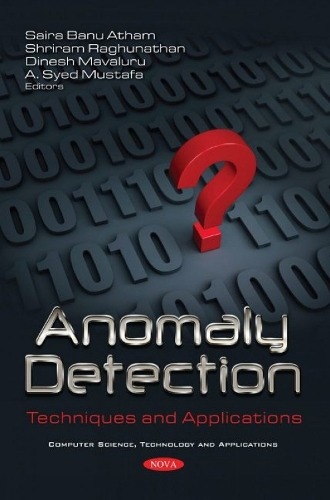
Anomaly Detection : Techniques and Applications
When information in the data warehouse is processed, it follows a definite pattern. An unexpected deviation in the data pattern from the usual behavior is called an anomaly. The anomaly in the data is also referred to as noise, outlier, spammer, deviations, novelties and exceptions. Identification of the rare items, events, observations, patterns which raise suspension by differing significantly from the majority of data is called anomaly detection. With progress in the technologies and the widespread use of data for the purpose for business the increase in the spams faced by the individuals and the companies are increasing day by day. This noisy data has boomed as a major problem in various areas such as Internet of Things, web service, Machine Learning, Artificial Intelligence, Deep learning, Image Processing, Cloud Computing, Audio processing, Video Processing, VoIP, Data Science, Wireless Sensor etc. Identifying the anomaly data and filtering them before processing is a major challenge for the data analyst. This anomaly is unavoidable in all areas of research. This book covers the techniques and algorithms for detecting the deviated data.
