



الصفحة 3
الصفحة 3

Control and Observer Design for Nonlinear Finite and Infinite Dimensional Systems
This volume presents a well balanced combination of state-of-the-art theoretical results in the field of nonlinear controller and observer design, combined with industrial applications stemming from mechatronics, electrical, (bio–) chemical engineering, and fluid dynamics. The unique combination of results of finite as well as infinite–dimensional systems makes this book a remarkable contribution addressing postgraduates, researchers, and engineers both at universities and in industry. The contributions to this book were presented at the Symposium on Nonlinear Control and Observer Design: From Theory to Applications (SYNCOD), held September 15–16, 2005, at the University of Stuttgart, Germany.

Computational Mind : A Complex Dynamics Perspective
Computational Mind: A Complex Dynamics Perspective is a graduate–level monographic textbook in the field of Computational Intelligence. It presents a modern dynamical theory of the computational mind, combining cognitive psychology, artificial and computational intelligence, and chaos theory with quantum consciousness and computation. The book introduces to human and computational mind, comparing and contrasting main themes of cognitive psychology, artificial and computational intelligence. It presents brain/mind dynamics from the chaos theory perspective, including sections on chaos in human EEG, basics of nonlinear dynamics and chaos, techniques of chaos control, synchronization in chaotic systems and complexity in humanoid robots. This book presents modern theory of quantum computational mind, including sections on Dirac–Feynman quantum dynamics, quantum consciousness, and quantum computation using Josephson junctions. The book is designed as a one–semester course for computer scientists, engineers, physicists and applied mathematicians, both in industry and academia. It includes a strong bibliography on the subject and detailed index.

Collective Dynamics of Nonlinear and Disordered Systems
Phase transitions in disordered systems and related dynamical phenomena are a topic of intrinsically high interest in theoretical and experimental physics. This book presents a unified view, adopting concepts from each of the disjoint fields of disordered systems and nonlinear dynamics. Special attention is paid to the glass transition, from both experimental and theoretical viewpoints, to modern concepts of pattern formation, and to the application of the concepts of dynamical systems for understanding equilibrium and nonequilibrium properties of fluids and solids. The content is accessible to graduate students, but will also be of benefit to specialists, since the presentation extends as far as the topics of ongoing research work.

Mathematical Epidemiology
Based on lecture notes of two summer schools with a mixed audience from mathematical sciences, epidemiology and public health, this volume offers a comprehensive introduction to basic ideas and techniques in modeling infectious diseases, for the comparison of strategies to plan for an anticipated epidemic or pandemic, and to deal with a disease outbreak in real time. It covers detailed case studies for diseases including pandemic influenza, West Nile virus, and childhood diseases. Models for other diseases including Severe Acute Respiratory Syndrome, fox rabies, and sexually transmitted infections are included as applications. Its chapters are coherent and complementary independent units. In order to accustom students to look at the current literature and to experience different perspectives, no attempt has been made to achieve united writing style or unified notation.

Mathematica for Theoretical Physics : Electrodynamics, Quantum Mechanics, General Relativity, and Fractals
Mathematica for Theoretical Physics: Electrodynamics, Quantum Mechanics, General Relativity, and Fractals This second edition of Baumann's Mathematica® in Theoretical Physics shows readers how to solve physical problems and deal with their underlying theoretical concepts while using Mathematica® to derive numeric and symbolic solutions. Each example and calculation can be evaluated by the reader, and the reader can change the example calculations and adopt the given code to related or similar problems. The second edition has been completely revised and expanded into two volumes: The first volume covers classical mechanics and nonlinear dynamics. Both topics are the basis of a regular mechanics course. The second volume covers electrodynamics, quantum mechanics, relativity, and fractals and fractional calculus. New examples have been added and the representation has been reworked to provide a more interactive problem-solving presentation. This book can be used as a textbook or as a reference work, by students and researchers alike. A brief glossary of terms and functions is contained in the appendices.

Mathematica for Theoretical Physics : Classical Mechanics and Nonlinear Dynamics
Mathematica for Theoretical Physics: Classical Mechanics and Nonlinear Dynamics This second edition of Baumann's Mathematica® in Theoretical Physics shows readers how to solve physical problems and deal with their underlying theoretical concepts while using Mathematica® to derive numeric and symbolic solutions. Each example and calculation can be evaluated by the reader, and the reader can change the example calculations and adopt the given code to related or similar problems. The second edition has been completely revised and expanded into two volumes: The first volume covers classical mechanics and nonlinear dynamics. Both topics are the basis of a regular mechanics course. The second volume covers electrodynamics, quantum mechanics, relativity, and fractals and fractional calculus. New examples have been added and the representation has been reworked to provide a more interactive problem-solving presentation. This book can be used as a textbook or as a reference work, by students and researchers alike. A brief glossary of terms and functions is contained in the appendices.

IUTAM Symposium on Hamiltonian Dynamics, Vortex Structures, Turbulence ; Proceedings of the IUTAM Symposium held in Moscow, 25–30 August, 2006
This work brings together previously unpublished notes contributed by participants of the IUTAM Symposium on Hamiltonian Dynamics, Vortex Structures, Turbulence (Moscow, 25-30 August 2006). The study of vortex motion is of great interest to fluid and gas dynamics: since all real flows are vortical in nature, applications of the vortex theory are extremely diverse, many of them (e.g. aircraft dynamics, atmospheric and ocean phenomena) being especially important. The last few decades have shown that serious possibilities for progress in the research of real turbulent vortex motions are essentially related to the combined use of mathematical methods, computer simulation and laboratory experiments. These approaches have led to a series of interesting results which allow us to study these processes from new perspectives.

IUTAM Symposium on Fluid-Structure Interaction in Ocean Engineering ; Proceedings of the IUTAM Symposium held in Hamburg, Germany, July 23-26, 2007
This book collects contributions from leading scientists working on the following topics: Ocean waves, probabilistic models of sea waves, fluid-loading on structures including pipes, cables, drill-strings etc., behavior of floating systems, stability and capsizing of ships, coupled structural behavior, sloshing in tanks, CFD validation and verification.

Iutam Symposium on Dynamics and Control of Nonlinear Systems with Uncertainty ; Proceedings of the IUTAM Symposium held in Nanjing, China, September 18-22, 2006
The last decade has witnessed an increasing interest towards the dynamics and control of nonlinear engineering systems from the scientists engaged in nonlinear dynamics and the control engineers. Both groups of people have recognized the importance of interaction between nonlinear dynamics and robust control during their efforts to improve the dynamic performance of engineering systems with uncertainty, which comes from either the random excitations, such as wind and earthquake, or the modelling errors of real systems including their sensors, controllers and actuators. The dynamics and control of nonlinear systems with uncertainty, therefore, is a vital interdisciplinary topic related to both stochastic systems and deterministic systems. This volume contains the papers presented at the IUTAM Symposium on Dynamics and Control of Nonlinear Systems with Uncertainty, which was sponsored by the International Union of Theoretical and Applied Mechanics (IUTAM)

IUTAM symposium on chaotic dynamics and control of systems and processes in mechanics ; Proceedings of the IUTAM Symposium held in Rome, Italy, 8-13 June 2003
In recent years, careful experimental studies have been made to establish the actual occurrence and observability of the predicted dynamic phenomenaComplex dynamics have been shown to characterize the behaviour of a great number of nonlinear mechanical systemswhen the first IUTAM Symposium devoted to the general topic of nonlinear

Complexity Explained
This book explains why complex systems research is important in understanding the structure, function and dynamics of complex natural and social phenomena. It illuminates how complex collective behavior emerges from the parts of a system, due to the interaction between the system and its environment.

Complex Systems Science in Biomedicine
Complex Systems Science in Biomedicine covers the emerging field of systems science involving the application of physics, mathematics, engineering and computational methods and techniques to the study of biomedicine including nonlinear dynamics at the molecular, cellular, multi-cellular tissue, and organismic level. With all chapters helmed by leading scientists in the field, Complex Systems Science in Biomedicine's goal is to offer its audience a timely compendium of the ongoing research directed to the understanding of biological processes as whole systems instead of as isolated component parts.

Complex systems approach to economic dynamics
This monograph introduces new concepts of unstable periodic orbits and chaotic saddles which are unstable structures embedded in a chaotic attractor, responsible for economic intermittency.

Complex Nonlinearity : Chaos, Phase Transitions, Topology Change and Path Integrals
The book starts with a textbook-like expose on nonlinear dynamics, attractors and chaos, both temporal and spatio-temporal, including modern techniques of chaos–control. Chapter 2 turns to the edge of chaos, in the form of phase transitions (equilibrium and non-equilibrium, oscillatory, fractal and noise-induced), as well as the related field of synergetics. While the natural stage for linear dynamics comprises of flat, Euclidean geometry (with the corresponding calculation tools from linear algebra and analysis), the natural stage for nonlinear dynamics is curved, Riemannian geometry (with the corresponding tools from nonlinear, tensor algebra and analysis). The extreme nonlinearity – chaos – corresponds to the topology change of this curved geometrical stage, usually called configuration manifold. Chapter 3 elaborates on geometry and topology change in relation with complex nonlinearity and chaos. Chapter 4 develops general nonlinear dynamics, continuous and discrete, deterministic and stochastic, in the unique form of path integrals and their action-amplitude formalism.

Complex Dynamics in Communication Networks
Computer and communication networks are among society's most important infrastructures. The internet, in particular, is a giant global network of networks without central control or administration. It is a paradigm of a complex system, where complexity may arise from different sources: topological structure, network evolution, connection and node diversity, or dynamical evolution. The present volume is the first book entirely devoted to the new and emerging field of nonlinear dynamics of TCP/IP networks. It addresses both scientists and engineers working in the general field of communication networks.
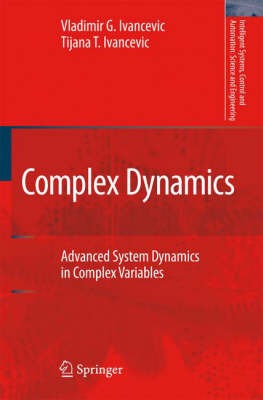
Complex dynamics : Advanced system dynamics in complex variables
Complex Dynamics: Advanced System Dynamics in Complex Variables is a graduate-level monographic textbook. It is designed as a comprehensive introduction into methods and techniques of modern complex-valued nonlinear dynamics with its various physical and non-physical applications.

Chaos : A Program Collection for the PC
This new edition strives yet again to provide readers with a working knowledge of chaos theory and dynamical systems through parallel introductory explanations in the book and interaction with carefully-selected programs supplied on the accompanying diskette. The programs enable readers, especially advanced-undergraduate students in physics, engineering, and math, to tackle relevant physical systems quickly on their PCs, without distraction from algorithmic details. For the third edition of Chaos: A Program Collection for the PC, each of the previous twelve programs is polished and rewritten in C++ (both Windows and Linux versions are included). A new program treats kicked systems, an important class of two-dimensional problems, which is introduced in Chapter 13. Each chapter follows the structure: theoretical background; numerical techniques; interaction with the program; computer experiments; real experiments and empirical evidence; reference.

Artificial neural networks – ICANN 2007 ; 17th International Conference, Porto, Portugal, September 9-13, 2007, Proceedings, Part I
This book contains learning theory, advances in neural network learning methods, ensemble learning, spiking neural networks, advances in neural network architectures neural network technologies, neural dynamics and complex systems, data analysis, estimation, spatial and spatio-temporal learning, evolutionary computing, meta learning, agents learning, complex-valued neural networks, as well as temporal synchronization and nonlinear dynamics in neural networks.
