


تحسين النتائح
ترتيب حسب
من
الى

The idea for this book emerged from a conversation between Vivian Forbes and Charles Eaton following two seminars held in the Department of Geography at the University of Western Australia given by Trevor So?eld and Christopher Grif?n more than ?ve years ago. One seminar involved papers from Charles Eaton and Christopher Grif?n on the recent Speight coup in Fiji; the other, given by Trevor So?eld, was on the Solomon Islands. The seminars were attended by, among others, Dennis Rumley, who on getting involved in the conversation, suggested the idea of a book and then followed through on its scope, structure, planning, and possible contributors. Looking back now, we owe a special debt of gratitude to Charles Eaton both for his enthusiasm and his ideas then, and for his continued support throughout the whole project. Since that time ?ve years ago, many people have boarded and have left the Arc.

Where fishing livelihoods come from and where they are going are simple questions with no simple answers. Using examples of small-scale fisheries in Asia-Pacific, Fabinyi and Barclay offer eloquent analyses of how fishing livelihoods are shaped, resting on a relational approach idea
The two-way oceanic exchanges that connect the Arctic and Atlantic oceans through subarctic seas are of fundamental importance to climate. Change may certainly be imposed on the Arctic Ocean from subarctic seas, including a changing poleward ocean heat flux that is central to determining the present state and future fate of the perennial sea-ice. And the signal of Arctic change is expected to have its major climatic impact by reaching south through subarctic seas, either side of Greenland, to modulate the Atlantic thermohaline ‘conveyor’. Developing the predictive skills of climate models is seen to be the most direct way of extending the ability of society to mitigate for or adapt to 'global change' and is the main justification for continuing an intense observational effort in these waters. As records have lengthened, they have shown that important aspects of oceanic exchange through subarctic seas are currently at a long-term extreme state, providing further motivation for their study.
This book critiques real world learning across both the curriculum and extracurricular activities. Drawing on disciplines as diverse as business, health, fashion, sociology and geography, the editors and authors employ a cross-disciplinary approach to examine how this concept is being applied in higher education.
This book presents a pioneering research on brownfield redevelopment in mountain regions, and specifically in the European Alps. The origins and causes, the actual conditions as well as the future challenges and potentials of mountain brownfields are investigated from an interdisciplinary yet landscape-centered perspective. Through the reasoned combination of research-by-design methods and case-study analysis, the book explores the infrastructural relevance of these sites for the specific mountain territory, while advancing an innovative structuralist-systemic approach for their physical and functional transformation. The book includes, among others, a first transnational geo-mapping of Alpine brownfields, whose impressive outcomes in terms of site numbers and distribution can only confirm the urgency of this research.

At a time when the polar regions are undergoing rapid and unprecedented change, understanding exchanges of momentum, heat and salt at the ice-ocean interface is critical for realistically predicting the future state of sea ice. By offering a measurement platform largely unaffected by surface waves, drifting sea ice provides a unique laboratory for studying aspects of geophysical boundary layer flows that are extremely difficult to measure elsewhere. This book draws on both extensive observations and theoretical principles to develop a concise description of the impact of stress, rotation, and buoyancy on the turbulence scales that control exchanges between the atmosphere and underlying ocean when sea ice is present. Several interesting and unique observational data sets are used to illustrate different aspects of ice-ocean interaction ranging from the impact of salt on melting in the Greenland Sea marginal ice zone, to how nonlinearities in the equation of state for seawater affect mixing in the Weddell Sea.

It systematically summarizes the past achievements and identifies the frontier issues as the research agenda for the near future. It covers all aspects of land remote sensing, from sensor systems, physical modeling, inversion algorithms, to various applications. The papers on remote sensing system evaluate the capabilities of different sensor systems for estimating key land surface variables and how they can best be improved and integrated effectively in the future.
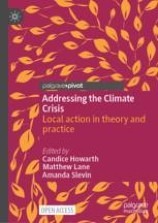
This book brings together a collection of cutting-edge insights into how action can and is already being taken against climate change at multiple levels of our societies, amidst growing calls for transformative and inclusive climate action. In an era of increasing recognition regarding climate and ecological breakdown, this book offers hope, inspiration and analyses for multi-level climate action, spanning varied communities, places, spaces, agents and disciplines, demonstrating how the energy and dynamism of local scales are a powerful resource in turning the tide.

This book shines a light on how and why academic work became entwined with air travel, and what can be done to change academia’s flying habit. The starting point of the book is that flying is only one means of scholarly communication among many, and that the state of the planet now obliges us to shift to other means.

سوريا - اتستراد درعا - غباغب
+963-15 2050 - 15 860 380 /1/2/3 - 11 662 3900