



الصفحة 3
الصفحة 3

Forest Strategy : Strategic Management and Sustainable Development for the Forest Sector
The book will provide a valuable resource for both forestry professionals – particularly those in managerial positions in government departments and forest services throughout the world – and for advanced students and researchers exploring the issues around forest sector administration. The latter will include researchers from a range of backgrounds, including forestry, ecology, geography, conservation, rural development, economics, forest or environmental policy, social studies and public affairs, and will be of particular interest to groups adopting an interdisciplinary approach to forestry issues.

Forest Road Operations in the Tropics
This book brings together information on road planning, location, design, construction and maintenance to support environmentally acceptable operations in tropical forests. It highlights the challenges of road operations in the tropics, includes techniques that have been shown to be successful, and discusses newer technologies. It is intended as a reference book for the forest engineer and others interested in the planning and management of tropical forests. Numerical examples are provided to provide clarity for interpreting graphs, procedures, and formulas. The book covers the various facets of road management from design objectives through practices to control environmental impacts.

Forest Restoration in Landscapes
This book integrates the restoration of forest functions into landscape conservation plans. and this book represents the collective body of knowledge and experience of WWF and its many partners--which is collected here for the first time and which will be invaluable to all of those working in the field. This guide will serve as a first stop for practitioners and researchers in any organization or region and as a key reference on the subject. Along with concise, practical information for a variety of specific systems and issues, it gives many suggestions for further research.

Forest Radioecology in Fukushima : Radiocesium Dynamics, Impact, and Future
This book provides holistic information on the radioactive contamination of forests. Topics are highly interdisciplinary, ranging from the dynamics of radioactive cesium in forest ecosystems to the radiation protection or the socio-economic aspects of radiation effects. It is designed to help people understand the radioactive contamination in forests and provide hints of how to cope with it and restore their livelihoods. The book is characterized by its well-balanced structure that allows the reader to understand the whole picture without going into too much scientific content. After explaining the basics of radioactive materials and radiation, the book illustrates the radioactive contamination of forests, it also describes the impacts on the forestry and life of local people and the measures taken by. Few books address the concerns about how to deal with radioactive contamination of forests and the future perspectives. In this book, people can learn all about the Fukushima nuclear accident of forests, forest products, and people with abundant reference materials.

Forest Policy Analysis
This book gives an introduction in the methodology of social sciences. It is a guideline for all those who are interested in the use and protection of the forest. It shows how to identifying political options for solving issues of the forest. The book builds a bridge between the problems concerning forests to the political process.

Forest Policies and Social Change in England
The book stresses how values and perceptions shape policies, and conversely how policies can modify perceptions, and also how policies can fail if they do not take perceptions into account. She concludes that many of the issues facing English forestry in the 21st century – from leisure, health and amenity provision, through education and rural as well as urban regeneration, to biodiversity conservation – go well beyond both national borders and the scope of forestry. This novel synthesis provides a valuable resource for advanced students and researchers from all areas of natural resource studies, including those interested in social history, socio-economics, cultural geography and environmental psychology, as well as those studying landscape ecology, environmental history, policy analysis and natural resource management.

Forest Mensuration
Van Laar and Akça’s popular text book, Forest Mensuration, was first published in 1997. Like that first edition, this modern update is based on extensive research, teaching and practical experience in both Europe, and the tropics and subtropics. However, it has also been extensively revised, and now includes chapters on remote sensing and the application of aerial photographs and satellite imagery. As with its predecessor, this book assumes no advanced knowledge of statistical methods, and combines practical techniques with important historical and disciplinary context. The result is a strong balance between a handbook on traditional mensuration methods, and a valuable reference on the many recent research and inventory-related innovations which have emerged in recent years.

Forest Landscape Ecology : Transferring Knowledge to Practice
Forest Landscape Ecology: Transferring Knowledge to Practice is the first book to introduce landscape ecologists to the discipline of knowledge transfer. The book considers knowledge transfer in general, critically examines aspects of transfer that are unique to forest landscape ecology, and reviews several case studies of successful applications for policy developers and forest managers in North America. Readers are encouraged to recognize the value of sharing their knowledge, and to understand their role in active knowledge transfer. The intent is to connect, as seamlessly and effectively as possible, ecological principles to policy and practice.

Forest Inventory : Methodology and Applications
This book has been developed as a forest inventory textbook for students and can also serve as a handbook for practical foresters. The book is divided into four sections. The first section deals mostly with sampling issues. First, we present the basic sampling designs at a fairly non-technical mathematical level. In addition, we present some more advanced sampling issues often needed in forest inventory. Those include for instance problems with systematic sampling, and methods for sampling vegetation or rare populations. Forest inventory also includes issues that are unique to forestry, like problems in measuring sample plots in the field, or utilising sample tree measurements. These issues include highly sophisticated methodology, but we try to present these also such that forestry students can grasp the ideas behind them. Each method is presented with examples. For foresters who need more details, references are given to more advanced scientific papers and books in the fields of statistics and biometrics.

Forest Environments in the Mekong River Basin
Deforestation and forest degradation have continued over a long period of time, and the deterioration of forest environment management services is becoming one of the biggest concerns in the world. Especially in large continental river basins, sel? sh political attitudes and individual interests in some regions predispose other regions to problems downstream and bring about international issues. The Mekong is just such a river basin and its water is the most important resource, interdependent with the forest conditions in the region. The lives of millions of people are sustained by the water of the Mekong River, and mutual understanding on water resource mana- ment is essential in this region. Consequently, appropriate environment management to control water resources is required of each country along with scienti? c knowledge of forest management, including forest hydrology.

Forest Entomology in West Tropical Africa : Forests Insects of Ghana
The forests of West Africa are complex, beautiful and under continued threat of over exploitation. This monograph, in its second edition, remains the only comprehensive source of information on economically important forest insects in West Africa. Many pest insects discussed in this book have the potential to greatly alter the utilization of these valuable tropical forests. Several key pests such as mahogany shoot borer, odum gallfly and pests of endangered tree species like Pericopsis, are extensively discussed. This comprehensive treatise of insects includes information on the general forest cover types and insects of utilitarian value. The book will be a great value to foresters, forest entomologists, researchers, conservation biologists and others with a basic biological interest in West Africa forests.

Forest Entomology in East Africa : Forest Insects of Tanzania
East African forests, among the world’s most biologically rich and diverse, are subject to multiple pressures, including insects. As the first work to focus exclusively on East African forest insects, this monograph distils 135 years of scientific and historical literature extending from before the colonial era to the present into an authoritative survey of this region’s major pests of trees and wood, as well as their antagonists. This comprehensive treatise also addresses insects of social and economic importance, such as endemics, edible and collectible insects, wild bees and silk producers. It should be of great value to foresters, entomologists, conservation biologists, resource managers, safari outfitters and anyone else interested in the natural history of this fascinating region.

Forest ecosystems and environments : Scaling up from shoot module to watershed
The Global Change Impacts on Terrestrial Ecosystems in Monsoon Asia (TEMA) project was carried out as a unique contribution to the international project Global Change and Terrestrial Ecosystems. TEMA aimed to integrate forest ecosystem processes. This volume presents the scaling-up concept for better understanding of ecosystem functioning.
Forest Diversity and Management
Natural forests with thousands of years of ecological continuity are unrivalled as the treasure store of terrestrial biodiversity on Earth. And while there is currently no fully comprehensive inventory of the biota associated with any given forest, it is reasonable to assume that in conserving natural forests we can conserve the myriads of unnamed bacteria, fungi, insects, mites and nematodes that forests support. Drawing on diverse research from biodiversity experts around the world, this collection of papers reflects the diversity of forest types and forest issues that concern forest scientists globally. Forest types considered vary from savannah and tropical rainforests to the ancient oak forests of Poland; issues explored include the effects of logging, management practices, forest dynamics and climate change on forest structure and biodiversity.
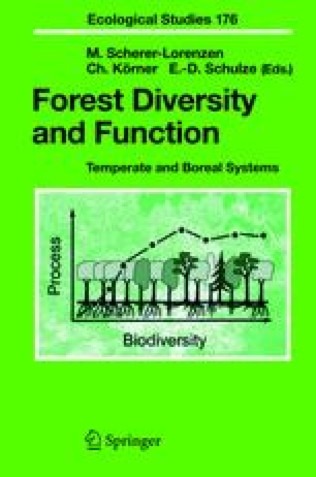
Forest Diversity and Function : Temperate and Boreal Systems
One of the central research themes in ecology is evaluating the extent to which biological richness is necessary to sustain the Earth's system and the functioning of individual ecosystems. In this volume, for the first time, the relationship between biodiversity and ecosystem processes in forests is thoroughly explored. The text examines the multiple effects of tree diversity on productivity and growth, biogeochemical cycles, animals, pests, and disturbances.
Forest and Rangeland Soils of the United States Under Changing Conditions : A Comprehensive Science Synthesis
This book synthesizes leading-edge science and management information about forest and rangeland soils of the United States. It offers ways to better understand changing conditions and their impacts on soils, and explores directions that positively affect the future of forest and rangeland soil health.

Field Measurements for Forest Carbon Monitoring : A Landscape-Scale Approach
This volume is a comprehensive guide to the methods and techniques employed in forest carbon inventory and monitoring. Since forest carbon research is interdisciplinary, it is unlikely that any one investigator will possess expertise in all of the types of measurements needed to conduct forest carbon research at scales larger than a forest stand. Techniques used to characterize standing stocks of carbon in a forest, measure key carbon fluxes, and collect related data (such as forest canopy nitrogen concentrations and meteorological measurements) that are required to drive process models, develop predictive relationships, and link to remote sensing data are described in detail. In addition to the measurement methods, the chapters include background information, necessary calculations, and equipment requirements.

Field Manual of Techniques in Invertebrate Pathology : Application and Evaluation of Pathogens for Control of Insects and other Invertebrate Pests
The Field Manual of Techniques in Invertebrate Pathology is designed to provide background and instruction on a broad spectrum of techniques and their use in the evaluation of entomopathogens in the field. The second edition of the Field Manual provides updated information and includes two additional chapters and 12 new contributors. The intended audience includes researchers, graduate students, practitioners of integrated pest management (IPM), regulators and those conducting environmental impact studies of entomopathogens. Although it can function as a stand alone reference, the Field Manual is complementary to the laboratory oriented Manual of Techniques in Insect Pathology and to comprehensive texts in insect pathology.

Field and Service Robotics ; Vol. 25 : Results of the 5th International Conference
Field robots are robots which operate in outdoor, complex, and dynamic environments. Service robots are those that work closely with humans, with particular applications involving indoor and structured environments. There are a wide range of topics presented in this issue on field and service robots including: Agricultural and Forestry Robotics, Mining and Exploration Robots, Robots for Construction, Security & Defence Robots, Cleaning Robots, Autonomous Underwater Vehicles and Autonomous Flying Robots.

Extreme Conflict and Tropical Forests
At a time when the international community is devoting significant attention to the issue of governance as a key factor in global environmental decline, this book provides a timely insight into the relationships between extreme conflict, the international trade in forest products, and the social, economic and environmental condition of tropical forests and their human communities. Drawing on the expertise of both natural and social scientists, Extreme Conflict and Tropical Forests explores the underlying causes and the social and environmental consequences of conflict in tropical forest areas. Case studies from Africa, Asia and Latin America present a range of issues – from illicit crops and ‘conflict timber’ production, to the potential of peace parks for improving human security, social quality and biodiversity conservation.
