



الصفحة 3
الصفحة 3

Darboux Transformations in Integrable Systems : Theory and their Applications to Geometry
This book presents the Darboux transformations in matrix form and provides purely algebraic algorithms for constructing the explicit solutions. A basis for using symbolic computations to obtain the explicit exact solutions for many integrable systems is established. Moreover, the behavior of simple and multi-solutions, even in multi-dimensional cases, can be elucidated clearly. The method covers a series of important equations such as various kinds of AKNS systems in R1+n, harmonic maps from 2-dimensional manifolds, self-dual Yang-Mills fields and the generalizations to higher dimensional case, theory of line congruences in three dimensions or higher dimensional space etc. All these cases are explained in detail.

Curve e superfici
The book provides an introduction to Differential Geometry of Curves and Surfaces. The theory of curves starts with a discussion of possible definitions of the concept of curve, proving in particular the classification of 1-dimensional manifolds. We then present the classical local theory of parametrized plane and space curves (curves in n-dimensional space are discussed in the complementary material): curvature, torsion, Frenet’s formulas and the fundamental theorem of the local theory of curves. Then, after a self-contained presentation of degree theory for continuous self-maps of the circumference

Conformal Groups in Geometry and Spin Structures
This book provides a self-contained overview of this important area of mathematical physics, beginning with its origins in the works of Cartan and Chevalley and progressing to recent research in spinors and conformal geometry. Key topics and features: * Focuses initially on the basics of Clifford algebras * Studies the spaces of spinors for some even Clifford algebras * Examines conformal spin geometry, beginning with an elementary study of the conformal group of the Euclidean plane * Treats covering groups of the conformal group of a regular pseudo-Euclidean space, including a section on the complex conformal group * Introduces conformal flat geometry and conformal spinoriality groups, followed by a systematic development of riemannian or pseudo-riemannian manifolds having a conformal spin structure * Discusses links between classical spin structures and conformal spin structures in the context of conformal connections * Examines pseudo-unitary spin structures and pseudo-unitary conformal spin structures using the Clifford algebra associated with the classical pseudo-unitary space
Mathematical Implications of Einstein-Weyl Causality
The present work is the first systematic attempt at answering the following fundamental question: what mathematical structures does Einstein-Weyl causality impose on a point-set that has no other previous structure defined on it? The authors propose an axiomatization of Einstein-Weyl causality (inspired by physics), and investigate the topological and uniform structures that it implies. Their final result is that a causal space is densely embedded in one that is locally a differentiable manifold. The mathematical level required of the reader is that of the graduate student in mathematical physics.

Material Inhomogeneities and their Evolution : A Geometric Approach
The first part of the book deals with the geometrical description of uniform bodies and their homogeneity (i.e., integrability) conditions. In the second part, a theory of material evolution is developed and its relevance in various applied contexts discussed. The necessary geometrical notions are introduced as needed in the first two parts but often without due attention to an uncompromising mathematical rigour. This task is left for the third part of the book, which is a highly technical compendium of those concepts of modern differential geometry that are invoked in the first two parts (differentiable manifolds, Lie groups, jets, principal fibre bundles, G-structures, connections, frame bundles, integrable prolongations, groupoids, etc.).
Loop Spaces, Characteristic Classes and Geometric Quantization
This book deals with the differential geometry of manifolds, loop spaces, line bundles and groupoids, and the relations of this geometry to mathematical physics. Various developments in mathematical physics (e.g., in knot theory, gauge theory, and topological quantum field theory) have led mathematicians and physicists to search for new geometric structures on manifolds and to seek a synthesis of ideas from geometry, topology and category theory. In this spirit, this book develops the differential geometry associated to the topology and obstruction theory of certain fiber bundles (more precisely, associated to grebes). The theory is a 3-dimensional analog of the familiar Kostant--Weil theory of line bundles. In particular the curvature now becomes a 3-form.

Linearity, Symmetry, and Prediction in the Hydrogen Atom
The predictive power of mathematics in quantum phenomena is one of the great intellectual successes of the 20th century. This textbook, aimed at undergraduate or graduate level students (depending on the college or university), concentrates on how to make predictions about the numbers of each kind of basic state of a quantum system from only two ingredients: the symmetry and the linear model of quantum mechanics. This method, involving the mathematical area of representation theory or group theory, combines three core mathematical subjects, namely, linear algebra, analysis and abstract algebra. Wide applications of this method occur in crystallography, atomic structure, classification of manifolds with symmetry, and other areas.
Lie Sphere Geometry : With Applications to Submanifolds
Provides a clear and comprehensive modern treatment of Lie sphere geometry and its applications to the study of Euclidean submanifolds. It begins with the construction of the space of spheres, including the fundamental notions of oriented contact, parabolic pencils of spheres, and Lie sphere transformations. The link with Euclidean submanifold theory is established via the Legendre map, which provides a powerful framework for the study of submanifolds, especially those characterized by restrictions on their curvature spheres.

Lectures on the Automorphism Groups of Kobayashi-Hyperbolic Manifolds
Presents a coherent exposition of recent results on complete characterization of Kobayashi-hyperbolic manifolds with high-dimensional groups of holomorphic automorphisms. These classification results can be viewed as complex-geometric analogues of those known for Riemannian manifolds with high-dimensional isotropy groups, that were extensively studied in the 1950s-70s. The common feature of the Kobayashi-hyperbolic and Riemannian cases is the properness of the actions of the holomorphic automorphism group and the isometry group on respective manifolds.
Lectures on Symplectic Geometry
Provides a fast introduction to symplectic geometry for graduate students with some knowledge of differential geometry, de Rham theory and classical Lie groups. This text addresses symplectomorphisms, local forms, contact manifolds, compatible almost complex structures, Kaehler manifolds, hamiltonian mechanics, moment maps, symplectic reduction and symplectic toric manifolds. It contains guided problems, called homework, designed to complement the exposition or extend the reader's understanding.
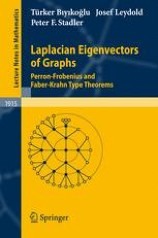
Laplacian Eigenvectors of Graphs : Perron-Frobenius and Faber-Krahn Type Theorems
Eigenvectors of graph Laplacians have not, to date, been the subject of expository articles and thus they may seem a surprising topic for a book. The authors propose two motivations for this new LNM volume: (1) There are fascinating subtle differences between the properties of solutions of Schrödinger equations on manifolds on the one hand, and their discrete analogs on graphs. (2) "Geometric" properties of (cost) functions defined on the vertex sets of graphs are of practical interest for heuristic optimization algorithms. The observation that the cost functions of quite a few of the well-studied combinatorial optimization problems are eigenvectors of associated graph Laplacians has prompted the investigation of such eigenvectors.
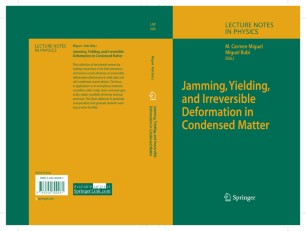
Jamming, Yielding, and Irreversible Deformation in Condensed Matter
This collection ot ten tutorial reviews by leading researchers in the field introduces and renews recent advances on irreversible deformation phenomena in solid state and soft condensed matter physics. The focus in applications is on amorphous materials, crystalline solids under stress and more generally, elastic manifolds driven by external processes. This book addresses in particular nonspecialists and graduate students wishing to enter the field.

Comprehensive mathematics for computer scientists 1 : Sets and numbers, graphs and algebra, logic and machines, linear geometry
This two-volume textbook Comprehensive Mathematics for Computer Scientists is a self-contained comprehensive presentation of mathematics including sets, numbers, graphs, algebra, logic, grammars, machines, linear geometry, calculus, ODEs, and special themes such as neural networks, Fourier theory, wavelets, numerical issues, statistics, categories, and manifolds. The concept framework is streamlined but defining and proving virtually everything.
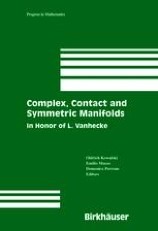
Complex, Contact and Symmetric Manifolds : In Honor of L. Vanhecke
This volume contains introductory and contextual material, describe recent developments and research trends in spectral geometry, the theory of geodesics and curvature, contact and symplectic geometry, complex geometry, algebraic topology, homogeneous and symmetric spaces, and various applications of partial differential equations and differential systems to geometry. One of the key strengths of these articles is their appeal to non-specialists, as well as researchers and differential geometers.
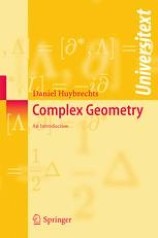
Complex Geometry : An Introduction
Complex geometry studies (compact) complex manifolds. It discusses algebraic as well as metric aspects. The subject is on the crossroad of algebraic and differential geometry. Recent developments in string theory have made it an highly attractive area, both for mathematicians and theoretical physicists. The book contains detailed accounts of the basic concepts and the many exercises illustrate the theory. Appendices to various chapters allow an outlook to recent research directions.
Complex Analysis with Applications to Number Theory
The book discusses major topics in complex analysis with applications to number theory.It 's including the theory of several finitely and infinitely complex variables, hyperbolic geometry, two- and three-manifolds, and number theory. In addition to solved examples and problems, the book covers most topics of current interest, such as Cauchy theorems, Picard’s theorems, Riemann–Zeta function, Dirichlet theorem, Gamma function, and harmonic functions.
Complex Analysis : In the Spirit of Lipman Bers
In this book, the main focus is the theory of complex-valued functions of a single complex variable. This theory is a prerequisite for the study of many current and rapidly developing areas of mathematics including the theory of several and infinitely many complex variables, the theory of groups, hyperbolic geometry and three-manifolds, and number theory.
Compactifications of Symmetric and Locally Symmetric Spaces
Noncompact symmetric and locally symmetric spaces naturally appear in many mathematical theories, including analysis (representation theory, nonabelian harmonic analysis), number theory (automorphic forms), algebraic geometry (modulae) and algebraic topology (cohomology of discrete groups). In most applications it is necessary to form an appropriate compactification of the space. The literature dealing with such compactifications is vast. The main purpose of this book is to introduce uniform constructions of most of the known compactifications with emphasis on their geometric and topological structures. The book is divided into three parts. Part I studies compactifications of Riemannian symmetric spaces and their arithmetic quotients. Part II is a study of compact smooth manifolds. Part III studies the compactification of locally symmetric spaces.

Classics in total synthesis IV : new targets, strategies, and methods
A compilation of highly important synthetic methods which lead to complex molecules with valuable properties. From the complex architectures of natural products to the streamlined synthesis of functional molecules, each chapter in Classics in Total Synthesis IV unfolds a unique story. The interplay of mechanisms, reactivity, selectivity, and stereochemical aspects is thoroughly examined, echoing the pedagogical format that has become synonymous with this series. Well-designed graphics are included throughout, and all important parts of the reaction sequences are highlighted.
C*-algebras and Elliptic Theory II
This book consists of a collection of original, refereed research and expository articles on elliptic aspects of geometric analysis on manifolds, including singular, foliated and non-commutative spaces. There are contributions from leading specialists, and the book maintains a reasonable balance between research, expository and mixed papers.
