



الصفحة 3
الصفحة 3

An Introduction to Manifolds
Manifolds, the higher-dimensional analogs of smooth curves and surfaces, are fundamental objects in modern mathematics. Combining aspects of algebra, topology, and analysis, manifolds have also been applied to classical mechanics, general relativity, and quantum field theory. In this streamlined introduction to the subject, the theory of manifolds is presented with the aim of helping the reader achieve a rapid mastery of the essential topics. By the end of the book the reader should be able to compute, at least for simple spaces, one of the most basic topological invariants of a manifold, its de Rham cohomology. Along the way the reader acquires the knowledge and skills necessary for further study of geometry and topology.

Algèbre, Chapitre 4 à 7 = Algebra, Chapter 4 to 7
The Mathematics Elements of Nicolas BOURBAKI aim to provide a rigorous, systematic presentation without prerequisites of mathematics from their foundations. Deals in particular with extensions of fields and Galois theory. It includes the chaptires: 4. Polynomials and rational fractions; 5. Commutative bodies 6. Orderly groups and bodies; 7. Modules on the main rings

Algebra ; Vol. I : Fields and Galois Theory
The present textbook is a lively, problem-oriented and carefully written introduction to classical modern algebra. The first volume focuses on field extensions. Galois theory and its applications are treated more thoroughly than in most texts. It also covers basic applications to number theory, ring extensions and algebraic geometry.The main focus of the second volume is on additional structure of fields and related topics. Much material not usually covered in textbooks appears here, including real fields and quadratic forms, diophantine dimensions of a field, the calculus of Witt vectors, the Schur group of a field, and local class field theory.
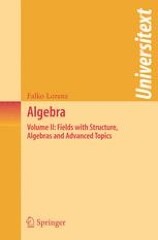
Algebra : Fields with structure, algebras and advanced topics
The present textbook is a lively, problem-oriented and carefully written introduction to classical modern algebra. The author leads the reader through interesting subject matter, while assuming only the background provided by a first course in linear algebra. The first volume focuses on field extensions. Galois theory and its applications are treated more thoroughly than in most texts. It also covers basic applications to number theory, ring extensions and algebraic geometry. The main focus of the second volume is on additional structure of fields and related topics. Much material not usually covered in textbooks appears here, including real fields and quadratic forms, the Tsen rank of a field, the calculus of Witt vectors, the Schur group of a field, and local class field theory.

Advanced Quantum Mechanics
Advanced Quantum Mechanics, the second volume on quantum mechanics by Franz Schwabl, discusses nonrelativistic multi-particle systems, relativistic wave equations and relativistic fields. Characteristic of Schwabl’s work, this volume features a compelling mathematical presentation in which all intermediate steps are derived and where numerous examples for application and exercises help the reader to gain a thorough working knowledge of the subject. The treatment of relativistic wave equations and their symmetries and the fundamentals of quantum field theory lay the foundations for advanced studies in solid-state physics, nuclear and elementary particle physics. This text extends and complements Schwabl’s introductory Quantum Mechanics, which covers nonrelativistic quantum mechanics and offers a short treatment of the quantization of the radiation field. New material has been added to this third edition of Advanced Quantum Mechanics on Bose gases, the Lorentz covariance of the Dirac equation, and the ‘hole theory’ in the chapter "Physical Interpretation of the Solutions to the Dirac Equation."

A Mathematical Introduction to Conformal Field Theory
The first part of this book gives a detailed, self-contained and mathematically rigorous exposition of classical conformal symmetry in n dimensions and its quantization in two dimensions. In particular, the conformal groups are determined and the appearance of the Virasoro algebra in the context of the quantization of two-dimensional conformal symmetry is explained via the classification of central extensions of Lie algebras and groups. The second part surveys some more advanced topics of conformal field theory, such as the representation theory of the Virasoro algebra, conformal symmetry within string theory, an axiomatic approach to Euclidean conformally covariant quantum field theory and a mathematical interpretation of the Verlinde formula in the context of moduli spaces of holomorphic vector bundles on a Riemann surface.
