


تحسين النتائح
ترتيب حسب
من
الى

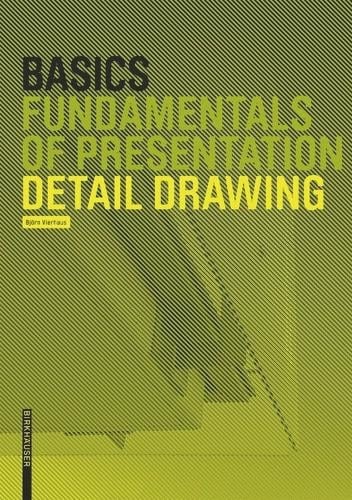
Detailed drawings are developed on the basis of the working drawings; they form an important part of the specification and contain precise information for the tradesmen, indicating how materials are to be used and how they are to be joined. Drawings are produced in various degrees of detail. Depending on the function of the drawings, they are produced in scales from 1:20 to 1:1 in order to define the materials and method of joining, and to better illustrate the various dimensions. Basics Detailed Drawings explains, step by step, how to compose detailed designs and produce correct construction drawings, using clear examples
It not only contains new and up to date information on materials, practical methods, and historical research but also reflects changes in the attitudes, outlook and perceptions within the wider conservation, architectural heritage and construction communities which give a new dimension to the conservation and restoration. The growing interest in the preservation of post war ceramic tile murals and the subsequent demand for information pertaining specifically to this era is a welcome and useful addition.
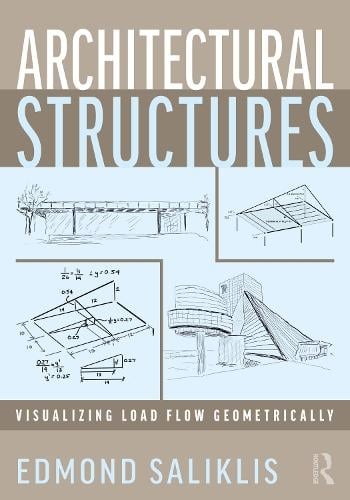
Presents an alternative approach to understanding structural engineering load flow using a visually engaging and three-dimensional format. This book presents a ground-breaking new way of establishing equilibrium in architectural structures using the Modern Müller-Breslau method. Includes approachable coverage of parametric modeling of two-dimensional and three-dimensional structures, as well as more advanced topics such as indeterminate structural analysis and plastic analysis. Hundreds of detailed drawings created by the author are included throughout to aid understanding. Architecture and structural engineering students can employ this novel method by hand sketching, or by programming in parametric design software.

From Ancient Egypt, where architects were members of the ruling class, tied into the running of the empire, to the 21st century when questions are being raised about the future of the profession, this book, with its engaging narrative, explores the constant threads that remain as the profession adapts. While architects are no longer deified, their ability to imagine a new impending reality in built form implies a visionary dimension to their work. By focusing on both the practicalities of the profession and the more intangible motivations behind design – humans’ need to make a mark upon their surroundings – this volume provides a critical overview of over 3000 years of practice and education.

People's everchanging lifestyles bring about more and more requirements for the overall qualities of houses, and the demands for residences have marched towards the psychological dimension and cultural sphere. Consequently, there arise new design trends and new requirements for environment, material selection and design concept. The design projects in this book lead readers to perceive the comfort and cosiness of the natural space. The designers of these projects have created more natural, and convenient living spaces in the most natural and purest design languages, giving them a comprehensive and vivid explanation of the architecture design concept that buildings are created for people.

The mechanics of Coupled Fields is a discipline at the edge of modern research connecting Continuum Mechanics with Solid State Physics. It integrates the Mechanics of Continuous Media, Heat Conductivity and the theory of Electromagnetism that are usually studied seperately. For an accurate description of the influence of static and dynamic loadings, high temperatures and strong electromagneticfields in elastic media and constructive installations, a new aproach is required; an approach that has the potential to establish a synergism between the above-mentioned fields. Throughout the book a vast number of problems are considered: two-dimensional problems of electro-magneto-elasticity as well as static and dynamical problems for piecewise homogenous compound piezoelectric plates weakened by cracks and openings. The boundary conditions, the constuctive equations and the mathematical methods for their solution are thoroughly presented, so that the reader can get a clear quantative and qualitative understnding of the phenomena taking place.

Mathematical Control Theory: An Introduction presents, in a mathematically precise manner, a unified introduction to deterministic control theory. With the exception of a few more advanced concepts required for the final part of the book, the presentation requires only a knowledge of basic facts from linear algebra, differential equations, and calculus. In addition to classical concepts and ideas, the author covers the stabilization of nonlinear systems using topological methods, realization theory for nonlinear systems, impulsive control and positive systems, the control of rigid bodies, the stabilization of infinite dimensional systems, and the solution of minimum energy problems.

We talk about theater even if the page cannot tell about Bustric's unforgettable show. And about art, and applied arts, such as geometric structure and spiritual meaning of the Zen garden of Ryoanji in Kyoto, and of soap bubbles, which are almost never lacking in Venetian encounters, Four-dimensional bubbles and gigantic bubbles that serve as a model for the Olympic swimming pool in Bejing

The book sets the philosophical writings of philosophers in the context of the development of Marxist philosophy internationally, and examines particularly the influence on these philosophers of Soviet Marxist philosophy. It argues that these Chinese Marxist philosophers’ interpretations of Marxist philosophy were quite orthodox when judged by the standards of contemporary Soviet Marxism. The book explores core themes in Marxist philosophy in China, including the dilemma of determinism, and investigates the way in which these Chinese Marxist philosophers sought a formula for the ‘Sinification’ of Marxist philosophy that both retained the universal dimensions of Marxism and allowed its application to the Chinese context. The book concludes with analysis of the role of the Yanan New Philosophy Association in developing from Soviet Marxist philosophy the philosophical dimension of Mao Zedong Thought, the official ideology of the Chinese Communist Party after 1945.

This monograph addresses the field theoretical aspects of magnetic monopoles. Written for graduate students as well as researchers, the author demonstrates the interplay between mathematics and physics. He delves into details as necessary and develops many techniques that find applications in modern theoretical physics. This introduction to the basic ideas used for the description and construction of monopoles is also the first coherent presentation of the concept of magnetic monopoles. It arises in many different contexts in modern theoretical physics, from classical mechanics and electrodynamics to multidimensional branes. The book summarizes the present status of the theory and gives an extensive but carefully selected bibliography on the subject. The first part deals with the Dirac monopole, followed in part two by the monopole in non-abelian gauge theories. The third part is devoted to monopoles in supersymmetric Yang-Mills theories.

Assimilating new research in the field of low-dimensional metals, this monograph provides a detailed overview of the current status of research on quasi-one- and two-dimensional molecular metals, describing normal-state properties, magnetic field effects, superconductivity, and the phenomena of interacting p and d electrons. It will be useful not only for frontier researchers with a broad interest in low-dimensional electronic and magnetic properties, but also for graduate students of solid-state physics and chemistry with some background knowledge of solid-state physics. It includes a number of fundamental and novel findings relating to the characteristics of these low-dimensional metals, which in future are likely to become standard material in textbooks on solid-state physics.
This book deals with the differential geometry of manifolds, loop spaces, line bundles and groupoids, and the relations of this geometry to mathematical physics. Various developments in mathematical physics (e.g., in knot theory, gauge theory, and topological quantum field theory) have led mathematicians and physicists to search for new geometric structures on manifolds and to seek a synthesis of ideas from geometry, topology and category theory. In this spirit, this book develops the differential geometry associated to the topology and obstruction theory of certain fiber bundles (more precisely, associated to grebes). The theory is a 3-dimensional analog of the familiar Kostant--Weil theory of line bundles. In particular the curvature now becomes a 3-form.

Once again KAM theory is committed in the context of nearly integrable Hamiltonian systems. While elliptic and hyperbolic tori determine the distribution of maximal invariant tori, they themselves form n-parameter families. Hence, without the need for untypical conditions or external parameters, torus bifurcations of high co-dimension may be found in a single given Hamiltonian system. The text moves gradually from the integrable case, in which symmetries allow for reduction to bifurcating equilibria, to non-integrability, where smooth parametrisations have to be replaced by Cantor sets. Planar singularities and their versal unfoldings are an important ingredient that helps to explain the underlying dynamics in a transparent way.
This significantly expanded fourth edition is designed as an introduction to the theory and applications of linear PDEs. The authors provide fundamental concepts, underlying principles, a wide range of applications, and various methods of solutions to PDEs. In addition to essential standard material on the subject, the book contains new material that is not usually covered in similar texts and reference books, including conservation laws, the spherical wave equation, the cylindrical wave equation, higher-dimensional boundary-value problems, the finite element method, fractional partial differential equations, and nonlinear partial differential equations with applications.
Begins with a reflection on the history of test design--the core activity of all educational and psychological testing. It then presents a standard language for modeling test design problems as instances of multi-objective constrained optimization. The main portion of the book discusses test design models for a large variety of problems from the daily practice of testing, and illustrates their use with the help of numerous empirical examples. The presentation includes models for the assembly of tests to an absolute or relative target for their information functions, classical test assembly, test equating problems, item matching, test splitting, simultaneous assembly of multiple tests, tests with item sets, multidimensional tests, and adaptive test assembly. Two separate chapters are devoted to the questions of how to design item banks for optimal support of programs with fixed and adaptive tests. Linear Models for Optimal Test Design, which does not require any specific mathematical background, has been written to be a helpful resource on the desk of any test specialist.
This introduction to the ideas and methods of linear functional analysis shows how familiar and useful concepts from finite-dimensional linear algebra can be extended or generalized to infinite-dimensional spaces. Aimed at advanced undergraduates in mathematics and physics, the book assumes a standard background of linear algebra, real analysis (including the theory of metric spaces), and Lebesgue integration, although an introductory chapter summarizes the requisite material. The initial chapters develop the theory of infinite-dimensional normed spaces, in particular Hilbert spaces, after which the emphasis shifts to studying operators between such spaces. Functional analysis has applications to a vast range of areas of mathematics; the final chapters discuss the particularly important areas of integral and differential equations.
A study of how a particular vision of the unity of mathematics, often called geometric function theory, was created in the 19th century. The central focus is on the convergence of three mathematical topics: the hypergeometric and related linear differential equations, group theory, and on-Euclidean geometry. The text for this second edition has been greatly expanded and revised, and the existing appendices enriched with historical accounts of the Riemann–Hilbert problem, the uniformization theorem, Picard–Vessiot theory, and the hypergeometric equation in higher dimensions. The exercises have been retained, making it possible to use the book as a companion to mathematics courses at the graduate level.
Extending modules are generalizations of injective modules and, dually, lifting modules generalize projective supplemented modules. There is a certain asymmetry in this duality. While the theory of extending modules is well documented in monographs and text books, the purpose of our monograph is to provide a thorough study of supplements and projectivity conditions needed to investigate classes of modules related to lifting modules. The text begins with an introduction to small submodules, the radical, variations on projectivity, and hollow dimension. The subsequent chapters consider preradicals and torsion theories (in particular related to small modules), decompositions of modules (including the exchange property and local semi-T-nilpotency), supplements in modules (with specific emphasis on semilocal endomorphism rings), finishing with a long chapter on lifting modules, leading up their use in the theory of perfect rings, Harada rings, and quasi-Frobenius rings.
Provides a clear and comprehensive modern treatment of Lie sphere geometry and its applications to the study of Euclidean submanifolds. It begins with the construction of the space of spheres, including the fundamental notions of oriented contact, parabolic pencils of spheres, and Lie sphere transformations. The link with Euclidean submanifold theory is established via the Legendre map, which provides a powerful framework for the study of submanifolds, especially those characterized by restrictions on their curvature spheres.

This book, designed for advanced graduate students and post-graduate researchers, provides an introduction to Lie algebras and some of their applications to the spectroscopy of molecules, atoms, nuclei and hadrons. In the first part, a concise exposition is given of the basic concepts of Lie algebras, their representations and their invariants. The second part contains a description of how Lie algebras are used in practice in the treatment of bosonic and fermionic systems. Physical applications considered include rotations and vibrations of molecules (vibron model), collective modes in nuclei (interacting boson model), the atomic shell model, the nuclear shell model, and the quark model of hadrons. One of the key concepts in the application of Lie algebraic methods in physics, that of spectrum generating algebras and their associated dynamic symmetries, is also discussed. The book contains many examples that help to elucidate the abstract algebraic definitions. It provides a summary of many formulas of practical interest, such as the eigenvalues of Casimir operators and the dimensions of the representations of all classical Lie algebras.

سوريا - اتستراد درعا - غباغب
+963-15 2050 - 15 860 380 /1/2/3 - 11 662 3900