



الصفحة 3
الصفحة 3
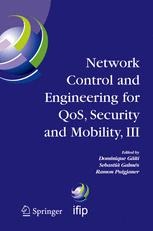
Network Control and Engineering for QOS, Security and Mobility, III ; IFIP TC6 / WG6.2, 6.6, 6.7 and 6.8. Third International Conference on Network Control and Engineering for QoS, Security and Mobility, NetCon 2004 on November 2-5, 2004, Palma de Mallorca, Spain
This volume contains the proceedings of the Third International Conference on Network Control and Engineering for Quality of Service, Security and Mobility (Net-Con'2004), celebrated in Palma de Mallorca (Illes Balears, Spain) during November 2-5, 2004. This IFIP TC6 Conference was organized by the Universitat de les Illes Balears and sponsored by the following Working Groups: WG6.2 (Network and Internetwork Architectures), WG6.6 (Management of Networks and Distributed Systems), WG6.7 (Smart Networks) and WG6.8 (Mobile and Wireless Communications). The rapid evolution of the networking industry introduces new exciting challenges that need to be explored by the research community. The adoption of Internet as the global network infrastructure places the issue of quality of service among one of the hot topics nowadays: a huge diversity of applications with quite different service requirements must be supported over a basic core of protocols. Also, the open and uncontrolled nature of Internet enforces the need to guarantee secure transactions among users, thus placing security as another hot topic. Finally, the explosion of mobility and its integration as part of the global infrastructure are probably now the most challenging issues in the networking field.

Neo-Liberalism, Globalization and Human Capital Learning : Reclaiming Education for Democratic Citizenship
Throughout the world, neoliberalism functions to decouple learning from the most important elements of civic education, transforming education into training and students into consumers. Neoliberalism, Globalization, and Human Capital Learning is an enormously important book that reveals in painstaking detail how neoliberal ideology destroys critical education. But it does much more. It also provides the insights and tools for educators to both overcome the market-based attack on critical education and address schooling as a democratic public sphere and the classroom as a laboratory for the nurturing of critical agency and social responsibility. This dynamic book should stir a public outcry among concerned citizens and educators through out the globe.

Natural Products : Drug Discovery and Therapeutic Medicine
Although the natural product drug discovery programs of the large drug companies are now equaled by programs for the high throughput screening of synthetic compounds generated through combinatorial chemistry, natural compounds still hold great promise to overcome such problems as antibiotic resistance, the emergence of new diseases, the failure to conquer old diseases, and the toxicity of some contemporary medical products. In Natural Products: Drug Discovery and Therapeutic Medicine, a panel of recognized experts and leaders in the field discuss the past successes of natural products as medicines and review future possibilities arising from both conventional and new technologies. High-performance liquid chromatography profiling, combinatorial synthesis, genomics, proteomics, DNA shuffling, bioinformatics, and genetic manipulation all now make it possible to rapidly evaluate the activities of extracts as well as purified components derived from microbes, plants, and marine organisms. The authors apply these methods to new natural product drug discovery, to accessing microbial diversity, to investigating specific groups of products (Chinese herbal drugs, antitumor drugs from microbes and plants, terpenoids, and arsenic compounds), and to exploiting specific sources (the sea, rainforest, and endophytes). These new opportunities show how research and development trends in the pharmaceutical industry can advance to include both synthetic compounds and natural products, and how this paradigm shift can be more productive and efficacious.

Natural Oral Care in Dental Therapy
Because of increasing antibiotic resistance, stronger antibiotics are reserved for serious active infection, paving the way for a greater use of herbal antibiotics. This book helps dentists in implementing safe and effective natural medicine therapies to complement the current practice guidelines. Oral diseases continue to be a major health problem world-wide. Oral health is integral to general well-being and relates to the quality-of-life that extends beyond the functions of the craniofacial complex. The standard Western medicine has had only limited success in the prevention of periodontal disease and in the treatment of a variety of oral diseases.

Natural Disasters as Interactive Components of Global-Ecodynamics
This book opens a new approach to the study of global environmental changes having unfavourable character for mankind and other living systems. The main advantage of the book consists in the accumulation of knowledge from different sciences to parametrize the global ecodynamic process. Natural catastrophes are considered as an interactive element of global natural dynamics which are described by means of simulation models of global nature/society. The realization of this approach allows the integration within a complex structure of all international and national means of environmental monitoring and provides a tool for objective evaluation of the environmental quality. The main purpose of this book is to develop a universal information technology to estimate the state of environmental subsystems functioning under various climatic and anthropogenic conditions.

Natural anti-aging skin care
Ageing is a natural phenomenon which is a fold, ridge and crease in the skin that occurs due to loss of body mass, poor hydration, disintegration of dermis and epidermis junction. The Skin ageing process involves many changes that occur due to the combination of both endogenous factors and exogenous factors. The ageing of the skin occurs due to various mechanisms like glycation, free radical, cell cycle, and cellular and molecular mechanism of skin ageing. In this review article, we have discussed the treatment, worldwide newer therapies and marketed formulation that are currently available for the reduction of skin ageing.

Natriuretic Peptides : The Hormones of the Heart
The rapid knowledge in the field of neuro-humoral regulation of cardiovascular pathophysiology is changing the picture of current diagnosis and treatment of cardiac patients. The emerging conceptual revolutionary idea is that heart acts not as a pump, merely, but as a "gland", that is as a regulator of circulatory homeostasis and salt-water balance. Cardiovascular pathophysiology has to be written, indeed, on this basis: this physiology textbook gives an up-to-date description of the complexity and novelty of actual knowledge, with all its potential clinical implications.

Nanotechnology in Intelligent Food Packaging
This book is a state-of-the-art exposition of nanotechnology and food packaging which is undergoing rapid advancement. This book is specially designed with an emphasis on the state-of-the-art in nanotechnology and food packaging. It offers fascinating techniques for producing smart and active food packaging and also discusses its toxicity and the role that nanosensors play in detecting different pathogens in food packaging. The concluding chapters also explain recent developments concerning the incorporation of health supplements in food packaging and their future role in producing intelligent food packaging.

Nanotechnology and Occupational Health
Nanotechnology is rapidly invading many aspects of modern society - from science, research and engineering to industrial and commercial applications and, inevitably, to man and his environment. One of the biggest challenges, therefore, is managing environmental, health and safety risks of nanomaterials. Yet, the information necessary to assess their longterm effects is scarce. Systematic research into what potentially makes engineered nanomaterials hazardous, how this translates into risk, and how these can be managed will be vital and involves interdisciplinary collaboration.

Nanotechnology and drug delivery : Principles and applications
Presents an overview of the rapidly developing field of nanotechnology applications in drug delivery systems and covers a variety of technologies and materials that help in achieving vast variation in the particle size needed in technology and drug delivery-based research. It discusses nanotechnology’s use in healthcare for the development of target-specific drug therapy and smart field systems and in the pharmaceutical industry to improve the quality, efficacy, and shelf life of medicines. Bringing together principles, theory, practice, and applications of nanotechnology.

Nanostructured Coatings
Controlling the performance of structures and components of all sizes and shapes through the use of engineered coatings has long been a key strategy in materials processing and technological design. The ever-increasing sophistication of en- neered coatings and the rapid trend toward producing increasingly smaller devices with greater demands on their fabrication, properties and performance have led to signicant progress in the science and technology of coatings, particularly in the last decade or two. Nanostructured coatings constitute a major area of sci- ti?c exploration and technological pursuit in this development.Nanostructured coatings demand study in a highly interdisciplinary research arena which encompasses: surface and interface science study of defects modern characterization methodologies cutting-edge experimental developments to deposit.

Nanoscaled Semiconductor-on-Insulator Structures and Devices
This proceedings volume constitutes an archive of the contributions of the key-speakers who attended the NATO Advanced Research Workshop on “Nanoscaled Semiconductor-On-Insulator Structures and devices” held in the Tourist and Recreation Centre “Sudak” (Crimea, Ukraine) from 15 to 19 October 2006. The semiconductor industry has sustained a very rapid growth during the last three decades through impressive technological developments which have resulted in products with higher performance and lower cost per function. After many years of development it is now confidently predicted that semiconductor-on-insulator materials will enter and increasingly be used by manufacturing industry. The wider use of semiconductor (es- cially silicon) on insulator materials will not only enable the benefits of these materials to be demonstrated but, also, will drive down the cost of substrates which, in turn, will stimulate the development of other novel devices and applications.

Nanomaterials in clinical therapeutics : Synthesis and applications
Nanotechnology-based applications is a rapidly growing field encompassing a diverse range of disciplines that impact our daily lives. Nanotechnology is being used to carry out large-scale reactions in practically every field of biotechnology and healthcare. The incredible progress being made in these applications is particularly true for the healthcare sector, where they are used in cancer detection and treatment, medical implants, tissue engineering, and so forth. Expansions in this discipline are expected to continue in the future, resulting in the creation of a variety of life-saving medical technology and treatment procedures.

Nanomaterials and nanotechnology in medicine
The use of nanotechnology and nanomaterials more generally is an emerging field that has generated a lot of interest in the last few years. To this point, there have been few books that deal with the recent advances in nanomaterials or nanocomposites in the medical discipline. Intended as a one-stop reference, Nanomaterials and Nanotechnology in Medicine provides the reader with the most-up-to-date and comprehensive exploration of the field of nanomedicine. The scope of the topic is huge, with nano applications in every medical specialization—from diagnostics to pharmaceuticals, from biological therapies to surgical devices, and from regenerative therapies to gene therapy. As such, this volume provides the most comprehensive coverage of this intriguing field of study.

NanoBiotechnology : BioInspired Devices and Materials of the Future
NanoBioTechnology: BioInspired Devices and Materials of the Future is a groundbreaking text that will assist scientists and students in learning the fundamentals and cutting-edge nature of this new and emerging science. Focusing on materials and building blocks for nanotechnology, leading scientists from around the world share their knowledge and expertise in this authoritative volume. The volume is broken into five sections. The first section presents an overview of nanotechnology and describes the many aspects of the field. Section 2 details biological materials serving as nanotemplates for bottom-up fabrication. Section 3 covers the use of biological macromolecules for electron transfer and computation. Section 4 presents a brief overview of the extensive and rapidly growing field of nanomedicine. Finally, Section 5 details de-novo designed structures and the various approaches different scientific groups take with molecular level training and language

Nano physical pharmaceutics
Nanomedicine is an emerging and rapidly evolving field, which could significantly help in early disease diagnosis, therapeutic improvement, novel therapeutic modality development, and medical expenditure reduction. The challenge remains, however, that the specially designed and carefully synthesized nanomedicines function poorly in animal verification despite great performance in vitro. A deeper understanding of the physicochemical properties of nanomedicine is the key. This book applies physical theories and models to determine the parameters for controlling the physicochemical properties of nanomedicines, including micelles, liposomes, and inorganic nanoparticles. Qualitative and quantitative relationships are established to provide guidance for nanomedicine design, characterization, and analysis. The text also compiles cutting-edge research in nanomedicine from the interdisciplinary team of the Department of Nanomedicine at Naval Medical University, China, which is currently establishing the characteristic discipline called Nano Physical Pharmaceutics. Edited by Wei Li, a prominent nanotechnology researcher, this book will appeal to anyone involved in nanotechnology, medicine, macromolecular science, biology, chemistry, and especially those with an interest in drug delivery or cancer therapy.

Musculoskeletal Diseases : Diagnostic Imaging and Interventional Techniques
Written by internationally renowned experts, this volume is a collection of chapters dealing with imaging diagnosis and interventional therapies in musculoskeletal diseases. The different topics are disease-oriented and encompass all the relevant imaging modalities including X-ray technology, nuclear medicine, ultrasound and magnetic resonance, as well as image-guided interventional techniques. This book represents a condensed version of twenty topics relevant in musculoskeletal disease, and is aimed both at residents in radiology and at experienced radiologists wishing to be updated on the current state-of-the art.

Multiwavelength Mapping of Galaxy Formation and Evolution ; Proceedings of the ESO Workshop Held at Venice, Italy, 13-16 October 2003
The possibilities of astronomical observation have dramatically increased over the last decade. Major satellites, like the Hubble Space Telescope, Chandra and XMM Newton, are complemented by numerous large ground-based observatories, from 8m-10m optical telescopes to sub-mm and radio facilities. As a result, observational astronomy has access to virtually the whole electromagnetic spectrum of galaxies, even at high redshifts. Theoretical models of galaxy formation and cosmological evolution now face a serious challenge to match the plethora of observational data. In October 2003, over 170 astronomers from 15 countries met for a 4-day workshop to extensively illustrate and discuss all major observational projects and ongoing theoretical efforts to model galaxy formation and evolution. This volume contains the complete proceedings of this meeting and is therefore a unique and timely overview of the current state of research in this rapidly evolving field.

Multiscale Dissipative Mechanisms and Hierarchical Surfaces : Friction, Superhydrophobicity, and Biomimetics
Multiscale Dissipative Mechanisms and Hierarchical Surfaces covers the rapidly developing topics of hierarchical surfaces, roughness-induced superhydrophobicity and biomimetic surfaces. The research in these topics has been progressing rapidly in the recent years due to the advances in the nanosciences and surfaces science and due to potential applications in nanotechnology. The first in its field, this monograph provides a comprehensive review of these subject and presents the background introduction as well as recent and new results in the area.

Multiple Sclerosis: Autoimmunity and Management
Multiple sclerosis (MS) is an immune-mediated inflammatory disease that attacks myelinated axons in the central nervous system, destroying the myelin and the axon in variable degrees and producing significant physical disability within 20–25 years in more than 30% of patients. The hallmark of MS is symptomatic episodes that occur months or years apart and affect different anatomic locations. Also, see the Autoimmune Disorders: Making Sense of Nonspecific Symptoms slideshow to help identify several diseases that can cause a variety of nonspecific symptoms. MS is diagnosed on the basis of clinical findings and supporting evidence from ancillary tests. Treatment consists of immunomodulatory therapy for the underlying immune disorder and management of symptoms, as well as nonpharmacologic treatments, such as physical and occupational therapy. Disease-modifying therapies have shown beneficial effects in patients with relapsing MS, including reduced frequency and severity of clinical attacks. These agents appear to slow the progression of disability and the reduce accumulation of lesions within the brain and spinal cord.
