



الصفحة 29
الصفحة 29
Mathematical Methods for Robust and Nonlinear Control : EPSRC Summer School
The underlying theory on which much modern robust and nonlinear control is based can often be dif?cult for the student to grasp. In particular, the mathematical - pects can be problematic for students from a standard engineering background. The EPSRC sponsored Summer School which was held in Leicester in September 2006 attempted to “?ll the gap” in students’ appreciation the theory relevant to several important areas of control. This book is a collection of lecture notes which were p- sented at that workshop and consists of, broadly, two parts. The ?rst nine chapters are devoted to the theory behind several areas of robust and nonlinear control and are aimed at introducing fundamental concepts to the reader. The last six chapters contain detailed case studies which aim to demonstrate the use and effectiveness of these modern techniques in real engineering applications. It is hoped that this book will provide a useful introduction to many of the more common robust and nonlinear control techniques and serve as a valuable reference for the more adept practitioner.
Mathematical Methods for Mechanics : A Handbook with MATLAB Experiments
The interaction between mathematics and mechanics is a never ending source of new developments. Today, challenging problems like space flight, gyroscope motions and tidal currents, can be studied on a laptop, feats that people still in the 1950’s dreamed of accomplishing. The present textbook addresses such problems and moreover, a wide-ranging spectrum of topics from bifurcation theory, optimization and control to rigid-body motion and continuum mechanics of elastic bodies and fluids. It fully encompasses the provision of mathematical tools up to their technical application. Because verifiability is a main element of science and numerical mathematics remain lackluster without demonstrations, a portion of the book is dedicated purely to computations.
Mathematical methods for engineers and scientists 3 : Fourier analysis, partial differential equations and variational methods
Pedagogical insights gained through 30 years of teaching applied mathematics led the author to write this set of student oriented books. Topics such as complex analysis, matrix theory, vector and tensor analysis, Fourier analysis, integral transforms, ordinary and partial differential equations are presented in a discursive style that is readable and easy to follow.
Mathematical methods for engineers and scientists 2 : Vector analysis, ordinary differential equations and laplace transforms
Pedagogical insights gained through 30 years of teaching applied mathematics led the author to write this set of student-oriented books. Topics such as complex analysis, matrix theory, vector and tensor analysis, Fourier analysis, integral transforms, ordinary and partial differential equations are presented in a discursive style that is readable and easy to follow.
Mathematical methods for engineers and scientists 1 : Complex analysis, determinants and matrices
Pedagogical insights gained through 30 years of teaching applied mathematics led the author to write this set of student oriented books. Topics such as complex analysis, matrix theory, vector and tensor analysis, Fourier analysis, integral transforms, ordinary and partial differential equations are presented in a discursive style that is readable and easy to follow.
Mathematical Methods for Engineers and Geoscientists
This book introduces and explains classical and modern mathematical procedures as applied to the real problems confronting engineers and geoscientists. Written in a manner that is understandable for students across the breadth of their studies, it lays out the foundations for mastering difficult and sometimes confusing mathematical methods.
Mathematical methods and modelling in hydrocarbon exploration and production
Hydrocarbon exploration and production incorporate great technology challenges for the oil and gas industry. In order to meet the world's future demand for oil and gas, further technological advance is needed, which in turn requires research across multiple disciplines, including mathematics, geophysics, geology, petroleum engineering, signal processing, and computer science. This book addresses important aspects and fundamental concepts in hydrocarbon exploration and production. Moreover, new developments and recent advances in the relevant research areas are discussed, whereby special emphasis is placed on mathematical methods and modelling. The book reflects the multi-disciplinary character of the hydrocarbon production workflow, ranging from seismic data imaging, seismic analysis and interpretation and geological model building, to numerical reservoir simulation. Various challenges concerning the production workflow are discussed in detail.
Mathematical Masterpieces : Further Chronicles by the Explorers
Experience the discovery of mathematics by reading the original work of some of the greatest minds throughout history. Here are the stories of four mathematical adventures, including the Bernoulli numbers as the passage between discrete and continuous phenomena, the search for numerical solutions to equations throughout time, the discovery of curvature and geometric space, and the quest for patterns in prime numbers. Each story is told through the words of the pioneers of mathematical thought. Particular advantages of the historical approach include providing context to mathematical inquiry, perspective to proposed conceptual solutions, and a glimpse into the direction research has taken.
Mathematical Linguistics
Mathematical Linguistics introduces the mathematical foundations of linguistics to computer scientists, engineers, and mathematicians interested in natural language processing. The book presents linguistics as a cumulative body of knowledge from the ground up, with no prior knowledge of linguistics being assumed, covering more than the average two-semester introductory course in linguistics.This comprehensive, reader-friendly volume offers readers a high-level orientation, discussing the foundations of the field and presenting both the classical work and the most recent results. It covers an extremely rich array of topics including not only syntax and semantics but also phonology and morphology, probabilistic approaches, complexity, learnability, and the analysis of speech and handwriting.

Mathematical Knowledge Management ; Vol. 4108 ; 5th International Conference, MKM 2006, Wokingham, UK, August 11-12, 2006, Proceedings
This book constitutes the refereed proceedings of the 5th International Conference on Mathematical Knowledge Management, MKM 2006, held in Wokingham, UK in August 2006 as official satellite event of the International Congress of Mathematicians, ICM 2006. The 22 revised full papers presented were carefully selected during two rounds of reviewing and improvement. The papers in this volume cover the whole area of mathematical knowledge management in the intersection of mathematics, computer science, library science, and scientific publishing. The papers are organized in topical sections on proof representations, proof processing, knowledge extraction, knowledge representation, as well as systems and tools.

Mathematical Knowledge Management ; Vol. 3863 ; 4th International Conference, MKM 2005, Bremen, Germany, July 15-17, 2005, Revised Selected Papers
This volume contains the proceedings of the Fourth International Conference on Mathematical Knowledge Management MKM 2005 held July 15–17, 2005 at - ternational University Bremen, Germany.
Mathematical Implications of Einstein-Weyl Causality
The present work is the first systematic attempt at answering the following fundamental question: what mathematical structures does Einstein-Weyl causality impose on a point-set that has no other previous structure defined on it? The authors propose an axiomatization of Einstein-Weyl causality (inspired by physics), and investigate the topological and uniform structures that it implies. Their final result is that a causal space is densely embedded in one that is locally a differentiable manifold. The mathematical level required of the reader is that of the graduate student in mathematical physics.

Mathematical Foundations of Computer Science 2008 ; 33rd International Symposium, MFCS 2008, Toru´n, Poland, August 25-29, 2008. Proceedings
Constitutes the refereed proceedings of the 33rd International Symposium on Mathematical Foundations of Computer Science, MFCS 2008, held in Torun, Poland, in August 2008.The 45 revised full papers presented together with 5 invited lectures were carefully reviewed and selected from 119 submissions. All current aspects in theoretical computer science and its mathematical foundations are addressed, ranging from algorithmic game theory, algorithms and data structures, artificial intelligence, automata and formal languages, bioinformatics, complexity, concurrency and petrinets, cryptography and security, logic and formal specifications, models of computations, parallel and distributed computing, semantics and verification.

Mathematical Foundations of Computer Science 2007 ; 32nd International Symposium, MFCS 2007 Ceský Krumlov, Czech Republic, August 26-31, 2007, Proceedings
This book constitutes the refereed proceedings of the 32nd International Symposium on Mathematical Foundations of Computer Science, MFCS 2007, held in Cesk?? Krumlov, Czech Republic, August 26-31, 2007. All current aspects in theoretical computer science and its mathematical foundations are addressed.

Mathematical foundations of computer science 2006 ; 31st International Symposium, MFCS 2006, Stará Lesná, Slovakia, August 28-September 1, 2006, Proceedings
This book constitutes the refereed proceedings of the 31st International Symposium on Mathematical Foundations of Computer Science, MFCS 2006, held in Stará Lesná, Slovakia in August/September 2006. The 62 revised full papers presented together with the full papers or abstracts of 7 invited talks were carefully reviewed and selected from 174 submissions. All current aspects in theoretical computer science and its mathematical foundations are addressed, ranging from algorithms and data structures, to complexity, automata, semantics, logic, formal specifications, models of computation, concurrency theory, computational geometry, parallel and distributed computing, networks, bioinformatics, quantum computing, cryptography, knowledge-based systems, and artificial intelligence.

Mathematical Foundations of Computer Science 2005 ; 30th International Symposium, MFCS 2005, Gdansk, Poland, August29-September 2. 2005, Proceedings
Constitutes the proceedings of the 30th International Symposium on Mathematical Foundations of Computer Science, MFCS 2005, held in Gdansk, Poland in August/September 2005. The 62 papers address various aspects in theoretical computer science, ranging from quantum computing, approximation, automata, circuits, scheduling, games, and more.

Mathematical Foundation of Turbulent Viscous Flows : Lectures given at the C.I.M.E. Summer School held in Martina Franca, Italy, September 1-5, 2003
Five leading specialists reflect on different and complementary approaches to fundamental questions in the study of the Fluid Mechanics and Gas Dynamics equations. Constantin presents the Euler equations of ideal incompressible fluids and discusses the blow-up problem for the Navier-Stokes equations of viscous fluids, describing some of the major mathematical questions of turbulence theory.
Mathematical Foundation of Geodesy : Selected Papers of Torben Krarup
This volume contains selected papers by Torben Krarup, one of the most important geodesists of the 20th century. His writings are mathematically well founded and scientifically relevant. In this impressive collection of papers he demonstrates his rare innovative ability to present significant topics and concepts. Modern students of geodesy can learn a lot from his selection of mathematical tools for solving actual problems. The collection contains the famous booklet "A Contribution to the Mathematical Foundation of Physical Geodesy" from 1969, the unpublished "Molodenskij letters" from 1973, the final version of "Integrated Geodesy" from 1978, "Foundation of a Theory of Elasticity for Geodetic Networks" from 1974, as well as numerous trend setting papers on the theory of adjustment.
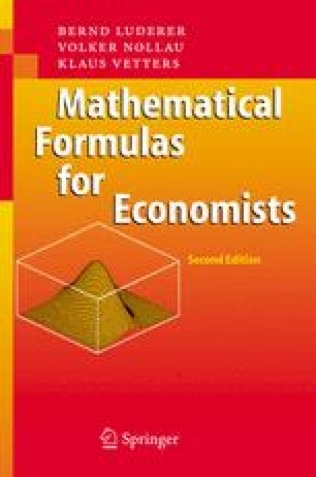
Mathematical Formulas for Economists
The present collection of formulas has been composed for students of economics or management science at universities, colleges and trade schools. It contains basic knowledge in mathematics, financial mathematics and statistics in a compact and clearly arranged form. This volume is meant to be a reference work to be used by students of undergraduate courses together with a textbook and by researchers in need of exact statements of mathematical results. People dealing with practical or applied problems will also find this collection to be an efficient and easy-to-use work of reference.
Mathematical Formulas for Economists
This collection of formulas constitutes a compendium of mathematics for eco nomics and business. It contains the most important formulas, statements and algorithms in this significant subfield of modern mathematics and addresses primarily students of economics or business at universities, colleges and trade schools. But people dealing with practical or applied problems will also find this collection to be an efiicient and easy-to-use work of reference. First the book treats mathematical symbols and constants, sets and state ments, number systems and their arithmetic as well as fundamentals of com binatorics. The chapter on sequences and series is followed by mathematics of finance, the representation of functions of one and several independent vari ables, their differential and integral calculus and by differential and difference equations. In each case special emphasis is placed on applications and models in economics. The chapter on linear algebra deals with matrices, vectors, determinants and systems of linear equations. This is followed by the representation of struc tures and algorithms of linear programming. Finally, the reader finds formu las on descriptive statistics (data analysis, ratios, inventory and time series analysis), on probability theory (events, probabilities, random variables and distributions) and on inductive statistics (point and interval estimates, tests). Some important tables complete the work.
