



الصفحة 28
الصفحة 28

Microflows and Nanoflows : Fundamentals and Simulation
This book provides a comprehensive summary of these changes describing fluid flow in micro and nano configurations. Where as in their previous book entitled Microflows: Fundamentals and Simulation. In this new book they discuss length scales from angstroms to microns (and beyond). While still maintaining the emphasis on fundamental concepts with a mix of semianalytical, experimental, and numerical results, this book outlines their relevance to modeling and analyzing functional devices.

Microearthquake Seismology and Seismotectonics of South Asia
This volume comprehensively deals with plate tectonics and seismic waves in general and earthquake monitoring by permanent and temporary networks for active fault mapping, aftershock, swarm and induced seismicity investigations in interplate collision and subduction zones and in intraplate shield region.

Microcontrollers in Practice
Stressing common characteristics and real applications of the most used microcontrollers, this practical guide provides readers with hands-on knowledge of how to implement three families of microcontrollers (HC11, AVR, and 8051). Unlike the rest of the ocean of literature on individual chips, Microcontrollers in Practice supplieS side-by-side comparisons and an overview that treats the systems as resources available for implementation. Packed with hundred of practical examples and exercises to foster mastery of concepts and details, the guide also includes several extended projects. By treating the less expensive 8-bit and RISC microcontrollers, this information-dense manual equips students and home-experimenters with the know-how to put these devices into operation.

The 8051 microcontroller and embedded systems
The Classical Period: Nineteenth Century Sociology Auguste Comte (1798-1857) on Women in Positivist Society Harriett Martineau (1802-1876) on American Women Bebel, August (1840-1913) on Women and Socialism Emile Durkheim (1858-1917) on the Division of Labor and Interests in Marriage Herbert Spencer (1820-1903) on the Rights and Status of Women Lester Frank Ward (1841-1913) on the Condition of Women Anna Julia Cooper (1858-1964) on the Voices of Women Thorstein Veblen (1857-1929) on Dress as Pecuniary Culture The Progressive Era: Early Twentieth Cent.

Microbiome
Despite the increasing interest of healthy or fat as well sick people in selecting a suitable diet for them, as nutrition is becoming an interesting area recently, in contrast to that we have noticed that there is almost a rare or no interest in Microbiome field in our country by which we can be much more accurate in selecting a diet based on comparing a map of microbiomein healthy person with ill person individually to provide a patient with the right missing food to improve his immune system, or even for a child since birth, to build the best immune system as we compared the benefits of mother’s milk, and artificial one, therefore we will focus in our study on this new science for two reasons the first is to present it and secondly to integrate it in the practice by interested doctors.

Microbiology of Extreme Soils
This volume provides an excellent introduction to the study of extreme soil micro-biology, and a variety of the challenging and fascinating environments that Earth-bound microbes face. Some are natural, and some are the result of human activity, and all of them have lessons to teach us about life’s adaptations within the “extreme” hori-zons of terrestrial soils. What’s more, each of these chapters (including the chapter on the soils of Mars by Ronald L. Crawford and David A. Newcombe) can give us insights into strategies that may make life possible beyond the safe confines of our present-day biosphere, to other worlds in this solar system and beyond

Microbial Root Endophytes
Plant roots may not only be colonized by mycorrhizal fungi, but also by a myriad of bacterial and fungal root endophytes that are usually not considered by the investigators of classic symbioses. This is the first book dedicated to the interactions of non-mycorrhizal microbial endophytes with plant roots. The phenotypes of these interactions can be extremely plastic, depending on environmental factors, nutritional status, genetic disposition and developmental stages of the two partners. The book deals with diversity, life history strategies, interactions, applications in agriculture and forestry, methods for isolation, cultivation, and both conventional and molecular methods for identification and detection of these endophytes. The comprehensive reviews demonstrate the high diversity of interactions and will provoke further studies to better understand the mechanisms which determine whether a plant-microbial interaction remains asymptomatic, leads to disease or to a mutualistic interaction.

Microbial protein toxins
Since the initial establishment of Robert Koch’s postulates in the nineteenth century, microbial protein toxins have been recognized as a major factor of bacterial and fungal virulence. An increasing number of proteins produced and secreted by various bacteria, yeasts and plants are extremely toxic and most of them developed remarkably "intelligent" strategies to enter, to penetrate and to finally kill a eukaryotic target cell by modifying or blocking essential cellular components. This book describes the strategies employed by protein toxins to render their pro- and eukaryotic producers a selective growth advantage over competitors. In providing an up-to-date overview on the mode of protein toxin actions, it accommodates biomedically and biologically relevant toxin model systems. As a result, it significantly broadens our perspective on biochemical architecture and molecular ploy behind the lethal principles of pro- and eukaryotic toxins.

Microbial Phosphate Solubilization
Last decade has seen a significantly increased knowledge about phosphate solubilizing microorganisms. Sixty specialists from thirteen countries met in Salamanca to discuss the problems of the high P-unavailability as a soil nutrient for crops, and the hazards of an increasing phosphate input to aquatic habitats from industrial and mining activities, sewage disposal, detergents, and other sources. Updated solutions to enhance P-uptake by plants, bioremediation potential in the rehabilitation of ecosystems, taxonomic characterization interactions with mycorrizae, the physiological and molecular basis of PSM, and possibilities of genetic modifications of rhizospheric microorganisms were among the contributions presented. Challenges in commercializing a phosphate solubilizing microorganism were also outlined by a relevant biotech company.

Microbes in agri-forestry biotechnology
Explores recent advances on the use of microbes for agri-forestry biotechnological applications. It provides technical concepts and discussions on the use of microorganisms for processes such as bioprocessing, bioremediation, soil enhancement, aquaponics advances, and plant-host symbiosis. The book provides an overview of the microbial approach to the tools and processes used in agriculture and forestry that make or modify products, improve plants for specific uses, and make use of livestock in agricultural systems. The authors discuss the main process conditions that enhance agri-forestry applications with the use of microbes and introduce the use of genetically modified (GM) microbes in agrobiotechnology. Finally, the authors explore the main technological advances in the production of secondary metabolites with potential applications in agri-forestry.

Micro-Assembly Technologies and Applications ; IFIP TC5 WG5.5 Fourth International Precision Assembly Seminar (IPAS’2008) Chamonix, France February 10–13, 2008
The IFIP series publishes state-of-the-art results in the sciences and technologies of information and communication. The scope of the series includes: foundations of computer science; software theory and practice; education; computer applications in technology; communication systems; systems modeling and optimization; information systems; computers and society; computer systems technology; security and protection in information processing systems; artificial intelligence; and human-computer interaction. Proceedings and post-proceedings of referred international conferences in computer science and interdisciplinary fields are featured. These results often precede journal publication and represent the most current research.

Microalgae Building Enclosures : Design and Engineering Principles
Aims to provide design, engineering, and biotechnical guidelines for microalgae building enclosures that need to be considered for symbiotic relations among the built environment, humans, and ecosystems. Introduces the theoretical background of microalgae as a bioremediator and future energy system and their potential roles toward sustainable and healthy built environments. Part II exemplifies interventions and multiple benefits of microalgae systems in product, architecture, urban, and infrastructure applications across the globe including Africa, Asia, Australia, Europe, South America, and North America. Part III explains the design and engineering criteria, biotechnical design requirements, and various performance metrics for microalgae architecture. Finally, Part IV investigates potential building applications in low-rise buildings, high-rise buildings, and energy-efficient retrofitting. The book also includes international case studies of microalgae building systems within various building types and climates.

Micro-, Meso- and Macro-Dynamics of the Brain
This book brings together leading investigators who represent various aspects of brain dynamics with the goal of presenting state-of-the-art current progress and address future developments. The topics cover the most fascinating facets of neuroscience from elementary computation of neurons, mesoscopic network oscillations, internally generated assembly sequences in the service of cognition, large-scale neuronal interactions within and across systems, the impact of sleep on cognition, memory and mental illness, brain controlled robots, motor-sensory integration, spatial navigation, large-scale computation and consciousness. Overall, this volume offers an integrated view of the challenges and opportunities in deciphering brain circuits in health and disease.

Micro Cogeneration : Towards Decentralized Energy Systems
The need for replacement is an extremely important driving force for the current transformation, forcing conventional and new technologies to compete for a role in the future energy supply. The overall transformation of electricity systems is neither driven nor shaped by technical or societal modifications alone, but rather by a rich diversity of processes in the realms of technology, politics, society and economy.

Micro- and opto-electronic materials and Structures : Physics, mechanics, design, reliability, packaging ; Vol. I : Materials physics - materials mechanics ; Vol. II : Physical design - reliability and packaging
Micro- and Opto-Electronic Materials and Structures: Physics, Mechanics, Design, Reliability, Packaging is the first comprehensive reference to collect and present the most, up-to-date, in-depth, practical and easy-to-use information on the physics, mechanics, reliability and packaging of micro- and opto-electronic materials, assemblies, structures and systems. The chapters in these two volumes contain summaries of the state-of-the-art and present new information on recently developed important methods or devices. Furthermore, practical recommendations are offered on how to successfully apply current knowledge and recently developed technology to design, manufacture and operate viable, reliable and cost-effective electronic components or photonic devices. The emphasis is on the science and engineering of electronic and photonic packaging, on physical design problems, challenges and solutions.

MICAI 2008 : Advances in Artificial Intelligence ;7th Mexican International Conference on Artificial Intelligence, Atizapán de Zaragoza, Mexico, October 27-31, 2008 Proceedings
The 96 revised full papers presented together with 2 invited lectures were carefully reviewed and selected from 363 submissions. The papers are organized in topical sections on logic and reasoning, knowledge-based systems, knowledge representation and acquisition, ontologies, natural language processing, machine learning, pattern recognition, data mining, neural networks, genetic algorithms, hybrid intelligent systems, computer vision and image processing, robotics, planning and scheduling, uncertainty and probabilistic reasoning, fuzzy logic, intelligent tutoring systems, multi-agent systems and distributed ai, intelligent organizations, bioinformatics and medical applications, as well as applications.
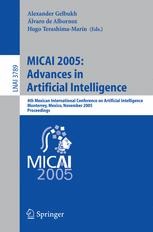
MICAI 2005 : Advances in Artificial Intelligence ; 4th Mexican International Conference on Artificial Intelligence, Monterrey, Mexico, November 14-18, 2005, Proceedings
Constitutes the refereed proceedings of the 4th Mexican International Conference on Artificial Intelligence, MICAI 2005, held Mexico, in November 2005. This book is organized in topical sections on knowledge representation and management, logic and constraint programming, uncertainty reasoning, multiagent systems and distributed AI, and others.

M-Health : Emerging Mobile Health Systems
M-health: Emerging Mobile Health Systems presents recent advances in this area and explores future trends in the applications of current and emerging wireless communication and network technologies for healthcare delivery and new wireless telemedical services. This work also evaluates the impact of the synergies between the 2.5G and 3G systems and beyond for healthcare applications and explores the augmentation of these technologies for the next generation of m-health services. M-health is commonly defined as the ‘emerging mobile communications and network technologies for healthcare systems’.

Metric Handbook : Planning and Design Data
A major handbook of planning and design data for architects and architecture students. Covering basic design data for all the major building types, it is the ideal starting point for any project. For each building type, the book gives the basic design requirements and all the principal dimensional data, and succinct guidance on how to use the information and what regulations the designer needs to be aware of.

Metric Driven Design Verification : An Engineer's and Executive's Guide to First Pass Success
A metric based flow is described that focuses on the four steps of: 1. Planning: Defining what needs to be done and the automatically trackable metrics that will be used to measure progress. 2. Execution: Implementing verification environments and then extensively exercising the device under verification utilizing comprehensive, massively parallel regression strategies. 3. Measurement: Automatically capturing the metrics defined in planning to provide objective data with which to manage the verification project. Custom tailoring those metrics through an automated reporting framework to provide all stakeholders a real-time meaningful view of project status. 4. Response: Utilizing the returned metrics to effectively adapt to changing project conditions. Making use of automated response mechanisms to automate engineering processed and management response to streamline project management processes
