



الصفحة 28
الصفحة 28
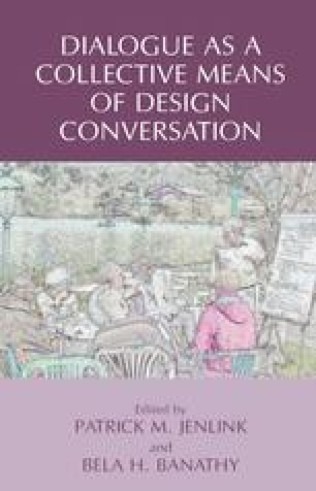
Dialogue as a Collective Means of Design Conversation
Dialogue as a Collective Means of Design Conversation is the second volume edited by Patrick M. Jenlink and Bela H. Banathy to offer a cross-disciplinary approach to examining dialogue as a communicative medium. In this Compendium, the contributing authors set forth their ideas, experiences, and perspectives as the path of a learning journey—a journey of new meaning, of new understanding, and of becoming self-aware of design conversation as future creating and consciousness evolving. In particular, this volume comes at a time when we as a global society are faced with the question of how we shape our actions and in turn shape our future, through conversation that is focused on resolving global conflict and fostering world peace. The volume evokes in the reader a realization that our greatest potential rests, in no small measure, with our collective capacity for cultural creativity and in our capacity to achieve new levels of consciousness through dialogue and design conversation.

Development, Sexual Cultural Practices and HIV/AIDS in Africa
This book introduces the theoretical frameworks and academic debates concerning sexual cultural practices and HIV/AIDS in Africa. It shows how these frameworks have been applied in a practical sense in Africa to investigate sexual cultural practices and their link with HIV/AIDS. The author provides an overview of both the field of study and the methods used during fieldwork. Finally, it assesses the implications of the findings for the conceptualization and provision of current and future HIV/AIDS policies and programs in Africa. This monograph will appeal to policy makers and practitioners working in the field of HIV/AIDS in the Global South as well as academics and students.

Development of trans-free lipid systems and their use in food products
Encompasses the work of leading researchers discussing, from a scientific and technological perspective, the latest and most innovative approaches to structure edible oils without the use of trans fats. Additionally, the authors discuss practical uses and technical limitations associated with the use of "structured edible oils" in different food systems. Appealing to researchers and professionals working in lipid science, food chemistry and fat metabolism, it fills the gap in the literature for a book in this fast-changing field.

Development of geopolymer from pond ash-thermal power plant waste : Novel constructional materials for civil engineers
Demonstrates how to utilize fly ash/pond ash (waste materials from thermal power plants) to produce a novel material called 'Geopolymer' (GP). Red mud, slags, etc., are mixed with fly ash to produce GP with enhanced strength. As shown in a few European countries, GP can replace cement, and some permanent structures constructed with GP are now appearing in a few advanced countries. GP, and geopolymer concrete, is considered suitable for the construction of roads, buildings, etc., and will eventually, fully or partially, replace cement.

Development in Turbulent Times: The Many Faces of Inequality Within Europe
This open access book explores the most recent trends in the EU in terms of development, progress, and performance.This book reflect upon the developmental challenges of the moment, such as sustainable development, reducing inequality, ensuring social cohesion, and driving the digital revolution. They particularly focus on the relation between the less-developed Eastern part of the EU and its more developed Western counterpart, and discuss the consequences of this development gap in detail. Lastly, the book presents a range of case studies from different areas of governance, such as economy and commerce, health services, education, migration and public opinion in order to investigate the trends most likely to impact the European Union's medium and long-term development.

Determining Spectra in Quantum Theory
The main objective of this book is to give a collection of criteria available in the spectral theory of selfadjoint operators, and to identify the spectrum and its components in the Lebesgue decomposition. at the total spectral measure associated with it;often studying such ameasure meant looking at some transform of the measure. The transforms were of the form f,?(A)f which is expressible, by the spectral theorem, as ?(x)dµ (x) for some finite measure µ . The two most widely used functions were the sx ?1 exponential function?(x)=e and the inverse function?(x)=(x?z) . These functions are “usable” in the sense that they can be manipulated with respect to addition of operators, which is what one considers most often in the spectral theory of Schrodinger type operators. Starting with this basic structure we look at the transforms of measures from which we can recover the measures and their components in Chapter 1. In Chapter 2 we repeat the standard spectral theory of selfadjoint op- ators. The spectral theorem is given also in the Hahn–Hellinger form. Both Chapter 1 and Chapter 2 also serve to introduce a series of definitions and notations, as they prepare the background which is necessary for the criteria in Chapter 3.

Detection of Liquid Explosives and Flammable Agents in Connection with Terrorism
The organization of an Advanced Research Workshop with the title “Detection and Disposal of Liquid Explosives and Flammable Agents in Connection with Terrorism” was motivated by international findings about activities in this field of application. This ARW followed a meeting about the “Detection of Disposal Improvised Explosives” (St. Petersburg, 2005). Both items show the logistic problems as one of the lessons, terrorists have to overcome. These problems are connected with the illegal supply and transport of explosives and fuels and as counter-measure the detection of these materials. The invention of liquid explosives goes back to the middle of the 19th century and was used for special purposes in the commercial field of application. Because of the high sensitivity of liquid explosives against mechanical shock, caused by adiabatic compression of air-bobbles producing “hot spots” as origin of initiation the commercial application was not very successful. Because of this high risk, liquid explosives are not used in military or commercial application with some exceptions. In the commercial field explosives as slurries or emulsions consisting of suitable salts (Ammoniumnitrate etc.) and water are used to a large extend because of their high insensitivity. In many cases these slurries or emulsions were unfit for terrorist actions, because of their low sensitivity, large critical diameter and using in confinement. In the military field liquid explosives are used in World War I and II as bomb-fillings.

Designing healthy and liveable cities : Creating sustainable urban regeneration
Aim of this book is, after the definition of the field of investigation concerning sustainable regeneration trough topics such as resilience, adaptation, health and mixed connections, to illustrate the present-day approaches to the analysis and design of healthy places, and in particular the original Healthy Pl@ce Design method, flexible and repeatable in different contexts. The method aims at: identifying sustainable urban liveability and healthy and the factors which make places liveable and healthy from the user's point of view and identifying design interventions to enhance or create both urban liveability and health. Emblematic case studies carried out in Europe, USA and China - Bordeaux, Copenhagen, Hamburg, Madrid, Newcastle, Nice, Dublin, Vancouver and Wuhan - constitute the empirical part of the Book detailed with surveys, questionnaires, images and maps.

Designers' guide to Eurocode 1 : Actions on Bridges : EN 1991-2, EN 1991-1-1, -1-3 TO -1-7 and EN 1990 Annex A2
Provides comprehensive guidance in the form of design aids, indications for the most convenient design procedures and worked examples. The books also include background information to aid the designer in understanding the reasoning behind and the objectives of the codes. All of the individual guides work in conjunction with the Designers' Guide to EN 1990 Eurocode: Basis of Structural Design. The parts of Eurocode 1 covered by this guide, EN 1991-1 and EN 1991-2, address the general actions and traffic loads on civil engineering structures. This Designers' Guide looks specifically at these actions as they apply to bridges, including full explanation, commentary, examples, and direction to the National Annex documents on each of the following parts and sub-parts of the code. EN1990 Annex 2: Basis of structural design.

Designers' guide to EN 1994-2 Eurocode 4 : Design of steel and composite structures ; Part 2 : General rules and rules for bridges
It is an authoritative guide to the technical background and practical aspects of this European code of practice that will supersede corresponding national codes in the countries that are members of the European Standardisation Organisation - CEN (Comite Europeen de Normalisation). This book provides guidance on the interpretation and use of EN 1994-2 and presents worked examples. It deals with the issues that are encountered in typical steel and concrete composite bridge designs, and explains the relationships between EN 1994-1-1, EN 1994-2 and the other Eurocodes.

Designers' guide to EN 1993-2 Eurocode 3: Design of Steel Structures: Part 2: Steel Bridges
Describes the principles and requirements for safety, serviceability and durability of concrete bridges. This Designers' Guide provides the user with guidance on the interpretation and use of EN 1993-2 and also the relevant provisions in EN 1993-1-1, EN 1993-1-5, EN 1993-1-8, EN 1993-1-9, EN 1993-1-10 and EN 1993-1-11. Worked examples are provided to illustrate the use of the rules. It also explains the relationship with other Eurocode parts to which it refers (ENs 1990, 1991).

Design of residential tower in Swaida city
The project is a concrete design of residential tower located in Swaida city. Consisting of basement containing shelter, car parking, warehouses, guard room & service rooms such as boilers and pumps, ground floor containing four apartments, repeated eight floors each floor contains four apartments, ground tank & two upper tanks.

Design of a residential tower in Damascus (B131 Marota city)
The project is a residential building consisting of one basement and seventeen floors. The basement includes a car garage and a shelter. The first is a technical floor. The remaining sixtee floors are repeated residential floors.

Design Graphics : Drawing Techniques for Design Professionals
Combines–in a single volume–simple techniques and skills related to sketching, design-development, and the schematic or preliminary phase of design presentation. Emphasizing drawing as a mental as well as physical exercise, the text helps students draw designs on paper faster and easier, showing them how visual communication with clients can provide better, more economical design solutions. Practical, straightforward, and reader-friendly, Design Graphics provides more complete coverage of the basics, making concepts and techniques accessible to students with highly diversified educational and technical backgrounds.

Desertification in the Mediterranean Region : A security issue ; Proceedings of the NATO Mediterranean Dialogue Workshop, held in Valencia, Spain, 2-5 December 2003
This book focuses on two basic concepts: security and desertification in the Mediterranean Region and their linkages. Desertification is recognized as a process of land degradation in arid, semi-arid, and dry sub-humid areas of the world that is the result of natural phenomena (e.g. climate variation) and anthropogenic factors. The outcome of this type of degradation has typically been considered to be either a reduction or a loss of both biological and economic productivity. The scope of the book includes the identification of the physical processes of desertification specific to both the north and south Mediterranean Region. Additionally, it specifically questions how changing environmental conditions may potentially reduce stability and peace in the world and thus affect "environmental security."

Der junge Carnap in historischem kontext : 1918–1935 = Young Carnap in an historical context: 1918–1935
This volume is based on the 'Early Carnap in Context’ workshop that took place in Konstanz in 2017 and looks at Rudolf Carnap’s philosophy, documented in his recently released diaries, from a combination of historical, cultural and philosophical perspectives. It enables further evaluation of the diaries and traces newly found interrelationships and their systematic definition. From a cultural and historical point of view, Logical Empiricism and Carnap’s pivotal opus, The Logical Structure of the World, did not evolve in a vacuum

Dependable computing - EDCC 2005 ; 5th European dependable computing Conference, Budapest, Hungary, April 20-22, 2005, Proceedings
It is always a special honor to chair the European Dependable Computing C- ference (EDCC). EDCC has become one of the well-established conferences in the ?eld of dependability in the European research area. Budapest was selected as the host of this conference due to its traditions in organizing international scienti?c events and its traditional role of serving as a meeting point between East and West. EDCC-5 was the ?fth in the series of these high-quality scienti?c conf- ences. In addition to the overall signi?cance of such a pan-European event, this year’s conference was a special one due to historic reasons. The roots of EDCC date back to the moment when the Iron Curtain fell. Originally, two groups of scientists from di?erent European countries in Western and Eastern Europe – who were active in research and education related to dependability created a – joint forum in order to merge their communities as early as in 1989. This trend has continued up to today. This year’s conference was the ?rst one where the overwhelming majority of the research groups belong to the family of European nations united in the European Union. During the past 16 years we observed that the same roots in all the professional, cultural and scienti?c senses led to a seamless integration of these research communities previously separated ar- ?cially for a long time. EDCC has become one of the main European platforms to exchange new - searchideasinthe?eldofdependability.

Dependable and adaptable networks and services ; 13th Open European Summer School and IFIP TC6.6 Workshop, EUNICE 2007, Enschede, The Netherlands, July 18-20, 2007, Proceedings
Innovative Internet Applications.’ Much has changed since then: wireless network technologies have become a constantly growing part of the Internet infrastructure, and increasingly smaller and more powerful computing devices with ?exible connectivity open the possibility of new services and applications.

Dental anatomy and morphology
Conveys the practical knowledge of dental anatomy and the art of sculpting it in wax. The ideal anatomy of each dental structure is described in detail and the waxing techniques are beautifully illustrated step by step for visual reference. The author demonstrates that for every morphologic feature there is an explanation in nature, assigning significance to every minute feature of dental morphology. Organized by tooth and arch, this book views morphology through a clinical lens and repeatedly draws connections between anatomical features and clinical concepts. The fundamental knowledge presented in this text is essential for improving waxing and sculpting techniques and will be useful for students and specialists alike.

Dense Molecular Gas around Protostars and in Galactic Nuclei : European Workshop on Astronomical Molecules 2004
The European Workshop on Astronomical Molecules was held at ‘The Conference Building’ in Zwolle, the Netherlands, on 18–20 February 2004. The idea behind the workshop was to bring together astronomers studying similar processes in different astrophysical environments; masers and dense molecular gas around young stars and galactic nuclei. There is considerable overlap in physical and chemical phenomena between these environments, with scales ranging from circumstellar to central regions of galaxies. This issue includes 12 reviews and 27 contributed papers presented in this Wo- shop, all of them were refereed by invited speakers or the editors. The quality of the papers is outstanding. The projects discussed here are often in an early stage and undoubtedly their progress has bene?ted greatly from the opportunity to discuss results with the experts in a wide range of areas. Similarly,
