



الصفحة 27
الصفحة 27

Computational Probability : Algorithms and Applications in the Mathematical Sciences
Computational probability encompasses data structures and algorithms that have emerged over the past decade that allow researchers and students to focus on a new class of stochastic problems. COMPUTATIONAL PROBABILITY is the first book that examines and presents these computational methods in a systematic manner. The techniques described here address problems that require exact probability calculations, many of which have been considered intractable in the past. The first chapter introduces computational probability analysis, followed by a chapter on the Maple computer algebra system. The third chapter begins the description of APPL, the probability modeling language created by the authors. The book ends with three applications-based chapters that emphasize applications in survival analysis and stochastic simulation.

Computational Physiology : Simula Summer School 2021 − Student Reports
Compiles student reports from the 2021 Simula Summer School in Computational Physiology. Interested readers will find herein a number of modern approaches to modeling excitable tissue. This should provide a framework for tools available to model subcellular and tissue-level physiology across scales and scientific questions.

Computational Multiscale Modeling of Fluids and Solids : Theory and Applications
The book includes the micro-scale, the meso-scale and the macro-scale. The chapters follow this classification. The book will explain in detail many tricks of the trade of some of the most important methods and techniques that are used to simulate materials on the perspective levels of spatial and temporal resolution. Case studies are occasionally included to further illustrate some methods or theoretical considerations. Example applications for all techniques are provided, some of which are from the author’s own contributions to some of the research areas. Methods are explained, if possible, on the basis of the original publications but also references to standard text books established in the various fields are mentioned.

Computational Many-Particle Physics
Complicated many-particle problems abound in nature and in research alike. Plasma physics, statistical physics and condensed matter physics, as primary examples, are all heavily dependent on efficient methods for solving such problems. Addressing graduate students and young researchers, this book presents an overview and introduction to state-of-the-art numerical methods for studying interacting classical and quantum many-particle systems. A broad range of techniques and algorithms are covered, and emphasis is placed on their implementation on modern high-performance computers.

Computational logic in multi-agent systems ; Vol. 3900 ; 6th International Workshop, CLIMA VI, London, UK, June 27-29, 2005, Revised Selected and Invited Papers
The book presents 14 revised full technical papers, 4 contest papers, and 7 invited papers together with 1 invited article are organized in topical sections on foundational aspects of agency, agent programming, agent interaction and normative systems, the first CLIMA contest, and on the project report of the SOCS project.
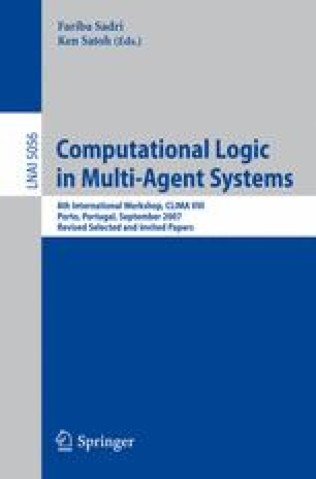
Computational logic in multi-agent systems ; 8th International Workshop, CLIMA VIII, Porto, Portugal, September 10-11, 2007. Revised Selected and Invited Papers
This book constitutes the thoroughly refereed post-conference proceedings of the 8th International Workshop on Computational Logic for Multi-Agent Systems, CLIMA VIII, held in Porto, Portugal, in September 2007 - co-located with ICLP 2008, the International Conference on Logic Programming.

Computational logic in multi-agent systems ; 4th International Workshop, CLIMA IV, Fort Lauderdale, FL, USA, January 6-7, 2004, Revised Selected and Invited Papers
Though multiagent systems (MASs) are being increasingly used, few methods exist to ensure survivability of MASs. All existing methods suffer from two flaws. First, a centralized survivability algorithm (CSA) ensures survivability of the MAS – unfortunately, if the node on which the CSA exists goes down, the survivability of the MAS is questionable. Second, no mechanism exists to change how the MAS is deployed when external factors trigger a re-evaluation of the survivability of the MAS. In this paper, we present three algorithms to address these two important problems. Our algorithms can be built on top of any CSA. Our algorithms are completely distributed and can handle external triggers to compute a new deployment. We report on experiments assessing the efficiency of these algorithms.

Computational linguistics and intelligent text processing ; 9th International Conference, CICLing 2008, Haifa, Israel, February 17-23, 2008. Proceedings
The CICLing conferences are intended to provide a wide-scope forum for the discussion of both the art and craft of natural language processing research and the best practices in its applications. This volume contains the papers accepted for oral presentation at the c- ference, as well as several of the best papers accepted for poster presentation.

Computational intelligence paradigms : Innovative Applications
The book includes a sample of research on the innovative applications of advanced computational intelligence paradigms. The characteristics of computational intelligence paradigms such as learning, generalization based on learned knowledge, knowledge extraction from imprecise and incomplete data are the extremely important for the implementation of intelligent machines.

Computational intelligence in biomedicine and bioinformatics : Current trends and applications
The purpose of this book is to provide an overview of powerful state-of-the-art methodologies that are currently utilized for biomedicine and/ or bioinformatics-oriented applications, so that researchers working in those fields could learn of new methods to help them tackle their problems.

Computational intelligence based on lattice theory
The emergence of lattice theory within the field of computational intelligence (CI) is partially due to its proven effectiveness in neural computation. Moreover, lattice theory has the potential to unify a number of diverse concepts and aid in the cross-fertilization of both tools and ideas within the numerous subfields of CI. The compilation of this eighteen-chapter book is an initiative towards proliferating established knowledge in the hope to further expand it. This edited book is a balanced synthesis of four parts emphasizing, in turn, neural computation, mathematical morphology, machine learning, and (fuzzy) inference/logic. The articles here demonstrate how lattice theory may suggest viable alternatives in practical clustering, classification, pattern analysis, and regression applications.

Computational intelligence and bioinspired systems ; 8th International Work-conference on artificial neural networks, IWANN 2005, Vilanova i la Geltrú, Barcelona, Spain, June 8-10, 2005, Proceedings
We present in this volume the collection of finally accepted papers of the eighth edition of the “IWANN” conference (“International Work-Conference on Artificial Neural Networks”). This biennial meeting focuses on the foundations, theory, models and applications of systems inspired by nature (neural networks, fuzzy logic and evolutionary systems). For scientists, engineers and professionals working in the area, this is a very good way to get solid and competitive applications. We are facing a real revolution with the emergence of embedded intelligence in many artificial systems (systems covering diverse fields: industry, domotics, leisure, healthcare, … ). So we are convinced that an enormous amount of work must be, and should be, still done. Many pieces of the puzzle must be built and placed into their proper positions, offering us new and solid theories and models (necessary tools) for the application and praxis of these current paradigms. The above-mentioned concepts were the main reason for the subtitle of the IWANN 2005 edition: “Computational Intelligence and Bioinspired Systems.” papers was addressing the following topics: 1. Mathematical and theoretical methods in computational intelligence.

Computational intelligence : Methods and techniques
This book focuses on various techniques of computational intelligence, both single ones and those which form hybrid methods. Those techniques are today commonly applied issues of artificial intelligence, e.g. to process speech and natural language, build expert systems and robots.

Computational Fluid Dynamics for Wind Engineering
Covers topics such as: Fluid mechanics, turbulence in fluid mechanics, turbulence modelling, and mathematical modelling of wind engineering problems The finite difference method for CFD, solutions to the incompressible Navier-Stokes equations, visualization, and animation in CFD, and the application of CFD to building and bridge aerodynamics How to compare CFD analysis with wind tunnel measurements, field measurements, and the ASCE-7 pressure coefficients Wind effects and strain on large structures

Computational Fluid Dynamics 2004 ; Proceedings of the Third International Conference on Computational Fluid Dynamics, ICCFD3, Toronto, 12-16 July 2004
The International Conference on Computational Fluid Dynamics (ICCFD) is the merger of the International Conference on Numerical Methods in Fluid Dynamics (ICNMFD) and the International Symposium on Computational Fluid Dynamics (ISCFD). It is held every two years and brings together physicists, mathematicians and engineers to review and share recent advances in mathematical and computational techniques for modeling fluid dynamics. The proceedings of the 2004 conference held in Toronto, Canada, contain a selection of refereed contributions and are meant to serve as a source of reference for all those interested in the state of the art in computational fluid dynamics.

Computational Electronic Circuits : Simulation and Analysis with MATLAB®
This textbook teaches in one, coherent presentation the three distinct topics of analysis of electronic circuits, mathematical numerical algorithms and coding in a software such as MATLAB®. By combining the capabilities of circuit simulators and mathematical software, the author teaches key concepts of circuit analysis and algorithms, using a modern approach. The DC, Transient, AC, Noise and behavioral analyses are implemented in MATLAB to study the complete characteristics of a variety of electronic circuits, such as amplifiers, rectifiers, hysteresis circuits, harmonic traps and passes, polyphaser filters, directional couplers, electro-static discharge and piezoelectric crystals. This book teaches basic and advanced circuit analysis, by incorporating algorithms and simulations that teach readers how to develop their own simulators and fully characterize and design electronic circuits.

Comfort and Perception in Architecture
This book discusses the design of comfortable buildings and shows that design perception and, as a result, comfort should be an intentional feature of architectural design. Modern buildings are often sealed boxes without operable windows or daylighting design. However, contemporary designers increasingly find themselves faced with the task of creating spaces that are comfortable in terms of thermal and visual aspects.

Combustion : Physical and Chemical Fundamentals, Modeling and Simulation, Experiments, Pollutant Formation
The actual fourth edition presents a completely restructured book: Mathematical Formulae and derivations as well as the space-consuming reaction mechanisms have been replaced from the text to appendix. A new chapter discusses the impact of combustion processes on the earth’s atmosphere, the chapter on auto-ignition is extended to combustion in Otto- and Diesel-engines, and the chapters on heterogeneous combustion and on soot formation appear heavily revised.

Combinatorial Optimization : Theory and Algorithms
Puts special emphasis on theoretical results and algorithms with provably good performance, in contrast to heuristics. It has arisen as the basis of several courses on combinatorial optimization and more special topics at graduate level. Since the complete book contains enough material for at least four semesters (4 hours a week), one usually selects material in a suitable way. The book contains complete but concise proofs, also for many deep results, some of which did not appear in a book before. Many very recent topics are covered as well, and many references are provided. Thus this book represents the state of the art of combinatorial optimization. This third edition contains a new chapter on facility location problems, an area which has been extremely active in the past few years. Furthermore there are several new sections and further material on various topics. New exercises and updates in the bibliography were added.

Combinatorial Optimization : Theory and Algorithms
Places special emphasis on theoretical results and algorithms with provably good performance, in contrast to heuristics. It has arisen as the basis of several courses on combinatorial optimization and more special topics at graduate level. It contains complete but concise proofs, also for many deep results, some of which did not appear in a textbook before. Many very recent topics are covered as well, and many references are provided. Thus this book represents the state of the art of combinatorial optimization.
