



الصفحة 23
الصفحة 23

Conceptual Ecology and Invasion Biology : Reciprocal Approaches to Nature
In this edited volume, global experts in ecology and evolutionary biology explore how theories in ecology elucidate the invasion processes while also examining how specific invasions informs ecological theory. This reciprocal benefit is highlighted in a number of scales of organization: population, community and biogeographic, while employing example invaders in all major groups of organisms and from a number of regions around the globe. The chapters in this volume utilize many of the cutting edge observational, experimental, analytical and computational methods used in modern ecology. Through merging conceptual ecology and invasion biology we can obtain a better understanding of the invasion process while also developing a better understanding of how ecological systems function.

Concepts, Frames and Cascades in Semantics, Cognition and Ontology
This book presents novel theoretical, empirical and experimental work exploring the nature of mental representations that support natural language production and understanding, and other manifestations of cognition. One fundamental question raised in the text is whether requisite knowledge structures can be adequately modeled by means of a uniform representational format, and if so, what exactly is its nature. Frames are a key topic covered which have had a strong impact on the exploration of knowledge representations in artificial intelligence, psychology and linguistics; cascades are a novel development in frame theory. Other key subject areas explored are: concepts and categorization, the experimental investigation of mental representation, as well as cognitive analysis in semantics. This book is of interest to students, researchers, and professionals working on cognition in the fields of linguistics, philosophy, and psychology.

Concepts in action : Representation, learning, and application
This book is a timely contribution in presenting recent issues, approaches, and results that are not only central to the highly interdisciplinary field of concept research but also particularly important to newly emergent paradigms and challenges. The contributors present a unique, holistic picture for the understanding and use of concepts from a wide range of fields including cognitive science, linguistics, philosophy, psychology, artificial intelligence, and computer science. The chapters focus on three distinct points of view that lie at the core of concept research: representation, learning, and application. The contributions present a combination of theoretical, experimental, computational, and applied methods that appeal to students and researchers working in these fields.

Computer Simulations of Liquid Crystals and Polymers ; Proceedings of the NATO Advanced Research Workshop on Computational Methods for Polymers and Liquid Crystalline Polymers, Erice, Italy. 16-22 July 2003
Liquid crystals, polymers and polymer liquid crystals are soft condensed matter systems of major technological and scientific interest. An understanding of the macroscopic properties of these complex systems and of their many and interesting peculiarities at the molecular level can nowadays only be attained using computer simulations and statistical mechanical theories. Both in the Liquid Crystal and Polymer fields a considerable amount of simulation work has been done in the last few years with various classes of models at different special resolutions, ranging from atomistic to molecular and coarse-grained lattice models. Each of the two fields has developed its own set of tools and specialized procedures and the book aims to provide a state of the art review of the computer simulation studies of polymers and liquid crystals. This is of great importance in view of a potential cross-fertilization between these connected areas which is particularly apparent for a number of experimental systems like, e.g. polymer liquid crystals and anisotropic gels where the different fields necessarily merge. An effort has been made to assess the possibilities of a coherent description of the themes that have developed independently, and to compare and extend the theoretical and computational techniques put forward in the different areas.

Computer Aided Pharmaceutics and Drug Delivery : An Application Guide for Students and Researchers of Pharmaceutical Sciences
Examines the role of computer-assisted techniques for discovering, designing, optimizing and manufacturing new, effective, and safe pharmaceutical formulations and drug delivery systems. The book discusses computational approaches, statistical modeling and molecular modeling for the development and safe delivery of drugs in humans. The application of concepts of QbD (Quality by Design), DoE (Design of Experiments), artificial intelligence and in silico pharmacokinetic assessment/simulation have been made a lot easier with the help of commercial software and expert systems. This title provides in-depth knowledge of such useful software with illustrations from the latest researches. The book also fills in the gap between pharmaceutics and molecular modeling at micro, meso and maro scale by covering topics such as advancements in computer-aided Drug Design (CADD), drug-polymer interactions in drug delivery systems, molecular modeling of nanoparticles and pharmaceutics/bioinformatics.

Computational methods in systems biology ; 18th International Conference, CMSB 2020, Konstanz, Germany, September 23–25, 2020, Proceedings
This book constitutes the refereed proceedings of the 18th International Conference on Computational Methods in Systems Biology, CMSB 2020, held in Konstanz, Germany, in September 2020.* The 17 full papers and 5 tool papers were carefully reviewed and selected from 30 submissions. In addition 3 abstracts of invited talks and 2 tutorials have been included in this volume. Topics of interest include formalisms for modeling biological processes; models and their biological applications; frameworks for model verification, validation, analysis, and simulation of biological systems; high-performance computational systems biology and parallel implementations; model inference from experimental data; model integration from biological databases; multi-scale modeling and analysis methods; computational approaches for synthetic biology; and case studies in systems and synthetic biology.

Computational intelligence in time series forecasting : Theory and engineering applications
Deals with the power of intelligent technologies individually and in combination. This book includes examples of the particular systems and processes susceptible to each technique. It is suitable for industrial training purposes, as well as serving as a useful reference material for experimental researchers.

Computational earthquake physics ; Part II
Exciting developments in earthquake science have benefited from new observations, improved computational technologies, and improved modeling capabilities. Designing realistic supercomputer simulation models for the complete earthquake generation process is a grand scientific challenge due to the complexity of phenomena and range of scales involved from microscopic to global. The present volume - Part II - incorporates computational environment and algorithms, data assimilation and understanding, model applications and iSERVO. Topics covered range from iSERVO and QuakeSim: implementing the international solid earth research virtual observatory by integrating computational grid and geographical information web services; LURR (Load-Unload Response Ratio) described in six papers involving this promising earthquake forecasting model; pattern informatics and phase dynamics and their applications, which was also a highlight in the Workshop; computational algorithms, including continuum damage models and visualization and analysis of geophysical datasets; evolution of mantle material; the state vector approach; and assimilation of data such as geodetic data, GPS data, and seismicity and laboratory experimental data.

Computational Cognitive Modeling and Linguistic Theory
This book introduces a general framework that allows natural language researchers to enhance existing competence theories with fully specified performance and processing components. Gradually developing increasingly complex and cognitively realistic competence-performance models, it provides running code for these models and shows how to fit them to real-time experimental data. This computational cognitive modeling approach opens up exciting new directions for research in formal semantics, and linguistics more generally, and offers new ways of (re)connecting semantics and the broader field of cognitive science.

Combinatorics, Algorithms, Probabilistic and Experimental Methodologies ; 1st International Symposium, ESCAPE 2007, Hangzhou, China, April 7-9, 2007, Revised Selected Papers
This book address practical large data processing problems with different, and eventually converging, methodologies from major important disciplines such as computer science, combinatorics, and statistics. The symposium provides an interdisciplinary forum for researchers across their discipline boundaries to exchange their approaches, to search for ideas, methodologies, and tool boxes, to find better, faster and more accurate solutions thus fostering innovative ideas as well as to develop research agenda of common interest.

Collider Physics within the Standard Model : A Primer
In 2013 the late Prof. Altarelli wrote: The discovery of the Higgs boson and the non-observation of new particles or exotic phenomena have made a big step towards completing the experimental confirmation of the standard model of fundamental particle interactions. It is thus a good moment for me to collect, update and improve my graduate lecture notes on quantum chromodynamics and the theory of electroweak interactions, with main focus on collider physics. I hope that these lectures can provide an introduction to the subject for the interested reader, assumed to be already familiar with quantum field theory and some basic facts in elementary particle physics as taught in undergraduate courses.

Collective Phenomena in Synchrotron Radiation Sources : Prediction, Diagnostics, Countermeasures
This book helps to dispel the notion that collective phenomena, which have become increasingly important in modern storage rings, are an obscure and inaccessible topic. Despite an emphasis on synchrotron light sources, the basic concepts presented here are valid for other facilities as well. Graduate students, scientists and engineers working in an accelerator environment will find this to be a systematic exposition of the principles behind collective instabilities and lifetime-limiting effects. Experimental methods to identify and characterize collective effects are also surveyed. Among other measures to improve the performance of a projected or existing facility, a detailed account of feedback control of instabilities is given.

Collective Dynamics of Nonlinear and Disordered Systems
Phase transitions in disordered systems and related dynamical phenomena are a topic of intrinsically high interest in theoretical and experimental physics. This book presents a unified view, adopting concepts from each of the disjoint fields of disordered systems and nonlinear dynamics. Special attention is paid to the glass transition, from both experimental and theoretical viewpoints, to modern concepts of pattern formation, and to the application of the concepts of dynamical systems for understanding equilibrium and nonequilibrium properties of fluids and solids. The content is accessible to graduate students, but will also be of benefit to specialists, since the presentation extends as far as the topics of ongoing research work.

Collecting spatial data : Optimum design of experiments for random fields
The book is concerned with the statistical theory for locating spatial sensors. It bridges the gap between spatial statistics and optimum design theory. The revised edition contains additional material on design for detecting spatial dependence and for estimating parametrized covariance functions.

Cohesion, coherence and temporal reference from an experimental corpus pragmatics perspective
Provides new methodological and theoretical insights into temporal reference and its linguistic expression, from a cross-linguistic experimental corpus pragmatics approach. Verbal tenses, in general, and more specifically the categories of tense, grammatical and lexical aspect are treated as cohesion ties contributing to the temporal coherence of a discourse, as well as to the cognitive temporal coherence of the mental representations built in the language comprehension process. As such, it investigates the phenomenon of temporal reference at the interface between corpus linguistics, theoretical linguistics and pragmatics, experimental pragmatics, psycholinguistics, natural language processing and machine translation.

Cognitive Supervision for Robot-Assisted Minimally Invasive Laser Surgery
This thesis lays the groundwork for the automatic supervision of the laser incision process, which aims to complement surgeons’ perception of the state of tissues and enhance their control over laser incisions. The research problem is formulated as the estimation of variables that are representative of the state of tissues during laser cutting. Prior research in this area leveraged numerical computation methods that bear a high computational cost and are not straightforward to use in a surgical setting. This book proposes a novel solution to this problem, using models inspired by the ability of experienced surgeons to perform precise and clean laser cutting. It shows that these new models, which were extracted from experimental data using statistical learning techniques, are straightforward to use in a surgical setup, allowing greater precision in laser-based surgical procedures.

Cognitive Aspects of Bilingualism
A unique feature of this book is that chapters favor that line of cognitive linguistics which makes a clear distinction between real world and projected world. Information conveyed by language must be about the projected world. Both the experimental results and the systematic claims in this volume call for a weak form of whorfianism. Also, chapters add some relatively unexplored issues of bilingualism to the well-known ones, such as gender systems in the bilingual mind, context and task, synergic concepts, blending, the relationship between lexical categorization and ontological categorization among others.

Materials Fundamentals of Gate Dielectrics
This book presents materials fundamentals of novel gate dielectrics that are being introduced into semiconductor manufacturing to ensure the continuous scalling of the CMOS devices. This is a very fast evolving field of research so we choose to focus on the basic understanding of the structure, thermodunamics, and electronic properties of these materials that determine their performance in device applications. Most of these materials are transition metal oxides. Ironically, the d-orbitals responsible for the high dielectric constant cause sever integration difficulties thus intrinsically limiting high-k dielectrics. Though new in the electronics industry many of these materials are wel known in the field of ceramics, and we describe this unique connection. The complexity of the structure-property relations in TM oxides makes the use of the state of the art first-principles calculations necessary. Several chapters give a detailed description of the modern theory of polarization, and heterojunction band discontinuity within the framework of the density functional theory. Experimental methods include oxide melt solution calorimetry and differential scanning calorimetry, Raman scattering and other optical characterization techniques, transmission electron microscopy, and x-ray photoelectron spectroscopy.
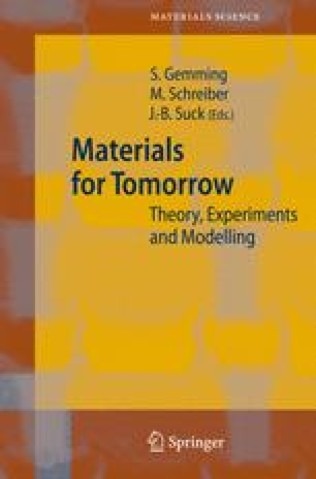
Materials for Tomorrow : Theory, Experiments and Modelling
This book contains six chapters on central topics in materials science. Each is written by specialists in the field, and gives a state-of-the-art presentation of the subject for graduate students and scientists not necessarily working in that field. Computer simulations of new materials, theory and experimental work are all extensively discussed. As nanomaterials are of great current interest, most of the topics discussed have a bearing on nanomaterials and nanodevices. In addition to inorganic nanotubes, metallic nanocrystals, electronic nanodevices, spintronics and interfaces on an atomic scale, the text also presents computer simulations on one of the less well understood fields in solid-state physics and materials science: glasses and undercooled fluids.

Material Properties under Intensive Dynamic Loading
Understanding the physical and thermomechanical response of materials subjected to intensive dynamic loading is a challenge of great significance in engineering today. This volume assumes the task of gathering both experimental and diagnostic methods in one place, since not much information has been previously disseminated in the scientific literature. This book will thus be an invaluable companion for both the seasoned practioner as well as for the novice entering the field of experimental shock physics.
