


تحسين النتائح
ترتيب حسب
من
الى

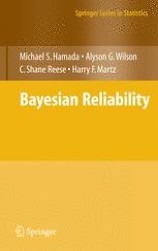
Bayesian Reliability presents modern methods and techniques for analyzing reliability data from a Bayesian perspective. The adoption and application of Bayesian methods in virtually all branches of science and engineering have significantly increased over the past few decades. This increase is largely due to advances in simulation-based computational tools for implementing Bayesian methods. The authors extensively use such tools throughout this book, focusing on assessing the reliability of components and systems with particular attention to hierarchical models and models incorporating explanatory variables. Such models include failure time regression models, accelerated testing models, and degradation models. The authors pay special attention to Bayesian goodness-of-fit testing, model validation, reliability test design, and assurance test planning. Throughout the book, the authors use Markov chain Monte Carlo (MCMC) algorithms for implementing Bayesian analyses--algorithms that make the Bayesian approach to reliability computationally feasible and conceptually straightforward.

Axial Flux Permanent Magnet (AFPM) brushless machines are modern electrical machines with a lot of advantageous merits over their conventional counterparts. They are increasingly used in power generation, domestic appliances, industrial drives, electric vehicles, and marine propulsion drives and many other applications. This book deals with the analysis, construction, design, optimisation, control and applications of AFPM machines. The authors present their own research results, as well as significant research contributions made by others. This monograph will be of interest to electrical engineers and other engineers involved in the design and application of AFPM brushless machine drives. It will be an important resource for researchers and graduate students in the field of electrical machine and drives.

This collection covers the state of the art in automatic differentiation theory and practice. Practitioners and students will learn about advances in automatic differentiation techniques and strategies for the implementation of robust and powerful tools. Computational scientists and engineers will benefit from the discussion of applications, which provide insight into effective strategies for using automatic differentiation for design optimization, sensitivity analysis, and uncertainty quantification.

Atomistic Modeling of Materials Failure is an introduction to molecular and atomistic modeling techniques applied to solid deformation and fracture. Focusing on a variety of brittle, ductile and geometrically confined materials, this detailed overview includes computational methods at the atomic scale, and describes how these techniques can be used to model the dynamics of cracks, dislocations and other deformation mechanisms.

This book is a blend of analytical methods based on the phenomenon of atomic and nuclear physics. It comprises comprehensive presentations about X-ray Fluorescence (XRF), Mössbauer Spectroscopy (MS), X-ray Photoelectron Spectroscopy (XPS), Neutron- Activation Analysis (NAA), Particle Induced X-ray Emission Analysis (PIXE), Rutherford Backscattering Analysis (RBS), Elastic Recoil Detection (ERD), Nuclear Reaction Analysis (NRA), Particle Induced Gamma-ray Emission Analysis (PIGE), and Accelerator Mass Spectrometry (AMS). These techniques are commonly applied in the fields of medicine, biology, environmental studies, archaeology or geology et al. and pursued in major international research laboratories.

The book describes the branch of astrophysics in which processes in the universe are investigated with experimental methods known from particle physics experiments. After a historical introduction to the basics of elementary particles, their interactions and the relevant detection techniques are described. The main body of the book concerns cosmic rays. The modern aspects of astroparticle physics are described in a chapter on cosmology. The book provides an orientation in the field of astroparticle physics that many beginners might look for. The physics issues are presented with little mathematics, and the results are illustrated by many diagrams. The reader has a chance to enter this field of astrophysics with a book that closes the gap between expert and popular level.
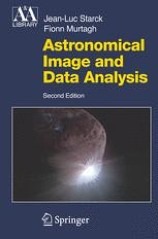
With information and scale as central themes, this comprehensive survey explains how to handle real problems in astronomical data analysis using a modern arsenal of powerful techniques. It treats those innovative methods of image, signal, and data processing that are proving to be both effective and widely relevant. The coverage includes chapters or appendices on: detection and filtering; image compression; multichannel, multiscale, and catalog data analytical methods; wavelets transforms, Picard iteration, and software tools. This second edition of Starck and Murtagh's highly appreciated reference again deals with topics that are at or beyond the state of the art. It presents material which is more algorithmically oriented than most alternatives and broaches new areas like ridgelet and curvelet transforms. Throughout the book various additions and updates have been made.

This book points out the need of a multidisciplinary approach in the field of risk assessment and management. It provides an overview of the problems, approaches and common practices directly related to earthquake risk mitigation and, in particular, to the preparation of earthquake emergency plans. Written by a team of specialists from different disciplines, the authors worked together extensively in order to create unity and continuity in the text as a whole. Each topic is illustrated with examples of actual applications taken from the bibliography – including websites with available relevant information. Case studies and information on some relevant international projects are given.
Chapter 3 Specifying RTL Properties 61 3. 3 Declarative versus procedural 67 3. 3 RTL assertion specification techniques 68 RTL invariant assertions 69 3. 2 Declaring properties with PSL 72 RTL cycle related assertions 73 3. 3 3. 1 Immediate assertions 84 3. 3 System functions 95 3. 3 Assertions across simulation time slots 111 4.
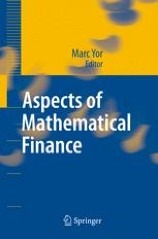
Considering the stupendous gain in importance, in the banking and insurance industries since the early 1990’s, of mathematical methodology, especially probabilistic methodology, it was a very natural idea for the French "Académie des Sciences" to propose a series of public lectures, accessible to an educated audience, to promote a wider understanding for some of the fundamental ideas, techniques and new tools of the financial industries. These lectures were given at the "Académie des Sciences" in Paris by internationally renowned experts in mathematical finance, and later written up for this volume which develops, in simple yet rigorous terms, some challenging topics such as risk measures, the notion of arbitrage, dynamic models involving fundamental stochastic processes like Brownian motion and Lévy processes.
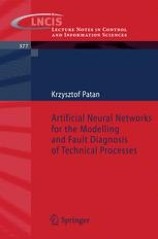
In this book, a wide spectrum of fault diagnosis techniques have been developed. A major category of fault diagnosis techniques is the model based one, where an analytical model of the plant to be monitored is assumed to be available.
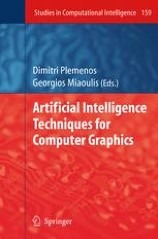
This volume contains both invited and selected extended papers from the last 3IA Conference (3IA’2008), together with an introduction presenting the area of Intelligent Computer Graphics and various Computer Graphics areas where introduction of intelligent techniques permitted to resolve important problems.

This book presents innovative techniques in Recognition and Classification of Astrophysical and Medical Images. The contents include: Introduction to pattern recognition and classification in astrophysical and medical images. Image standardization and enhancement. Region-based methods for pattern recognition in medical and astrophysical images. Advanced information processing using statistical methods. Feature recognition and classification using spectral method

The basic techniques of algebra and number theory useful in recent applications to cryptography and codes are developed, with the aim of being elementary and self-sufficient. The emphasis is on computational problems. This part of the volume can be useful as a textbook for a first course in algebra for mathematicians, computer scientists or engineers. Important applications of algebra and geometry to cryptography and codes are then illustrated. Both, cryptography and codes have significant applications in daily life which are illustrated here. Cryptography is developed in detail in much of its classic and current aspects, and both private and public key cryptography are developed. Cryptography with the use of elliptic curves on finite fields is also illustrated. A chapter introducing the subject is dedicated to linear codes.

This book aims to incorporate major aspects and essential elements underpinning the modern applications and perspectives of stratigraphy. It focuses on traditional and innovative techniques and how these can be utilized in reconstructing the geological history of sedimentary basins and in solving manifold geological problems and phenomena. Each chapter summarizes contributions by leading researchers in the field. It is hoped that this book will provide the reader with key insights into all these aspects and applications.

The present volumes cover three main areas: novel probes and techniques (Vol. V), charactarization (Vol. VI), and biomimetics and industrial applications (Vol. VII). Volume V includes an overview of probe and sensor technologies including integrated cantilever concepts, electrostatic microscanners, low-noise methods and improved dynamic force microscopy techniques, high-resonance dynamic force - croscopy and the torsional resonance method, modelling of tip cantilever systems, scanning probe methods, approaches for elasticity and adhesion measurements on the nanometer scale as well as optical applications of scanning probe techniques based on near?eld Raman spectroscopy and imaging.
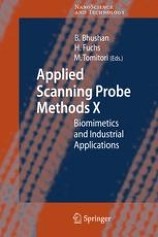
The success of the Springer Series Applied Scanning Probe Methods I–VII and the rapidly expanding activities in scanning probe development and applications worldwide made it a natural step to collect further speci c results in the elds of development of scanning probe microscopy techniques (Vol. VIII), characterization (Vol. IX), and biomimetics and industrial applications (Vol. X). These three volumes complement the previous set of volumes under the subject topics and give insight into the recent work of leading specialists in their respective elds. Following the tradition of the series, the chapters are arranged around techniques, characterization and biomimetics and industrial applications. Volume VIII focuses on novel scanning probe techniques and the understanding of tip/sample interactions. Topics include near eld imaging, advanced AFM, specialized scanning probe methods in life sciences including new self sensing cantilever systems, combinations of AFM sensors and scanning electron and ion microscopes, calibration methods, frequency modulation AFM for application in liquids, Kelvin probe force microscopy, scanning capacitance microscopy, and the measurement of electrical transport properties at the nanometer scale.
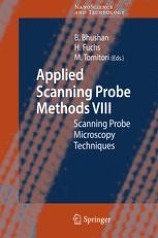
The success of the Springer Series Applied Scanning Probe Methods I–VII and the rapidly expanding activities in scanning probe development and applications worldwide made it a natural step to collect further speci c results in the elds of development of scanning probe microscopy techniques (Vol. VIII), characterization (Vol. IX), and biomimetics and industrial applications (Vol. X). These three volumes complement the previous set of volumes under the subject topics and give insight into the recent work of leading specialists in their respective elds. Following the tradition of the series, the chapters are arranged around techniques, characterization and biomimetics and industrial applications. Volume VIII focuses on novel scanning probe techniques and the understanding of tip/sample interactions. Topics include near eld imaging, advanced AFM, s- cializedscanningprobemethodsinlifesciencesincludingnewselfsensingcantilever systems, combinations of AFM sensors and scanning electron and ion microscopes, calibration methods, frequency modulation AFM for application in liquids, Kelvin probe force microscopy, scanning capacitance microscopy, and the measurement of electrical transport properties at the nanometer scale.
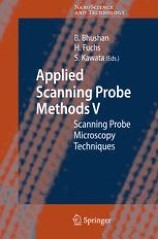
The scanning probe microscopy ?eld has been rapidly expanding. It is a demanding task to collect a timely overview of this ?eld with an emphasis on technical dev- opments and industrial applications. It became evident while editing Vols. I–IV that a large number of technical and applicational aspects are present and rapidly - veloping worldwide. Considering the success of Vols. I–IV and the fact that further colleagues from leading laboratories were ready to contribute their latest achie- ments, we decided to expand the series with articles touching ?elds not covered in the previous volumes. The response and support of our colleagues were excellent, making it possible to edit another three volumes of the series.
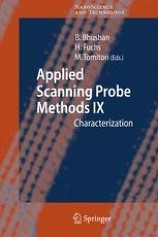
The success of the Springer Series Applied Scanning Probe Methods I–VII and the rapidly expanding activities in scanning probe development and applications worldwide made it a natural step to collect further speci c results in the elds of development of scanning probe microscopy techniques (Vol. VIII), characterization (Vol. IX), and biomimetics and industrial applications (Vol. X). These three volumes complement the previous set of volumes under the subject topics and give insight into the recent work of leading specialists in their respective elds. Following the tradition of the series, the chapters are arranged around techniques, characterization and biomimetics and industrial applications. Volume VIII focuses on novel scanning probe techniques and the understanding of tip/sample interactions. Topics include near eld imaging, advanced AFM, s- cializedscanningprobemethodsinlifesciencesincludingnewselfsensingcantilever systems, combinations of AFM sensors and scanning electron and ion microscopes, calibration methods, frequency modulation AFM for application in liquids, Kelvin probe force microscopy, scanning capacitance microscopy, and the measurement of electrical transport properties at the nanometer scale.

سوريا - اتستراد درعا - غباغب
+963-15 2050 - 15 860 380 /1/2/3 - 11 662 3900