



الصفحة 21
الصفحة 21

Geospace Electromagnetic Waves and Radiation
The contributions gathered in this volume provide introductions to current problems in geospace electromagnetic radiation, guides to the associated literature and tutorial reviews of the relevant space physics. Students and scientists working on various aspects of the terrestrial aurora or magnetospheric and near-Earth heliospheric high-frequency waves will find this volume an indispensable companion for their studies.

Geometry of Müntz Spaces and Related Questions
Starting point and motivation for this volume is the classical Muentz theorem which states that the space of all polynomials on the unit interval, whose exponents have too many gaps, is no longer dense in the space of all continuous functions. The resulting spaces of Muentz polynomials are largely unexplored as far as the Banach space geometry is concerned and deserve the attention that the authors arouse. They present the known theorems and prove new results concerning, for example, the isomorphic and isometric classification and the existence of bases in these spaces. Moreover they state many open problems. Although the viewpoint is that of the geometry of Banach spaces they only assume that the reader is familiar with basic functional analysis. In the first part of the book the Banach spaces notions are systematically introduced and are later on applied for Muentz spaces. They include the opening and inclination of subspaces, bases and bounded approximation properties and versions of universality.

Geometry for Computer Graphics : Formulae, Examples and Proofs
Geometry is the cornerstone of computer graphics and computer animation, and provides the framework and tools for solving problems in two and three dimensions. This may be in the form of describing simple shapes such as a circle, ellipse, or parabola, or complex problems such as rotating 3D objects about an arbitrary axis. Geometry for Computer Graphics draws together a wide variety of geometric information that will provide a sourcebook of facts, examples, and proofs for students, academics, researchers, and professional practitioners.

Geometry and Topology in Hamiltonian Dynamics and Statistical Mechanics
This book explores the foundations of hamiltonian dynamical systems and statistical mechanics, in particular phase transition, from the point of view of geometry and topology. A broad participation of topology in these fields has been lacking and this book will provide a welcome overview of the current research in the area, in which the author himself is a pioneer. Using geometrical thinking to solve fundamental problems in these areas, compared to the purely analytical methods usually used in physics could be highly productive. The author skillfully guides the reader, whether mathematician or physicists through the background needed to understand and use these techniques.

Geometry and monadology : Leibniz’s Analysis Situs and philosophy of space
Reconstructs, from both historical and theoretical points of view, Leibniz’s geometrical studies, focusing in particular on the research Leibniz carried out in the last years of his life. It is indeed the first ever comprehensive historical reconstruction of Leibniz’s geometry that meets the interests of both mathematicians and philosophers. The main purpose of the work is to offer a better understanding of the Leibnizean philosophy of space and mature metaphysics, through a pressing confrontation with the problems of geometric foundations. Regarding the scope of these problems, the book also deals in depth with Leibniz’s theory of sensibility, thus favouring the comparison and contrast between Leibniz’s philosophy and Kant’s transcendentalist solution. The Appendix references to a number of previously unpublished manuscripts on geometry from the Leibniz Archiv in Hannover, which disclose new theories, points of view and technicalities of Leibniz’s thought.

Geometric Problems on Maxima and Minima
Questions of maxima and minima have great practical significance, with applications to physics, engineering, and economics; they have also given rise to theoretical advances, notably in calculus and optimization. Indeed, while most texts view the study of extrema within the context of calculus, this carefully constructed problem book takes a uniquely intuitive approach to the subject: it presents hundreds of extreme-value problems, examples, and solutions primarily through Euclidean geometry.

Geometric numerical integration : Structure-preserving algorithms for ordinary differential equations
Numerical methods that preserve properties of Hamiltonian systems, reversible systems, differential equations on manifolds and problems with highly oscillatory solutions are the subject of this book. A complete self-contained theory of symplectic and symmetric methods, which include Runge-Kutta, composition, splitting, multistep and various specially designed integrators, is presented and their construction and practical merits are discussed. The long-time behaviour of the numerical solutions is studied using a backward error analysis (modified equations) combined with KAM theory. The book is illustrated by many figures, it treats applications from physics and astronomy and contains many numerical experiments and comparisons of different approaches.

Geometric Modelling, Numerical Simulation, and Optimization : Applied Mathematics at SINTEF
This book present scurrent activities of the Department of AppliedMathem- ics at SINTEF, the largest independent research organisation in Scandinavia. The book contains fteenpaperscontributedby employeesandfellowpartners from collaborating institutions. The research and development work within the department is focused on three main subject areas,andthestructureof the book refectsthisclustering: Part I Geometric Modelling Part II Numerical Simulation Part III Optimization Addressing Mathematics for Industry and Society, each contribution - scribesa problems ettingthatis of practical relevanceinone of thethreeareas and communicates the authors' own experiences in tackling these problems.

Geometric Modeling and Algebraic Geometry
The two ?elds of Geometric Modeling and Algebraic Geometry, though closely - lated, are traditionally represented by two almost disjoint scienti?c communities. Both ?elds deal with objects de?ned by algebraic equations, but the objects are studied in different ways. While algebraic geometry has developed impressive - sults for understanding the theoretical nature of these objects, geometric modeling focuses on practical applications of virtual shapes de?ned by algebraic equations. Recently, however, interaction between the two ?elds has stimulated new research. For instance, algorithms for solving intersection problems have bene?ted from c- tributions from the algebraic side.

Geometric Methods in Algebra and Number Theory
The transparency and power of geometric constructions has been a source of inspiration to generations of mathematicians. The beauty and persuasion of pictures, communicated in words or drawings, continues to provide the intuition and arguments for working with complicated concepts and structures of modern mathematics. This volume contains a selection of articles exploring geometric approaches to problems in algebra, algebraic geometry and number theory.

Geometric mechanics on riemannian manifolds : Applications to partial differential equations
This work presents a purely geometric treatment of problems in physics involving quantum harmonic oscillators, quartic oscillators, minimal surfaces, and Schrödinger's, Einstein's and Newton's equations. Historically, problems in these areas were approached using the Fourier transform or path integrals, although in some cases (e.g., the case of quartic oscillators) these methods do not work. New geometric methods are introduced in the work that have the advantage of providing quantitative or at least qualitative descriptions of operators, many of which cannot be treated by other methods. And, conservation laws of the Euler–Lagrange equations are employed to solve the equations of motion qualitatively when quantitative analysis is not possible. It includes : Lagrangian formalism on Riemannian manifolds; energy momentum tensor and conservation laws; Hamiltonian formalism; Hamilton–Jacobi theory; harmonic functions, maps, and geodesics; fundamental solutions for heat operators with potential; and a variational approach to mechanical curves.

Geometric Integration Theory
This textbook introduces geometric measure theory through the notion of currents. Currents—continuous linear functionals on spaces of differential forms—are a natural language in which to formulate various types of extremal problems arising in geometry, and can be used to study generalized versions of the Plateau problem and related questions in geometric analysis. Key features of Geometric Integration Theory: * Includes topics on the deformation theorem, the area and coarea formulas, the compactness theorem, the slicing theorem and applications to minimal surfaces * Applies techniques to complex geometry, partial differential equations, harmonic analysis, differential geometry, and many other parts of mathematics

Geometric Group Theory ; Geneva and Barcelona Conferences
This volume assembles research papers in geometric and combinatorial group theory. This wide area may be defined as the study of those groups that are defined by their action on a combinatorial or geometric object, in the spirit of Klein’s programme.The contributions range over a wide spectrum: limit groups, groups associated with equations, with cellular automata, their structure as metric objects, their decomposition, etc. Their common denominator is the language of group theory, used to express and solve problems ranging from geometry to logic.

Genetic Systems Programming : Theory and Experiences
This book is devoted to reporting innovative and significant progress about the contribution of genetic programming in systems programming. The contributions of this book clearly demonstrate that genetic programming is very effective in solving hard and yet-open problems in systems programming. Followed by an introductory chapter, in the remaining contributed chapters, the reader can easily learn about systems where genetic programming can be applied successfully. These include but are not limited to, information security systems, compilers, data mining systems, stock market prediction systems, robots and automatic programming.

Genetic rogramming ; Vol. 3447 : 8th European conference, EuroGP 2005, Lausanne, Switzerland, March 30-April 1, 2005, Proceedings
In this volume we present the contributions for the 18th European Conference on Genetic Programming (EuroGP 2005). The conference took place from 30 March to 1 April in Lausanne, Switzerland. EuroGP is a well-established conf- ence and the only one exclusively devoted to genetic programming. All previous proceedings were published by Springer in the LNCS series. From the outset, EuroGP has been co-located with the EvoWorkshops focusing on applications of evolutionary computation. Since 2004, EvoCOP, the conference on evolutionary combinatorial optimization, has also been co-located with EuroGP, making this year’s combined events one of the largest dedicated to evolutionary computation in Europe. Genetic programming (GP) is evolutionary computation that solves complex problems or tasks by evolving and adapting a population of computer programs, using Darwinian evolution and Mendelian genetics as its sources of inspiration. Some of the 34 papers included in these proceedings address foundational and theoretical issues and there is also a wide variety of papers dealing with di?erent application areas, such as computer science, engineering, language processing, biology and computational design, demonstrating that GP is a powerful and practical problem-solving paradigm.

Genetic Programming Theory and Practice V
Genetic Programming Theory and Practice V was developed from the fifth workshop at the University of Michigan’s Center for the Study of Complex Systems to facilitate the exchange of ideas and information related to the rapidly advancing field of Genetic Programming (GP). Contributions from the foremost international researchers and practitioners in the GP arena examine the similarities and differences between theoretical and empirical results on real-world problems. The text explores the synergy between theory and practice, producing a comprehensive view of the state of the art in GP application.
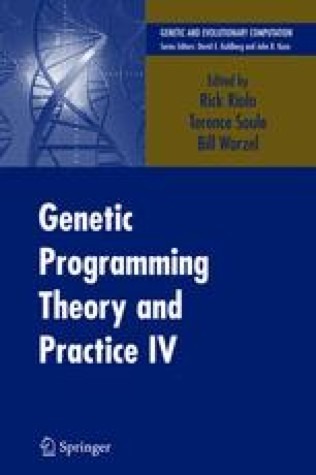
Genetic Programming Theory and Practice IV
Genetic Programming Theory and Practice IV was developed from the fourth workshop at the University of Michigan’s Center for the Study of Complex Systems to facilitate the exchange of ideas and information related to the rapidly advancing field of Genetic Programming (GP). Contributions from the foremost international researchers and practitioners in the GP arena examine the similarities and differences between theoretical and empirical results on real-world problems.

Genetic programming IV : Routine human-competitive machine intelligence
Genetic Programming IV: Routine Human-Competitive Machine Intelligence presents the application of GP to a wide variety of problems involving automated synthesis of controllers, circuits, antennas, genetic networks, and metabolic pathways. The book describes fifteen instances where GP has created an entity that either infringes or duplicates the functionality of a previously patented 20th-century invention, six instances where it has done the same with respect to post-2000 patented inventions, two instances where GP has created a patentable new invention, and thirteen other human-competitive results. The book additionally establishes: GP now delivers routine human-competitive machine intelligence GP is an automated invention machine GP can create general solutions to problems in the form of parameterized topologies GP has delivered qualitatively more substantial results in synchrony with the relentless iteration of Moore's Law

Generalized Plasticity
The book is divided into five major parts: 1. Yield function and choice; 2. Constitutive relation; 3. Slip-line Field Theory for plane strain problems, Characteristics Field Theory for plane stress problems and Characteristics Field Theory for spatial axisymmetrical problems; 4. Plastic zone analysis at crack tip and fracture criterion for mixed mode crack; 5. Limit loads and shakedown loads for pressure vessel. Examples of applications and problems are given for most chapters.

Generalized Convexity, Generalized Monotonicity and Applications ; Proceedings of the 7th International Symposium on Generalized Convexity and Generalized Monotonicity
This volume contains a collection of refereed articles on generalized convexity and generalized monotonicity. The first part of the book contains invited papers with applications of (generalized) convexity to such diverse fields as algebraic dynamics of the Gamma function values, discrete optimization, Lipschitzian stability of parametric constraint systems, and monotonicity of functions. The second part contains contributions presenting the latest developments in generalized convexity and generalized monotonicity: its connections with discrete and with continuous optimization, multiobjective optimization, fractional programming, nonsmooth Aanalysis, variational inequalities, and its applications to concrete problems such as finding equilibrium prices in mathematical economics, or hydrothermal scheduling.
