


تحسين النتائح
ترتيب حسب
من
الى

When Don Swanson hypothesized a connection between Raynaud’s phenomenon and dietary fish oil, the field of literature-based discovery (LBD) was born. During the subsequent two decades a steady stream of researchers have published articles about LBD and the field has made steady progress in laying foundations and creating an identity. LBD is an inherently multi-disciplinary enterprise where collaborations between the information and biomedical sciences are readily encountered. It is the hope and intention that this volume will plant a flag in the ground and inspire new researchers to the LBD challenge.
The book provides the reader with a comprehensive overview of stream data processing, including famous prototype implementations like the Nile system and the TinyOS operating system. The set of chapters covers the state-of-art in data stream mining approaches using clustering, predictive learning, and tensor analysis techniques, and applying them to applications in security, the natural sciences, and education.

In particular, these chapters cover computing techniques for interval linear systems of equations, interval matrix singular-value decomposition, interval function approximation, and decision making with statistical and graph-based data processing. To enable these applications, the book presents a standards-based object-oriented interval computing environment in C++.

This book is part of the LAMBDA Project (Learning, Applying, Multiplying Big Data Analytics), funded by the European Union, GA No. 809965. Data Analytics involves applying algorithmic processes to derive insights.
The basic ideas underlying knowledge visualization and information vi- alization are outlined. In a short preview of the contributions of this volume, the idea behind each approach and its contribution to the goals of the book are outlined. 2 The Basic Concepts of the Book Three basic concepts are the focus of this book: "data", "information", and "kno- edge". There have been numerous attempts to define the terms "data", "information", and "knowledge", among them, the OTEC Homepage "Data, Information, Kno- edge, and Wisdom" (Bellinger, Castro, & Mills, see http://www.syste- thinking.org/dikw/dikw.htm): Data are raw. They are symbols or isolated and non-interpreted facts. Data rep- sent a fact or statement of event without any relation to other data. Data simply exists and has no significance beyond its existence (in and of itself). It can exist in any form, usable or not. It does not have meaning of itself.
Knowledge and Data Management in GRIDs is the third volume of the CoreGRID series and brings together scientific contributions by researchers and scientists working on storage, data, and knowledge management in GRID and Peer-to-Peer systems. This volume presents the latest GRID solutions and research results in key areas of knowledge and data management such as distributed storage management, GRID databases, Semantic GRID and GRID-aware data mining.

The LNCS Journal on Data Semantics is devoted to the presentation of notable work that, in one way or another, addresses research and development on issues related to data semantics. The scope of the journal ranges from theories supporting the formal definition of semantic content to innovative domain-specific applications of semantic knowledge. The journal addresses researchers and advanced practitioners working on the semantic web, interoperability, mobile information services, data warehousing, knowledge representation and reasoning, conceptual database modeling, ontologies, and artificial intelligence.

Web semantics and semi-structured data , Semantic caching , Data warehousing and semantic data mining , Spatial, temporal, multimedia and multimodal semantics , Semantics in data visualization , Semantic services for mobile users , Supporting tools , Applications of semantic-driven approaches These topics are to be understood as specifically related to semantic issues. Contributions submitted to the journal and dealing with semantics of data will be considered even if they are not from the topics in the list. While the physical appearance of the journal issues is like the books from the we- known Springer LNCS series, the mode of operation is that of a journal. Contributions can be freely submitted by authors and are reviewed by the Editorial Board.

Data warehousing and semantic data mining • Spatial, temporal, multimedia and multimodal semantics • Semantics in data visualization • Semantic services for mobile users • Supporting tools • Applications of semantic-driven approaches These topics are to be understood as speci?cally related to semantic issues. Contributions submitted to the journal and dealing with semantics of data will be considered even if they are not within the topics in the list. While the physical appearanceof the journal issues looks like the books from the well-known Springer LNCS series, the mode of operation is that of a jo- nal. Contributions can be freely submitted by authors and are reviewed by the Editorial Board. Contributions may also be invited, and nevertheless carefully reviewed, as in the case for issues that contain extended versions of best papers from major conferences addressing data semantics issues. Special issues, foc- ing on a speci?c topic, are coordinated by guest editors once the proposal for a special issue is accepted by the Editorial Board.
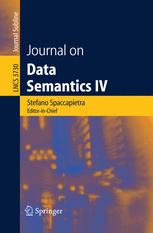
• Semantics in data visualization • Semantic services for mobile users • Supporting tools • Applications of semantic-driven approaches These topics are to be understood as specifically related to semantic issues. Contributions submitted to the journal and dealing with semantics of data will be considered even if they are not within the topics in the list. While the physical appearance of the journal issues is like the books from the we- known Springer LNCS series, the mode of operation is that of a journal. Contributions can be freely submitted by authors and are reviewed by the Editorial Board. Contributions may also be invited, and nevertheless carefully reviewed, as in the case for issues that contain extended versions of the best papers from major conferences addressing data semantics issues. Special issues, focusing on a specific topic, are coordinated by guest editors once the proposal for a special issue is accepted by the Editorial Board. Finally, it is also possible that a journal issue be devoted to a single text.
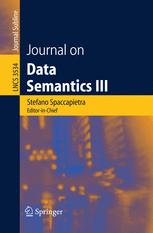
– semantic caching – data warehousing and semantic data mining – spatial, temporal, multimedia and multimodal semantics – semantics in data visualization – semantic services for mobile users – supporting tools – applications of semantic-driven approaches These topics are to be understood as speci?cally related to semantic issues. Contributions submitted to the journal and dealing with semantics of data will be considered even if they are not within the topics in the list. While the physical appearance of the journal issues looks like the books from the well-known Springer LNCS series, the mode of operation is that of a journal. Contributions can be freely submitted by authors and are reviewed by the Editorial Board. Contributions may also be invited, and nevertheless carefully reviewed, as in the case for issues that contain extended versions of best papers from major conferences addressing data semantics issues. Special issues, focusing on a speci?c topic, are coordinated by guest editors once the proposal for a special issue is accepted by the Editorial Board. Finally, it is also possible that a journal issue be devoted to a single text.

This book originate from a workshop held at the European University Institute of Florence, Italy, in December 2006. The workshop was devoted to the discussion of the different ways of understanding and explaining contemporary law, for the purpose of building computable models of it -- especially models enabling the development of computer applications for the legal domain.
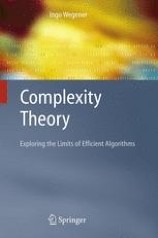
Complexity theory is the theory of determining the necessary resources for the solution of algorithmic problems and, therefore, the limits of what is possible with the available resources. An understanding of these limits prevents the search for non-existing efficient algorithms. This textbook considers randomization as a key concept and emphasizes the interplay between theory and practice: New branches of complexity theory continue to arise in response to new algorithmic concepts, and its results - such as the theory of NP-completeness - have influenced the development of all areas of computer science. The topics selected have implications for concrete applications, and the significance of complexity theory for today's computer science is stressed throughout.

This state-of-the-art survey contains the papers that were invited by the organizers after conclusion of an International Dagstuhl-Seminar on Complexity of Constraints, held in Dagstuhl Castle, Germany, in October 2006.

Many approaches have already been proposed for classification and modeling in the literature. These approaches are usually based on mathematical mod els. Computer systems can easily handle mathematical models even when they are complicated and nonlinear (e.g., neural networks). On the other hand, it is not always easy for human users to intuitively understand mathe matical models even when they are simple and linear. This is because human information processing is based mainly on linguistic knowledge while com puter systems are designed to handle symbolic and numerical information. A large part of our daily communication is based on words. We learn from various media such as books, newspapers, magazines, TV, and the Inter net through words. We also communicate with others through words. While words play a central role in human information processing, linguistic models are not often used in the fields of classification and modeling. If there is no goal other than the maximization of accuracy in classification and modeling, mathematical models may always be preferred to linguistic models. On the other hand, linguistic models may be chosen if emphasis is placed on interpretability.
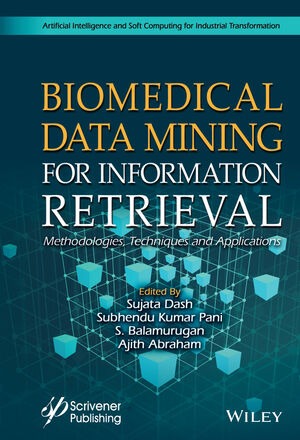
Discusses data mining, biomedical image processing, information retrieval with broad coverage of basic scientific applications. covers the topic of mining biomedical text, images and visual features towards information retrieval. Biomedical and health informatics is an emerging field of research at the intersection of information science, computer science, and healthcare and brings tremendous opportunities and challenges due to easily available and abundant biomedical data for further analysis. The aim of healthcare informatics is to ensure the high-quality, efficient healthcare, better treatment and quality of life by analyzing biomedical and healthcare data including patient’s data, electronic health records (EHRs) and lifestyle. Previously, it was a common requirement to have a domain expert to develop a model for biomedical or healthcare; however, recent advancements in representation learning algorithms allows us to automatically to develop the model. Biomedical image mining, a novel research area, due to the vast amount of available biomedical images, increasingly generates and stores digitally.

The 6th International Symposium on Biological and Medical Data Analysisaimed to become a place where researchersinvolved in these diverse but increas-ingly complementary areas could meet topresent and discuss their scientificresults.The papers in this volume discuss issues from statistical models to archi-tectures and applications to bioinformatics and biomedicine. They cover bothpractical experience and novel research ideas and concepts.

The book reports the proceedings of the 15th Italian workshop on neural networks issued by the Italian Society on Neural Networks SIREN. The longevity recipe of this conference stands in three main points that normally renders the reading of these proceedings so interesting as appealing. 1. The topics of the neural networks is considered an attraction pole for a set of researches centered on the inherent paradigm of the neural networks, rather than on a specific tool exclusively. Thus, the subsymbolic management of the data information content constitutes the key feature of papers in various fields such as Pattern Recognition, Stochastic Optimization, Learning, Granular Computing, and so on, with a special bias toward bioinformatics operational applications. An excerpt of all these matters may be found in the book. 2. Though managed at domestic level, the conference attracts contributions from foreign researchers as well, so that in the book the reader may capture the flavor of the state of the art in the international community. 3. The conference is a meeting of friends as well. Thus the papers generally reflect a relaxed atmosphere where researchers meet to generously exchange their thought and explain their actual results in view of a common cultural growing of the community.

Solving modern biological problems requires advanced computational methods. Bioinformatics evolved from the active interaction of two fast-developing disciplines, biology and information technology. The central issue of this emerging field is the transformation of often distributed and unstructured biological data into meaningful information. This book describes the application of well-established concepts and techniques from areas like data mining, machine learning, database technologies, and visualization techniques to problems like protein data analysis, genome analysis and sequence databases. Chen has collected contributions from leading researchers in each area. The chapters can be read independently, as each offers a complete overview of its specific area, or, combined, this monograph is a comprehensive treatment that will appeal to students, researchers, and R&D professionals in industry who need a state-of-the-art introduction into this challenging and exciting young field.

This book constitutes the refereed proceedings of the Second International Bioinformatics Research and Development Conference, BIRD 2008, held in Vienna, Austria in July 2008.

سوريا - اتستراد درعا - غباغب
+963-15 2050 - 15 860 380 /1/2/3 - 11 662 3900