



الصفحة 2
الصفحة 2

Information Processing in Medical Imaging ; 20th International Conference, IPMI 2007, Kerkrade, The Netherlands, July 2-6, 2007, Proceedings
The 20th International Conference on Information Processing in Medical Im- ing(IPMI)washeldduringJuly2–6,2007,atRolducAbbey,locatedinKerkrade in the south of the Netherlands. IPMI is one of the longest running conferences in medical imaging.
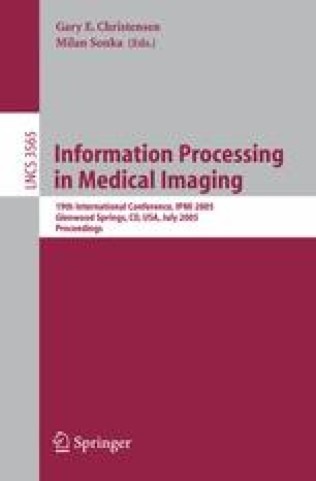
Information processing in medical imaging ; 19th International conference, IPMI 2005, Glenwood Springs, CO, USA, July 10-15, 2005, Proceedings
The nineteenth biennial International Conference on Information Processing in Medical Imaging (IPMI) was held July 11–15, 2005 in Glenwood Springs, CO, USA on the Spring Valley campus of the Colorado Mountain College. Following the successful meeting in beautiful Ambleside in England, this year’s conference addressed important recent developments in a broad range of topics related to the acquisition, analysis and application of biomedical images. Interest in IPMI has been steadily growing over the last decade. This is p- tially due to the increased number of researchers entering the ?eld of medical imagingasaresultoftheWhitakerFoundationandtherecentlyformedNational Institute of Biomedical Imaging and Bioengineering. This year, there were 245 full manuscripts submitted to the conference which was twice the number s- mitted in 2003 and almost four times the number of submissions in 2001. Of these papers, 27 were accepted as oral presentations, and 36 excellent subm- sions that could not be accommodated as oral presentations were presented as posters. Selection of the papers for presentation was a di?cult task as we were unable to accommodate many of the excellent papers submitted this year. All accepted manuscripts were allocated 12 pages in these proceedings.

Imaging Pelvic Floor Disorders
This volume builds on the success of the first edition of Imaging Pelvic Floor Disorders and is aimed at those practitioners with an interest in the imaging, diagnosis and treatment of pelvic floor dysfunction. Concise textual information from acknowledged experts is complemented by high-quality diagrams and images to provide a thorough update of this rapidly evolving field. Introductory chapters fully elucidate the anatomical basis underlying disorders of the pelvic floor. State of the art imaging techniques and their application in pelvic floor dysfunction are then discussed in detail. Additions since the first edition include consideration of the effect of aging and new chapters on perineal ultrasound, functional MRI and MRI of the levator muscles.

Imaging of the Shoulder : Techniques and Applications
This volume covers the broad spectrum of imaging methods and abnormalities of relevance in the diagnostic workup of the shoulder. In the first part of the book, individual chapters are devoted to radiography, arthrography, computed tomography and CT arthrography, magnetic resonance imaging and MR arthrography, ultrasound and interventional procedures. The second part of the book then documents the application of these techniques to each of the clinical problems and diseases encountered in the shoulder. The authors are all experts in their field and include rising stars of musculoskeletal radiology.

Imaging of the liver and Intra-hepatic biliary tract ; Vol.2 : Tumoral pathologies
This is the second of two volumes that together provide a comprehensive analysis of the embryology, normal anatomy, and pathology of the liver and intrahepatic biliary tract as seen on modern diagnostic imaging techniques. In this second volume, readers will find comprehensive description and illustration of the imaging appearances of tumoral pathologies, both in the “normal liver” and in the context of chronic liver disease and liver cirrhosis. In addition, the imaging findings in relation to different treatment approaches are presented, with extensive coverage of imaging of tumor response and post-treatment changes.

Imaging of the liver and Intra-hepatic biliary tract ; Vol.1 : Imaging techniques and non-tumoral pathologies
This is the first of two volumes that together provide a comprehensive analysis of the embryology, normal anatomy, and pathology of the liver and intrahepatic biliary tract as seen on modern diagnostic imaging techniques. In this volume, readers will find fundamental information on embryology, radiological anatomy, and anatomic variants. A thorough introduction is then provided to each imaging technique, including ultrasound, computed tomography, magnetic resonance imaging, nuclear medicine techniques, angiography, and interventional radiology. The remainder of the volume is devoted to non-tumoral pathology of the liver and intra-hepatic biliary tract
Imaging of Soft Tissue Tumors
This book provides a comprehensive survey of the growing role of medical imaging studies in the detection, staging, grading, tissue characterization, and post-treatment follow-up of soft tissue tumors. For each tumor group, imaging findings are correlated with clinical, epidemiologic, and histologic data.

Imaging of Orbital and Visual Pathway Pathology
This is one of the first books to deal with imaging of pathology of the entire visual system. It is divided into two parts, general and special. In the general part, the most important basics of modern imaging methods are discussed in detail, but with less emphasis on the physical background than in purely neuro-/radiological books. A chapter is devoted to the meticulous presentation of imaging anatomy of the orbit and intracranial visual pathway.
Image-Guided Interventions : Technology and Applications
Responding to the growing demand for minimally invasive procedures, Image-Guided Interventions: Technology and Applications provides a cohesive overview of the current technological advances in image-guided surgery, and their applications in the clinical environment.

Image-Guided IMRT
Intensity-modulated radiation therapy (IMRT), one of the most important developments in radiation oncology in the past 25 years, involves technology to deliver radiation to tumors in the right location, quantity and time. Unavoidable irradiation of surrounding normal tissues is distributed so as to preserve their function. The achievements and future directions in the field are grouped in the three sections of the book, each suitable for supporting a teaching course.

Image Processing in Radiology : Current Applications
Few fields have witnessed such impressive advances as image processing in radiology. The progress achieved has revolutionized diagnosis and greatly facilitated treatment selection and accurate planning of procedures. This book provides a comprehensive and up-to-date description of how to use 2D and 3D processing tools in clinical radiology.

How does MRI work? : An introduction to the physics and function of magnetic resonance imaging
A succinct introduction to the physics and function of magnetic resonance imaging with an emphasis on practical information. It progresses to more advanced techniques such as parallel imaging and cardiovascular MR imaging.

High Field Brain MRI : Use in Clinical Practice
This book describes the development of systems of magnetic resonance imaging using the higher magnetic field strength of 3 tesla, in comparison to the current gold standard of 1.5 tesla. It is the first monography on high-field Brain MR in Neuroradiology

Head and Neck Cancer Imaging ; 1st ed.
This book provides a comprehensive review of state-of-the-art imaging in head and neck cancer. Precise determination of tumor extent is of the utmost importance in these neoplasms, as it has important consequences for staging of disease, prediction of outcome and choice of treatment. Only the radiologist can fully appreciate submucosal, perineural, and perivascular tumor spread and detect metastatic disease at an early stage. Imaging is also of considerable benefit for patient surveillance after treatment.

Gastrointestinal Tract Sonography in Fetus and in Children
Sonography of the gastrointestinal tract in fetuses, neonates and children entails no known biological risk, permits serial scanning and can provide information unobtainable with any other imaging modality. In experienced hands it can be used as the initial imaging technique in a number of gastrointestinal diseases and conditions. This book provides a comprehensive account of the current state of the art regarding sonography in this context.

Functional MRI : Basic principles and clinical applications
This practical and timely volume presents an overview of the principles of fMRI and explains key concepts, including scanning methodologies, experimental research design, and data analysis. Informative discussions cover the technical and clinical challenges associated with fMRI. A neuroanatomical atlas adds to the sensible approach and serves as a useful reference by clearly illustrating normal functioning for important areas of the brain.

Essentials of Restenosis : For the Interventional Cardiologist
Essentials of Restenosis provides the practicing cardiologists and biologists an elaborate review of the current advances in the field. The book explore the process of restenosis from bench to bedside, encompassing in equal detail the newest scientific findings of the biological mechanisms as well as the progression in development of diagnostics and treatments. The volume also provides the reader with a basic understanding of the biological process and the latest diagnostics and treatments of the disease, with an up-to-date detailed discussion of the most important recent findings.

Dynamic Radiology of the Abdomen : Normal and Pathologic Anatomy
Meyers' Dynamic Radiology of the Abdomen, extensively revised and updated, is the classic text covering radiology of the abdomen as it relates to the progression of disease within an organ and from one organ to another. The book provides a systematic application of anatomic and dynamic principles to the practical understanding and diagnosis of intraabdominal disease. The full range of imaging modalities is addressed, from plain films and conventional contrast studies to CT, US, MRI and endoscopic ultrasonography. Highly selected, ample images including CT and MRI support the thoroughly descriptive text. Expanded references, citing both the classic and recent contributions, and a detailed cross-referenced index are presented. For radiologists, general surgeons, gastroenterologists, and others seeking insight into the clinical practice of radiology, this text continues to be the gold standard in the field.

Dynamic Contrast-Enhanced Magnetic Resonance Imaging in Oncology
Dynamic contrast-enhanced MRI is now established as the methodology of choice for the assessment of tumor microcirculation in vivo. This is assisting clinical practitioners in the management of patients with solid tumors and is finding prominence in the assessment of tumor treatments, including anti-angiogenics, chemotherapy, and radiotherapy. In this book, targeted at both clinical practitioners and basic scientists, the principles of the methods, their practical implementation, and their application to specific tumor types are discussed by the leading authorities in the field today. The book will serve as an invaluable single-volume reference covering all the latest developments in contrast-enhanced oncological MRI.

Diseases of the Heart, Chest & Breast : Diagnostic Imaging and Interventional Techniques
This book deals with imaging of diseases of heart, chest and breast. These fields have substantially advanced during the last few years, driven by both clinical developments and advances in imaging technology.لإheir chapters are disease-oriented and cover all the relevant imaging modalities, including standard radiography, CT, nuclear medicine with PET, ultrasound and magnetic resonance imaging, as well as imaging-guided interventions. As a result, this book presents a comprehensive review of current knowledge in imaging of the heart and chest , as well as thoracic interventions and a selection of "hot topics" of breast imaging.
