



الصفحة 2
الصفحة 2

Fuel cell technologies : State and perspectives ; Proceedings of the NATO advanced research workshop on fuel cell technologies: State and perspectives, Kyiv, Ukraine from 6 to 10 June 2004.
This book has brought together a team of world-renowned experts in all aspects of fuel cell development for both SOFC and PEM in a workshop environment. The workshop held between June 6–10, 2004 was held in the capital city of the Ukraine, Kiev. The reason for the venue was that Ukraine is the third largest resource of zircon sands, a major source of material for the solid oxide fuel cell. Ukraine is looking at undertaking a very large effort in the solid oxide fuel cell arena, and hopes, one day, to be an international player in this market, and this book is an outcome from the workshop. The book focuses on the issues related to fuel cells, particularly the state-of-the-art internationally, the issues that were of particular interest for getting fuel cells fully commercialized, and advances in fuel cell materials and technology. The focus was on all types of fuel cells, but the emphasis was particularly on solid oxide fuel cells (SOFC), due to their importance to the host country. The book is an essential reference to researchers, academics and industrialists interested in up-to-date information on SOFC and PEM development.

Foundations of Quantum Physics
Intended to be used as a textbook for an introductory course in quantum mechanics at the undergraduate level, Foundations of Quantum Physics is also meant to be retained by the student for later use as a reference. The presentation begins with the solution of some basic quantum mechanical problems. The emphasis is on those features of the solutions that are unique to quantum physics. It is only after these aspects of quantum physics are thoroughly discussed that the mathematical formalism of quantum mechanics is presented and related to the previous chapters. Throughout the book, the emphasis is on understanding the concepts and relating them to known phenomena.

Enzyme Biocatalysis : Principles and Applications
This book was written with the purpose of providing a sound basis for the design of enzymatic reactions based on kinetic principles, but also to give an updated vision of the potentials and limitations of biocatalysis, especially with respect to recent app- cations in processes of organic synthesis. The ?rst ?ve chapters are structured in the form of a textbook, going from the basic principles of enzyme structure and fu- tion to reactor design for homogeneous systems with soluble enzymes and hete- geneous systems with immobilized enzymes. The last chapter of the book is divided into six sections that represent illustrative case studies of biocatalytic processes of industrial relevance or potential, written by experts in the respective ?elds.

Energy dissipation in molecular systems
Energy Dissipation in Molecular Systems analyzes experimental data on the redistribution and dissipation of energy injected into molecular systems by radiation or charged particles. These processes, competing with such practically important relaxation channels as chemical reaction or stimulated emission (laser action), are the primary focus in this monograph. Among other topics, the book treats vibrational redistribution and electronic relaxation in isolated molecules and the effects of inter-molecular interactions (collisions, complex formation, solvent effects) on the relaxation paths. Primary photo-chemical processes (such as isomerization, proton or hydrogen-atom transfer, electron transfer and ionization) are also treated as particular cases of vibrational or electronic relaxation. Only a basic knowledge of quantum mechanics and spectroscopy is assumed and calculations are kept to a strict minimum, making the book more accessible to students.

Electron Scattering : From Atoms, Molecules, Nuclei and Bulk Matter
There is a unity to physics; it is a discipline which provides the most fundamental understanding of the dynamics of matter and energy. To understand anything about a physical system you have to interact with it and one of the best ways to learn something is to use electrons as probes. This book is the result of a meeting, which took place in Magdalene College Cambridge in December 2001. Atomic, nuclear, cluster, soHd state, chemical and even bio- physicists got together to consider scattering electrons to explore matter in all its forms. Theory and experiment were represented in about equal measure. It was meeting marked by the most lively of discussions and the free exchange of ideas. We all learnt a lot. The Editors are grateful to EPSRC through its Collaborative Computational Project program (CCP2), lOPP, the Division of Atomic, Molecular, Optical and Plasma Physics (DAMOPP) and the Atomic Molecular Interactions group (AMIG) of the Institute of Physics for financial support. The smooth running of the meeting was enormously facilitated by the efficiency and helpfulness of the staff of Magdalene College, for which we are extremely grateful.

Detection and Disposal of Improvised Explosives
It including: Methods of detection of Improvised Explosives (IE). Methods of detection of Improvised explosives devices (IED). Disposal and safe handling of ID and IED. The treatment of detection methods may be divided in the following groups: Overview about the different methods; Trace- and vapor detection; Electromagnetic methods; Neutron methods; Laser techniques. Because of different definitions of Improvised Explosives the parti- pants of the workshop agreed after some discussions with the following definition: An Improvised Explosive (IE) can be any chemical compound or mixture capable of an explosive reaction. They are normally easily prepared by a knowledgeable layman under simple conditions. Components of IE are typically inorganic salts containing molecular bound oxygen like nitrates, chlorates or perchlorates etc. or organic compounds with nitro-, nitami- or nitrate-groups or peroxides. Admixtures of military or commercial explosive materials are also used. From the chemical point of view IE can be divided into the following types: Salts containing chemical groups with oxygen (like nitrates, chlorates or perchlorates etc.) in mixtures with combustible substances like carbon-hydrogen compounds.
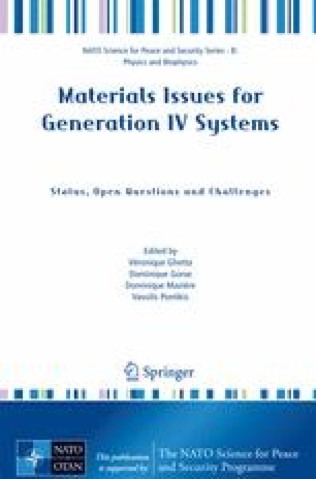
Materials Issues for Generation IV Systems ; Status, Open Questions and Challenges
Global warming, shortage of low-cost oil resources and the increasing demand for energy are currently controlling the world's economic expansion while often opposing desires for sustainable and peaceful development. In this context, atomic energy satisfactorily fulfills the criteria of low carbon gas production and high overall yield. However, in the absence of industrial fast-breeders the use of nuclear fuel is not optimal, and the production of high activity waste materials is at a maximum. These are the principal reasons for the development of a new, fourth generation of nuclear reactors, minimizing the undesirable side-effects of current nuclear energy production technology while increasing yields by increasing operation temperatures and opening the way for the industrial production of hydrogen through the decomposition of water.
Low Molecular Mass Gelators : Design, Self-Assembly, Function
Chapter 1 presents the physical principles of the growth mechanism of fiber and fiber network with LMGs, as treated on the basis of the heterogeneous nucleation model. in Chaps. 2 and 3, respectively. These chapters are intended to outline useful synthetic guidelines for the generation of an ever-increasing variety of molecular architectures within these two families of gelators. Recent developments in the chemistry of nucleobase-containing LMGs are described in Chap. 4. Hydrogen-bonding within these molecular systems involves complementary base pair formation, a process relevant to DNA double-helix formation The self-assembly of chiral organo- or hydrogelators is the subject of Chap. 5. result from the orthogonal self-assembly of liquid crystals and LMGs are presented in Chap. 6. The volume concludes with Chap. 7, a review of the emerging field of dendritic gels.

Linearity, Symmetry, and Prediction in the Hydrogen Atom
The predictive power of mathematics in quantum phenomena is one of the great intellectual successes of the 20th century. This textbook, aimed at undergraduate or graduate level students (depending on the college or university), concentrates on how to make predictions about the numbers of each kind of basic state of a quantum system from only two ingredients: the symmetry and the linear model of quantum mechanics. This method, involving the mathematical area of representation theory or group theory, combines three core mathematical subjects, namely, linear algebra, analysis and abstract algebra. Wide applications of this method occur in crystallography, atomic structure, classification of manifolds with symmetry, and other areas.
Light, Water, Hydrogen : The Solar Generation of Hydrogen by Water Photoelectrolysis
The development of a direct, inexpensive, and efficient method for converting solar energy into a portable, clean fuel would allow elimination of the growing problems associated with the ever increasing use of fossil fuels and the reality of their rapid depletion. As the title suggests, Light, Water, Hydrogen: The Solar Generation of Hydrogen by Water Photoelectrolysis, considers the combination of water and light with a suitable semiconductor to achieve a safe, renewable and therefore inexhaustable means for hydrogen generation via the splitting of the water molecule, or photoelectrolysis.

Lectures on Quantum Mechanics
Presents theoretical physics with a breathtaking array of examples and anecdotes. Basdevant's style is clear and stimulating, in the manner of a brisk classroom lecture that students can follow with ease and enjoyment.

Bioorganometallic Chemistry
Bioorganometallic Chemistry has become a mature area of science and is comprehensively covered by leading experts in this book. Naturally occuring bioorganometallic complexes, such as vitamin B12 and recently discovered iron and nickel hydrogenases, including a possible role of the latter in the geochemical theory of the origin of life, are considered.

Azaheterocycles Based on -, ß-Unsaturated Carbonyls
Devoted to heterocyclizations of aliphatic and aromatic, -unsaturated carbonyls with various binucleophiles leading to three-, five-, six and seven-membered partially hydrogenated nitrogen-containing heterocycles. During the last decade interest in these classes of organic c- pounds has been experiencing a scientific renaissance owing to their significant role in biological processes in living cells and diverse effects on physiological activities. In addition, such compounds are also more prevalent from the vi- point of ''classical'' problems of organic chemistry, among them reactivity, chemo- and regioselectivity, tautomerism, conformational analysis and features of their electronic structure. The character of these problems in the case of partially hydrogenated heterocycles differs sufficiently from that for hetero- omatized and perhydrogenated heterocyclic compounds and investigations in this field very often lead to interesting and unusual results. Extensively characterized cyclocondensations of, -unsaturated carbonyls, their synthetic equivalents and their precursors are the most widespread, facile and generally valid pathway to dihydroazaheterocycles.
Atoms, molecules and photons : An introduction to atomic- molecular- and quantum physics
This introduction to Atomic and Molecular Physics explains how our present model of atoms and molecules has been developed over the last two centuries both by many experimental discoveries and, from the theoretical side, by the introduction of quantum physics to the adequate description of micro-particles. It illustrates the wave model of particles by many examples and shows the limits of classical description. The interaction of electromagnetic radiation with atoms and molecules and its potential for spectroscopy is outlined in more detail and in particular lasers as modern spectroscopic tools are discussed more thoroughly. Many examples and problems with solutions are offered to encourage readers to actively engage in experimentation.
Atomic spectroscopy : Introduction to the theory of hyperfine structure
Atomic Spectroscopy provides a comprehensive discussion on the general approach to the theory of atomic spectra, based on the use of the Lagrangian canonical formalism. This approach is developed and applied to explain the hydrogenic hyperfine structure associated with the nucleus motion, its finite mass, and spin. The non-relativistic or relativistic, spin or spin-free particle approximations can be used as a starting point of general approach. The special attention is paid to the theory of Lamb shift formation. The formulae for hydrogenic spectrum including the account of Lamb shift are written in simple analytical form. The book is of interest to specialists, graduate and postgraduate students, who are involved into the experimental and theoretical research in the field of modern atomic spectroscopy.
Asymmetric hydrogenation and transfer hydrogenation
Details its complex subject matter clearly and plainly and covers everything from catalyst development and reactions to mechanisms and applications in academia and industry. The papers included within come from many of the leading voices in their respective fields and represent the newest and best research available today.

Assessment of hydrogen energy for sustainable development
Proceedings of the NATO Advanced Research Workshop on Assessment of Hydrogen Energy for Sustainable Development: Energy & Environmental Security, Istanbul, Turkey, 7-10 August 2006

Antioxidants effects in health : The bright and the dark side ; 1st ed.
Examines the role that antioxidants play in a variety of health and disease situations. The book discusses antioxidants’ historical evolution, their oxidative stress, and contains a detailed approach of 1) endogenous antioxidants, including endogenous sources, mechanisms of action, beneficial and detrimental effects on health, in vitro evidence, animal studies and clinical studies; 2) synthetic antioxidants, including sources, chemistry, bioavailability, legal status, mechanisms of action, beneficial and detrimental effects on health, in vitro evidence, animal studies and clinical studies; and 3) natural antioxidants, including sources, chemistry, bioavailability, mechanisms of action, possible prooxidant activity; beneficial and detrimental effects on health, in vitro evidence, animal studies and clinical studies. Throughout the boo, the relationship of antioxidants with different beneficial and detrimental effects are examined, and the current controversies and future perspectives are addressed and explored. Antioxidants Effects in Health: The Bright and the Dark Side evaluates the current scientific evidence on antioxidant topics, focusing on endogenous antioxidants, naturally occurring antioxidants and synthetic antioxidants. It will be a helpful resource for pharmaceutical scientists, health professionals, those studying natural chemistry, phytochemistry, pharmacognosy, natural product synthesis, and experts in formulation of herbal and natural pharmaceuticals.

Advances in Renewable Energy and Sustainable Environment : Select Proceedings of NCRESE 2019
comprises the select peer-reviewed proceedings of the National Conference on Renewable Energy and Sustainable Environment (NCRESE) 2019. brings together the latest developments in harvesting, storing and optimizing alternate and renewable energy resources. It covers latest developments in green energy technologies as well as smart grids, and their applications towards a sustainable environment. can be useful for beginners, academicians, entrepreneurs, and professionals interested in renewable energy technologies and sustainable environment practices.
Advanced Visual Quantum Mechanics
Investigate and to teach quantum mechanics with the aid of computer-generated animations. It is a self-contained textbook that combines selected topics from atomic physics (spherical symmetry, the hydrogen atom, and particles with spin) with an introduction to quantum information theory (qubits, EPR paradox, teleportation, quantum computers). It explores relativistic quantum mechanics and the strange behavior of Dirac equation solutions. A series of appendices covers important topics from perturbation and scattering theory. The book places an emphasis on ideas and concepts, with a fair to moderate amount of mathematical rigor. Though this book stands alone, it can also be paired with Thaller Visual Quantum Mechanics to form a comprehensive course in quantum mechanics. The software for the first book earned the European Academic Software Award 2000 for outstanding innovation in its field.
