



الصفحة 2
الصفحة 2

Methods of Legal Reasoning
The book attempts to describe and criticize four methods used in legal practice, legal dogmatics and legal theory: logic, analysis, argumentation and hermeneutics. Apart from a presentation of basic ideas connected with the above mentioned methods, the essays contained in this book seek to answer questions concerning the assumptions standing behind these methods, the limits of using them and their usefulness in the practice and theory of law. A specific feature of the book is that in one study four different, sometimes competing concepts of legal method are discussed. The panorama, sketched like this, allows one to reflect deeply on the questions concerning the methodological conditioning of legal science and the existence of a unique, specific legal method. The authors argue that there exists no such method.

Media resistance : Protest, dislike, abstention
his book is about those who dislike, protest, and try to abstain from media, both new and old. It explains why media resistance persists and answers two questions: What is at stake for resisters and how does media resistance inspire organized action? Yet, despite the interest in media scepticism and dislike, there seems to be no book on the market discussing media resistance as a phenomenon in its own right. This book explores resistance across media, historical periods and national borders, from early mass media to current digital media. Drawing on cases and examples from the US, Britain, Scandinavia and other countries, media resistance is discussed as a diverse phenomenon encompassing political, professional, networked and individual arguments and actions.

Mechanics of Materials
Provides a review of statics, covering the topics needed to begin the study of mechanics of materials including free-body diagrams, equilibrium, trusses, frames, centroids, and distributed loads. It presents the foundations and applications of mechanics of materials with emphasis on visual analysis, using sequences of figures to explain concepts and giving detailed explanations of the proper use of free-body diagrams. The Cauchy tetrahedron argument is included, which allows determination of the normal and shear stresses on an arbitrary plane for a general state of stress. An optional chapter discusses failure and modern fracture theory, including stress intensity factors and crack growth.

Measurement Uncertainty : An Approach via the Mathematical Theory of Evidence
This text is the first to make full use of the mathematical theory of evidence to express the uncertainty in measurements. It gives an overview of the current standard, then pinpoints and constructively resolves its limitations through its unique approach. The text presents various tools for evaluating uncertainty, beginning with the probabilistic approach and concluding with the expression of uncertainty using random-fuzzy variables. The exposition is driven by numerous examples. The book is designed for immediate use and application in research and laboratory work.

Max-Plus Methods for Nonlinear Control and Estimation
The central focus of this book is the control of continuous-time/continuous-space nonlinear systems. Using new techniques that employ the max-plus algebra, the author addresses several classes of nonlinear control problems, including nonlinear optimal control problems and nonlinear robust/H-infinity control and estimation problems. Several numerical techniques are employed, including a max-plus eigenvector approach and an approach that avoids the curse-of-dimensionality.. The max-plus-based methods examined in this monograph belong to an entirely new class of numerical methods for the solution of nonlinear control problems.The potential advantages of the max-plus-based approaches lie in the fact that solution operators for nonlinear HJB problems are linear over the max-plus algebra, and this linearity is exploited in the construction of algorithms.

Introduzione alla teoria della misura e all’analisi funzionale = Introduction to measurement theory and functional analysis
Presents a treatment of the theory of measure from an abstract point of view, with particular emphasis on some aspects of interest in probability. The typical arguments of the theory of integration are developed in a rather in-depth way, trying where possible to deduce classical results from the modern setting of the theory as well. The text has a modular structure, with interconnections between the parts: some chapters deal with theoretical aspects, others are dedicated to more applied topics. Alongside the numerous examples, a wide range of exercises is proposed.

International legal argument in the Permanent Court of International Justice : the rise of the international judiciary
The International Court of Justice is the principal judicial organ of the UN, and successor of the PCIJ, which was the first real permanent court of justice at the international level. Drawing on archival material, this book describes the ground-breaking contributions of the PCIJ to international law.

Intelligent Distributed Computing, Systems and Applications ; Proceedings of the 2nd International Symposium on Intelligent Distributed Computing – IDC 2008, Catania, Italy, 2008
Addresses many topics related to intelligent and distributed computing, systems and applications, including: adaptivity and learning; agents and multi-agent systems; argumentation; auctions; case-based reasoning; collaborative systems; data structures; distributed algorithms; formal modeling and verification; genetic and immune algorithms; grid computing; information extraction, annotation and integration; network and security protocols; mobile and ubiquitous computing; ontologies and metadata; P2P computing; planning; recommender systems; rules; semantic Web; services and processes; trust and social computing; virtual organizations; wireless networks; XML technologies.

Indigenous Knowledge and Education in Africa
This book presents a strong philosophical, theoretical and practical argument for the mainstreaming of indigenous knowledge in curricula development, and in teaching and learning across the African continent. Since the dawn of political independence in Africa, there has been an ongoing search for the kind of education that will create a class of principled and innovative citizens who are sensitive to and committed to the needs of the continent. When indigenous or environment-generated knowledge forms the basis of learning in classrooms, learners are able to immediately connect their education with their lived reality. The result is much introspection, creativity and innovation across fields, sectors and disciplines, leading to societal transformation. Drawing on several theoretical assertions, examples from a wide range of disciplines, and experiences gathered from different continents at different points in history, the book establishes that for education to trigger the necessary transformation in Africa, it should be constructed on a strong foundation of learners’ indigenous knowledge. The book presents a distinct and uncharted pathway for Africa to advance sustainably through home-grown and grassroots based ideas, leading to advances in science and technology, growth of indigenous African business and the transformation of Africans into conscious and active participants in the continent’s progress.

Homotopy Methods in Topological Fixed and Periodic Points Theory
The notion of a fixed point plays a crucial role in numerous branches of mat- maticsand its applications. Informationabout the existence of such pointsis often the crucial argument in solving a problem. In particular, topological methods of fixed point theory have been an increasing focus of interest over the last century. These topological methods of fixed point theory are divided, roughly speaking, into two types. The ?rst type includes such as the Banach Contraction Principle where the assumptions on the space can be very mild but a small change of the map can remove the fixed point. The second type, on the other hand, such as the Brouwer and Lefschetz Fixed Point Theorems, give the existence of a fixed point not only for a given map but also for any its deformations. This book is an exposition of a part of the topological fixed and periodic point theory, of this second type, based on the notions of Lefschetz and Nielsen numbers. Since both notions are homotopyinvariants, the deformationis used as an essential method, and the assertions of theorems typically state the existence of fixed or periodic points for every map of the whole homotopy class, we refer to them as homotopy methods of the topological fixed and periodic point theory.

Hedonic Methods in Housing Markets : Pricing Environmental Amenities and Segregation
Cities are growing worldwide and their sprawl is increasingly challenged for its pressure on open spaces and environmental quality. Economic arguments can help to decide about the trade-off between preserving environmental quality and developing housing and business surfaces, provided the benefits of environmental quality are adequately quantified. To this end, this book focuses on the use and advancement of the "hedonic approach", an economic valuation technique that analyses and quantifies the sources of rent and property price differentials. Starting from theoretical foundations, the hedonic approach is applied to the valuation of natural land use preservation and noise abatement measures, as well as to residential segregation and discrimination, extending the analysis to the role of the buyers' and sellers' identity on housing market prices and to the issue of environmental justice.

Happiness is the Wrong Metric : A Liberal Communitarian Response to Populism
This timely book addresses the conflict between globalism and nationalism. It provides a liberal communitarian response to the rise of populism occurring in many democracies. The book highlights the role of communities next to that of the state and the market. It spells out the policy implications of liberal communitarianism for privacy, freedom of the press, and much else. In a ersuasive argument that speaks to politics today from Europe to the United States to Australia, the author offers a compelling vision of hope. Above all, the book offers a framework for dealing with moral challenges people face as they seek happiness but also to live up to their responsibilities to others and the common good.

Handbook of philosophical logic : Vol.12
The first edition of the Handbook of Philosophical Logic (four volumes) was published in the period 1983-1989 and has proven to be an invaluable reference work to both students and researchers in formal philosophy, language and logic. The second edition of the Handbook is intended to comprise some 18 volumes and will provide a very up-to-date authoritative, in-depth coverage of all major topics in philosophical logic and its applications in many cutting-edge fields relating to computer science, language, argumentation, etc. The volumes will no longer be as topic-oriented as with the first edition because of the way the subject has evolved over the last 15 years or so. However the volumes will follow some natural groupings of chapters. Audience: Students and researchers whose work or interests involve philosophical logic and its applications

Guide to periodontal treatment solutions for general dentistry
A concise textbook on periodontics geared towards dental students, residents, and early career general dentists. Each chapter includes cases and evidence-based practice exercises that illustrate key concepts and enable application of these concepts through independent study or non-lecture based teaching methods. This book is arranged in a logical sequence mirroring the manner in which patients present with periodontal disease, from the initial exam to state-of-the art treatments. The opening chapters cover gingivitis and disease basics, data collection, epidemiology, classification systems, and diagnosis. Subsequent chapters encompass a wide array of nonsurgical and surgical approaches for treating issues such as gum pockets, furcation, gingival recession, mucogingival defects, and tooth mobility, as well as when to refer patients. The latest methods for controlling gingival inflammation are discussed, including scaling and root planing, systemic and local antimicrobial therapy, antiseptics, lasers, and photodynamic therapy

Gruppi : Una introduzione a idee e metodi della Teoria dei Gruppi = Groups : An introduction to the ideas and methods of Group Theory
Born from the university courses of Group Theory held by the author for several years, this book deals with the fundamental arguments of the theory: abelian, nilpotent and solvable groups, free groups, permutations, representations and cohomology. After the first notions, Hölder's program for the classification of finite groups is exposed. A long chapter is dedicated to the action of a group on a set and to the permutations, both under the algebraic and combinatorial aspects, with references to the theory of equations. Some questions of a logical nature are also considered, such as the decidability of the word problem for certain classes of groups. An essential aspect of the book is the presence of a great variety of exercises, about 400, mostly solved.

Grassroots Politics and Oil Culture in Venezuela : The Revolutionary Petro-State
This book presents an ethnographic study of how grassroots activism in Venezuela during the Chávez presidency can be understood in relation to the country's history as a petro-state. Taking the contested relationship between the popular sectors and the Venezuelan state as a point of departure, Iselin Åsedotter Strønen explores how notions such as class, race, state, bureaucracy, popular politics, capitalism, neoliberalism, consumption, oil wealth, and corruption gained salience in the Bolivarian process. A central argument is that the Bolivarian process was an attempt to challenge the practices, ideas, and values inherited from Venezuela's historical development as an oil-producing state.

Gottfried Wilhelm Leibniz : The Art of Controversies
All these perspectives (and more) are united in what this book identifies as his Art of Controversies, which might also be called an Art of Dialectical Cooperation. For it is based on the idea that knowledge production, acquisition, and evolution is not a one-man affair, but the result of the cooperation of many, coming from different perspectives; whence it follows that not only tolerance vis-à-vis the other, but also valuing the other’s contribution and integrating it – whether it stems from another age, continent, culture, discipline, religion, or individual – is indispensable. This dialectical Leibniz that emerges from the selected texts here translated, commented, and interpreted in the light of their context, isn’t for sure the familiar one. Yet, perhaps surprisingly.

Global perspectives on health promotion effectiveness
This edited volume ... raises important questions about 'what counts as evidence and who gets to decide.' It presents important challenges to dominant biomedical approaches assessing evidence and effectiveness within health promotion ... offers an introduction to the key debates and challenges involved in the evaluation of health promotion programs, as well as some useful strategies for measuring their impact ... the authors acknowledge the value and legitimacy of a wide range of epistemological positions and scientific approaches and present their arguments using language and logic likely to be accessible and acceptable to researchers using different paradigms.

Geometric Methods in Algebra and Number Theory
The transparency and power of geometric constructions has been a source of inspiration to generations of mathematicians. The beauty and persuasion of pictures, communicated in words or drawings, continues to provide the intuition and arguments for working with complicated concepts and structures of modern mathematics. This volume contains a selection of articles exploring geometric approaches to problems in algebra, algebraic geometry and number theory.
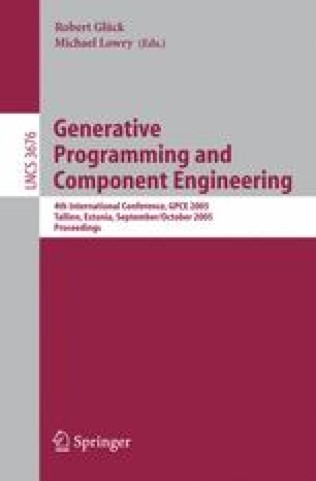
Generative programming and component engineering ; 4th International conference, GPCE 2005, Tallinn, Estonia, September 29 - October 1, 2005, Proceedings
Generative Programming and Component Engineering (GPCE) is a leading - searchconferenceonautomaticprogrammingandcomponentengineering.These approaches to software engineering have the potential to revolutionize software development as automation and components revolutionized manufacturing. The conference brings together researchers and practitioners interested in adva- ing automation for software development. It is also a premier forum for cro- fertilization between the programming language and software engineering - search communities. GPCEaroseasajointconference, mergingthepriorconferenceonGenerative and Component-Based Software Engineering (GCSE) and the Workshop on - mantics, Applications, andImplementationofProgramGeneration(SAIG). The proceedingsofthepreviousGPCEconferenceswerepublishedintheLNCSseries of Springer as volumes2487,2830, and 3286.In 2005 GPCE wasco-locatedwith the International Conference on Functional Programming (ICFP) and the s- posium on Trends in Functional Programming (TFP), re?ecting the vigorous interaction between the functional programming and generative programming research communities. GPCE and ICFP are both sponsored by the Association for Computing Machinery. The quality and breadth of the papers submitted to GPCE 2005 was impr- sive. All 86 papers, including 5 papers for tool demonstrations, were rigorously reviewed by 17 highly quali?ed Program Committee members. The members of the Program Committee ?rst provided in-depth individual reviews of the s- mitted papers, and then debated the merits of the papers through an extended electronicProgramCommitteemeeting.After much(friendly) argument,25r- ular papers and 2 tool demonstration papers were selected for publication. The ProgramCommittee provided extensive technical feedback to the authors of the submittedpapers.Theconferenceprogramwascomplementedwiththreeinvited talks, three extended tutorials, and three all-day workshops.
