



الصفحة 2
الصفحة 2

Evidence and Expertise in Nordic Education Policy : A Comparative Network Analysis
This book explores how policy makers draw on national, regional and international expertise in issuing school reform within five Nordic countries. In an era of international comparison, policy makers are expected to review best practices, learn from experiences from elsewhere, and apply international standards propelled by international organizations. The chapters draw methodologically on bibliometric data, network analysis, document analysis and expert interviews.

European Higher Education Area : Challenges for a New Decade
This book highlights the major outcomes of the fourth edition of the Future of Higher Education – Bologna Process Researchers Conference (January 2020), which has already established itself as a landmark in the European higher education environment.

Equity policies in global higher Education : Reducing inequality and increasing participation and attainment
This book discusses and analyses global policies and practices aimed at promoting equity in higher education participation and attainment. Although the massification of higher education systems has facilitated the participation of students from deprived backgrounds, socioeconomic inequalities persist in access to the most prestigious institutions and programmes. Privileged students benefit from a number of advantages in the competition for selective and scarce places: access to information, lower aversion to debt, higher expectations, better previous schooling and higher academic achievement.

Empowering teachers to build a better world : How six nations support teachers for 21st Century education
This book presents a comparative study on how large-scale professional development programs for teachers are designed and implemented. Around the world, governments and educators are recognizing the need to educate students in a broad range of higher order cognitive skills and socio-emotional competencies

Educational Theory in the 21st Century : Science, Technology, Society and Education
This book reviews the effects of the twenty-first century scientific-technological and social developments on the educational theory. The first part handles the subject, focusing on technology and educational philosophy. In the second part, the implications of new human and social conceptions towards the education paradigms are examined. In the chapters of the last part of the book, more practical dimensions of education are discussed. Transforming school designs, school management, learning-teaching approaches and teacher competencies are discussed in the context of broader social, cultural and technological changes.

Educational research : The educationalization of social problems
In this book distinguished philosophers and historians of education focus on ‘educationalization’ to expand its meaning through an engagement with educational theory. Topics discussed are the family and the child, the ‘learning society’, citizenship education, widening participation in higher education, progressive education, and schooling movements such as No Child Left Behind. ‘Smeyers’ and Depaepe's book offers great insights into one of the most ambivalent phenomena of today's educational world and especially educational policy. The contributions assembled represent perspectives of some of the most respected scholars in the field.

Education to Build Back Better : What Can We Learn from Education Reform for a Post-pandemic World
This book examines the implications of the COVID-19 Pandemic for education systems and argues that major education reforms will be necessary, particularly in the Global South, to address the learning loss caused by the pandemic. To inform those reforms, knowledge about the implementation reforms in the Global South is necessary, and such knowledge is seriously lacking as the existing literature on the implementation of educational change focused principally in reforms in countries in the Global North. This book contributes to address this gap by examining five major education reforms in India, Egypt, Taiwan, Vietnam, and Senegal, and by presenting two novel approaches to climate change education using a bottoms up strategy of reform.

Education for All and Multigrade Teaching : Challenges and Opportunities
This book is based on original research on challenges and opportunities in Colombia, England, Ghana, Malawi, Nepal, Sri Lanka, Sudan, Peru, Turks and Caicos and Vietnam. Its purpose is to raise awareness among educational policymakers and practitioners worldwide of the realities of multigrade classes in the context of Education for All, and to explore the implications for teachers, teacher educators, curriculum developers and educational planners.

Education and Development in Colonial and Postcolonial Africa : Policies, Paradigms, and Entanglements, 1890s–1980s
This book offers an analysis of the entangled histories of education and development in twentieth-century Africa. It deals with the plurality of actors that competed and collaborated to formulate educational and developmental paradigms and projects

Education and Climate Change : The Role of Universities
This book draws on a multidimensional model of educational change, the book reviews the field of climate change education and identifies some of the areas in which past efforts have fallen short in supporting effective pedagogical change at scale.

Educating Students to Improve the World
This book addresses how to help students find purpose in a rapidly changing world. In a probing and visionary analysis of the field of global education Fernando Reimers explains how to lead the transformation of schools and school systems in order to more effectively prepare students to address today’s’ most urgent challenges and to invent a better future.

Dinaric Perspectives on TIMSS 2019 : Teaching and Learning Mathematics and Science in South-Eastern Europe
This book brings together national experts from across the Dinaric region to rigorously review IEA’s Trends in International Mathematics and Science Study (TIMSS) 2019 grade four data to develop a multidimensional and culturally sensitive perspective on their TIMSS 2019 primary-level results. The Dinaric region, named after the Dinaric Alps, is located in South-eastern Europe, and stretches through Croatia, Bosnia and Herzegovina, Serbia, Montenegro, Kosovo[1], Albania, and North Macedonia. IEA’s TIMSS has been an invaluable resource for monitoring international trends in mathematics and science achievement at grades four and eight since 1995. The TIMSS 2019 administration of the test to grade four students, provided a unique opportunity for analysis within shared regional settings and enabled the construction of this first report based on international study results from the region, prepared by the National Research Coordinators in collaboration with IEA.

Cultural Competence and the Higher Education Sector : Australian Perspectives, Policies and Practice
This book explores cultural competence in the higher education sector from multi-disciplinary and inter-disciplinary perspectives. It addresses cultural competence in terms of leadership and the role of the higher education sector in cultural competence policy and practice.
Learners in a Changing Learning Landscape: Reflections from a Dialogue on New Roles and Expectations
Today's learners face constant change. Adaptive learner expertise is key to their survival on a learning journey that lasts a lifetime. This requires new thinking of all actors in the learning environment. The fundamental process through which this book was created is an extended in-depth dialogue among researchers, lifelong learners, educators, and thinkers.

Landscapes of Lifelong Learning Policies across Europe : Comparative Case Studies
This book explores different landscapes of Lifelong Learning policies (LLP), producing case-based examinations of their institutional, discursive, and relational dimensions. Across Europe, young people develop their life courses amidst diverse living conditions and are confronted with a variety of institutional and structural arrangements that impact on their opportunities in education and labour. Considering the relevance of LLP in shaping those opportunities, the chapters draw from multi-level, mixed-methods research and offer original insights on the interplay of discourses and governance patterns in the processes of policy-making and deliverance. The book yields noteworthy insights into the widely differing realities across the European landscape, and also into the diverging ways young people deal with and actively participate in LLP.
Comparative and Global Pedagogies : Equity, Access and Democracy in Education
This book critically examines equality, equity and democracy in education, globally as well as from various perspectives. Globally, there are increasing arguments both for the democratization of education and for the use of education to promote a democratic society. It is argued that democratic schools would better prepare for active citizenship and for a strong civil society which are seen to be the foundation of a democratic state. The book further argues that while there are inspiring examples of schools that engage in peace education or emancipatory pedagogy that work across various ethnic or religious divides, on balance, the forms, structures, ideologies and purposes of formal education interact to make national and international conflict more likely.
Bridging Educational Leadership, Curriculum Theory and Didaktik : Non-affirmative Theory of Education
This book is open access under a CC BY 4.0 license. This volume argues for the need of a common ground that bridges leadership studies, curriculum theory, and Didaktik. It proposes a non-affirmative education theory and its core concepts along with discursive institutionalism as an analytical tool to bridge these fields. It concludes with implications of its coherent theoretical framing for future empirical research.
Borderless Knowledge : Understanding the “New” Internationalisation of Research and Higher Education in Norway
this book analyses patterns of internationalisation comprising the national and supranational level, the level of higher education institutions and private companies, as well as the level of individual researchers and graduates. As a laboratory for studying internationalisation the book uses the case of Norway, a small knowledge system set in an open society, political system and economy. The case offers exceptionally good data on the developments in its research and higher education system that record changes over time and across the different parts and levels of a national knowledge system.

Becoming a world-class university : The case of King Abdulaziz University
This book written by international experts in the field of educational innovation is a guide for universities to become world-class universities. It contributes to the current international intellectual debate on the future of higher education. It also tells the story of King Abdulaziz University in Jeddah (Saudi Arabia) and its effort to become a world-class university. The book discusses excellence in different aspects such as education, research, community services, strategic planning, knowledge economy and international cooperation.
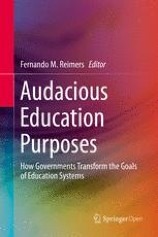
Audacious Education Purposes : How Governments Transform the Goals of Education Systems
This book offers a comparative study of eight ambitious national reforms that sought to create opportunities for students to gain the necessary breath of skills to thrive in a rapidly changing world.
