



الصفحة 2
الصفحة 2

Electromagnetic Field Matter Interactions in Thermoelasic Solids and Viscous Fluids
This book in two parts delivers a thorough derivation of nonrelativistic interaction models of electromagnetic field theories with thermoelastic solids and viscous fluids, the intention being to derive unique representations for the observable field quantities. Part I, a revised and updated version of LNP 88 "Field Matter Interactions in Thermoelastic Solids," investigates the foundations and the equivalence of various formulations of the interaction of the electromagnetic field with thermoelastic solids in the classical continuum physics limit, while Part II extensively surveys two major fields of applications, namely, magnetoelastic instabilities and vibrations, and electrorheological fluids.

Elastic Multibody Dynamics : A Direct Ritz Approach
This textbook is an introduction to and exploration of a number of core topics in the field of applied mechanics: On the basis of Lagrange's Principle, a Central Equation of Dynamics is presented which yields a unified view on existing methods. From these, the Projection Equation is selected for the derivation of the motion equations of holonomic and of non-holonomic systems. The method is applied to rigid multibody systems where the rigid body is defined such that, by relaxation of the rigidity constraints, one can directly proceed to elastic bodies. A decomposition into subsystems leads to a minimal representation and to a recursive representation, respectively, of the equations of motion.

ECOOP 2007 – Object-Oriented Programming ; 21th European Conference, Berlin, Germany, July 30 - August 3, 2007, Proceedings
This book contains sections on runtime implementation, empirical studies, programs and predicates, language design, inheritance and derivation, aspects, as well as language about language.

Dynamic Modeling, Predictive Control and Performance Monitoring : A Data-driven Subspace Approach
A typical design procedure for model predictive control or control performance monitoring consists of: identification of a parametric or nonparametric model, derivation of the output predictor from the model and design of the control law or calculation of performance indices according to the predictor.

Developments in Language Theory ; 12th International Conference, DLT 2008, Kyoto, Japan, September 16-19, 2008. Proceedings
This book constitutes the refereed proceedings of the 12th International Conference on Developments in Language Theory, DLT 2008, held in Kyoto, Japan, September 2008.

Data assimilation fundamentals : A unified formulation of the state and parameter estimation problem
This textbook's significant contribution is the unified derivation of data-assimilation techniques from a common fundamental and optimal starting point, namely Bayes' theorem. Unique for this book is the "top-down" derivation of the assimilation methods. It starts from Bayes theorem and gradually introduces the assumptions and approximations needed to arrive at today's popular data-assimilation methods. This strategy is the opposite of most textbooks and reviews on data assimilation that typically take a bottom-up approach to derive a particular assimilation method.

Data Assimilation : The Ensemble Kalman Filter
Data Assimilation comprehensively covers data assimilation and inverse methods, including both traditional state estimation and parameter estimation. This text and reference focuses on various popular data assimilation methods, such as weak and strong constraint variational methods and ensemble filters and smoothers. It is demonstrated how the different methods can be derived from a common theoretical basis, as well as how they differ and/or are related to each other, and which properties characterize them, using several examples.It presents the mathematical framework and derivations in a way which is common for any discipline where dynamics is merged with measurements. The mathematics level is modest, although it requires knowledge of basic spatial statistics, Bayesian statistics, and calculus of variations. Readers will also appreciate the introduction to the mathematical methods used and detailed derivations, which should be easy to follow, are given throughout the book. The codes used in several of the data assimilation experiments are available on a web page.The focus on ensemble methods, such as the ensemble Kalman filter and smoother, also makes it a solid reference to the derivation, implementation and application of such techniques. Much new material, in particular related to the formulation and solution of combined parameter and state estimation problems and the general properties of the ensemble algorithms, is available here for the first time.

Cyber-physical systems of systems : Foundations : A conceptual model and some derivations : The AMADEOS legacy
Technical Systems-of-Systems (SoS) – in the form of networked, independent constituent computing systems temporarily collaborating to achieve a well-defined objective – form the backbone of most of today’s infrastructure. The energy grid, most transportation systems, the global banking industry, the water-supply system, the military equipment, many embedded systems, and a great number more, strongly depend on systems-of-systems. The correct operation and continuous availability of these underlying systems-of-systems are fundamental for the functioning of our modern society.

Cost-Efficient Design
This is the first English edition of an established work on cost-driven product design and development. It offers tried and tested methods for understanding, influencing and reducing product costs. The methodology and organization of cost management, as well as the effects on each type of cost are described. Using this knowledge the product developer can assume responsibility for costs. The numerous examples and detailed derivation of results provide the practical user with problem solutions and hints. Methods such as Target Costing and Simultaneous Engineering are discribed. Thus the book will also help the specialist who does not have the overview of the complex interrelationships in the enterprise. The work is also suited for students, as well as for practicing engineers.

Contributions to the Science of Text and Language : Word Length Studies and Related Issues
This volume contains a collection of contributions to the science of language, focusing on the study of word length in particular. Within a synergetic framework, the word turns out to be a central linguistic unit, as is clearly outlined in the Editorâs preface. The bookâs first chapter is an extensive introduction to the history and state of the art of word length studies.The studies included unify contributions from three important linguistic fields, namely, linguistics and text analysis, mathematics and statistics, and corpus and data base design, which together give a comprehensive approach to the quantitative study of text and language and word length studies.
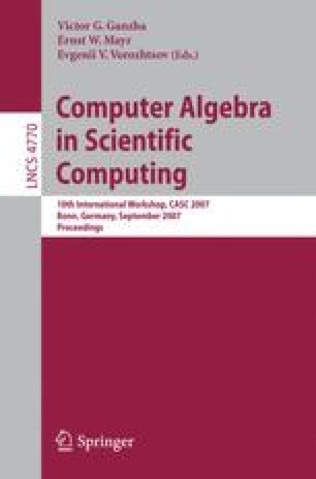
Computer Algebra in Scientific Computing ; 10th International Workshop, CASC 2007, Bonn, Germany, September 16-20, 2007, Proceedings
The book covers not only various expanding applications of computer algebra to scientific computing but also the computer algebra systems themselves and the CA algorithms. Topics addressed are studies in polynomial and matrix algebra, quantifier elimination, and Gröbner bases, as well as stability investigation of both differential equations and difference methods for them. Several papers are devoted to the application of computer algebra methods and algorithms to the derivation of new mathematical models in biology and in mathematical physics.

Combustion : Physical and Chemical Fundamentals, Modeling and Simulation, Experiments, Pollutant Formation
The actual fourth edition presents a completely restructured book: Mathematical Formulae and derivations as well as the space-consuming reaction mechanisms have been replaced from the text to appendix. A new chapter discusses the impact of combustion processes on the earth’s atmosphere, the chapter on auto-ignition is extended to combustion in Otto- and Diesel-engines, and the chapters on heterogeneous combustion and on soot formation appear heavily revised.

Magnetic Control of Tokamak Plasmas
The main topic of Magnetic Control of Tokamak Plasmas is the design of feedback control systems guaranteeing the stability of plasma equilibrium inside a tokamak and the regulation of the plasma position and shape during plasma pulses. Modelling and control details are presented, allowing the non-expert to understand the control problem. Starting from equations of magneto-hydro-dynamics, all the steps needed for the derivation of plasma state-space models are enumerated. The basics of electromagnetics are frequently recalled. The control problem is then described beginning with control of current and position – vertical and radial – and progressing to the more challenging shape control. The solutions proposed vary from simple PIDs to more sophisticated MIMO controllers.

Linear Estimation and Detection in Krylov Subspaces
Focuses on the foundations of linear estimation theory which is essential for effective signal processing. In its first part, it gives a comprehensive overview of several key methods like reduced-rank signal processing and Krylov subspace methods of numerical mathematics. Based on the derivation of the multistage Wiener filter in its most general form, the relationship between statistical signal processing and numerical mathematics is presented. In the second part, the theory is applied to iterative multiuser detection receivers (Turbo equalization) which are typically desired in wireless communication systems.
Computational Acoustics of Noise Propagation in Fluids - Finite and Boundary Element Methods
Among numerical methods applied in acoustics, the Finite Element Method (FEM) is normally favored for interior problems whereas the Boundary Element Method (BEM) is quite popular for exterior ones. That is why this valuable reference provides a complete survey of methods for computational acoustics, namely FEM and BEM. It demonstrates that both methods can be effectively used in the complementary cases. The chapters by well-known authors are evenly balanced: 10 chapters on FEM and 10 on BEM. An initial conceptual chapter describes the derivation of the wave equation and supplies a unified approach to FEM and BEM for the harmonic case. A categorization of the remaining chapters and a personal outlook complete this introduction. In what follows, both FEM and BEM are discussed in the context of very different problems.

Compositionality and Concepts in Linguistics and Psychology
By highlighting relations between experimental and theoretical work, this volume explores new ways of addressing one of the central challenges in the study of language and cognition. The articles bring together work by leading scholars and younger researchers in psychology, linguistics and philosophy. An introductory chapter lays out the background on concept composition, a problem that is stimulating much new research in cognitive science. Researchers in this interdisciplinary domain aim to explain how meanings of complex expressions are derived from simple lexical concepts and to show how these meanings connect to concept representations.

Classical Nucleation Theory in Multicomponent Systems
Nucleation is the initial step of every first-order phase transition, and most phase transitions encountered both in everyday life and industrial processes are of the first-order. Using an elegant classical theory based on thermodynamics and kinetics, this book provides a fully detailed picture of multi-component nucleation. As many of the issues concerning multi-component nucleation theory have been solved during the last 10-15 years, it also thoroughly integrates both fundamental theory with recent advances presented in the literature. It covered are: the basic relevant thermodynamics and statistical physics; modelling a molecular cluster as a spherical liquid droplet; predicting the size and composition of the nucleating critical clusters; kinetic models for cluster growth and decay; calculating nucleation rates; and a full derivation and application of nucleation theorems that can be used to extract microscopic cluster properties from nucleation rate measurements.

Bond Portfolio Optimization
1 The tools of modern portfolio theory are in general use in the equity markets, either in the form of portfolio optimization software or as an accepted frame- 2 work in which the asset managers think about stock selection. In the ?xed income market on the other hand, these tools seem irrelevant or inapplicable. Bond portfolios are nowadays mainly managed by a comparison of portfolio 3 4 risk measures vis ¶a vis a benchmark. The portfolio manager’s views about the future evolution of the term structure of interest rates translate th- selves directly into a positioning relative to his benchmark, taking the risks of these deviations from the benchmark into account only in a very crude 5 fashion, i.e. without really quantifying them probabilistically. This is quite surprising since sophisticated models for the evolution of interest rates are commonly used for interest rate derivatives pricing and the derivation of ?xed 6 income risk measures.
Bayesian core : A practical approach to computational Bayesian statistics
This Bayesian modeling book provides an operational methodology for conducting Bayesian inference, rather than focusing on its theoretical justifications. Special attention is paid to the derivation of prior distributions in each case and specific reference solutions are given for each of the models.

Automatic program development : A tribute to Robert Paige
This work, a tribute to renowned researcher Robert Paige, is a collection of revised papers published in his honor in the Higher-Order and Symbolic Computation Journal in 2003 and 2005. The book also includes some papers by members of the IFIP Working Group 2.1 of which Bob was an active member.
