



الصفحة 19
الصفحة 19

Computer-Aided Design of User Interfaces IV
Computer-Aided Design of User Interfaces IV gathers the latest research of experts, research teams and leading organisations involved in computer-aided design of user interactive applications supported by software, with specific attention for platform-independent user interfaces and context-sensitive or aware applications. This includes: innovative model-based and agent-based approaches, code-generators, model editors, task animators, translators, checkers, advice-giving systems and systems for graphical and multimodal user interfaces. It also addresses User Interface Description Languages. This books attempts to emphasize the software tool support for designing user interfaces and their underlying languages and methods, beyond traditional development environments offered by the market. It will be of interest to software development practitioners and researchers whose work involves human-computer interaction, design of user interfaces, frameworks for computer-aided design, formal and semi-formal methods, web services and multimedia systems, interactive applications, and graphical user and multi-user interfaces.

Computer Supported Cooperative Work in Design IV ; 11th International Conference, CSCWD 2007, Melbourne, Australia, April 26-28, 2007. Revised Selected Papers
This book constitutes the thoroughly refereed post-conference proceedings of the 11th International Conference on Computer Supported Cooperative Work in Design, CSCWD 2007, held in Melbourne, Australia, in April 2007.

Computer Supported Cooperative Work in Design II ; 9th International Conference, CSCWD 2005, Coventry, UK, May 24-26, 2005, Revised Selected Papers
This book constitutes the thoroughly refereed post-proceedings of the 9th International Conference on Computer Supported Cooperative Work in Design, CSCWD 2005. it contain expanded versions of the papers presented at the conference and are organized in topical sections on CSCW techniques and methods, Grids and Web services, agents and multi-agent systems, ontology and knowledge management, collaborative design and manufacturing, enterprise collaboration, workflows, and other related approaches and applications.

Computer supported cooperative work and social computing ; 15th CCF Conference, ChineseCSCW 2020, Shenzhen, China, November 7–9, 2020, Revised Selected Papers
This book constitutes the refereed post-conference proceedings of the 15th CCF Conference on Computer Supported Cooperative Work and Social Computing, ChineseCSCW 2020, held in Shenzhen, China, in November 2020. The 40 revised full papers and 15 revised short papers were carefully reviewed and selected from 137 submissions. The papers of this volume are organized in topical sections on: crowdsourcing, crowd intelligence, and crowd cooperative computing; domain-specific collaborative applications; collaborative mechanisms, models, approaches, algorithms, and systems; social media and online communities; and short papers.

Computer Security – ESORICS 2007 ; 12th European Symposium On Research In Computer Security, Dresden, Germany, September 24 - 26, 2007, Proceedings
This book address issues such as data protection; security protocols; systems; web and network security; privacy; threat modeling and detection; information flow; and security in emerging applications such as cryptocurrencies, the Internet of Things and automotive.

Computer recognition systems 2
Computer recognition systems are nowadays one of the most promising directions in artificial intelligence. This book presents actual comprehensive study of this field. It contains a collection of over one hundred carefully selected articles contributed by experts of pattern recognition. It reports on current research with respect to both methodology and applications. In particular, it includes the following sections: Features, learning and classifiers / Image processing and computer vision / Speech and word recognition / Medical applications / Various applications. This book is a great reference tool for scientists who deal with the problems of designing computer pattern recognition systems. Its target readers can be the as well researchers as students of computer science, artificial intelligence or robotics.

Computer Recognition Systems ; Proceedings of 4th International Conference on Computer Recognition Systems CORES'05
Presents the results of the 4th International Conference on Computer Recognition Sytems CORES-05. This book covers various topics in pattern recognition including: classification and interpretation of text, video, voice; statistical, soft and structural methods of pattern recognition; image processing, analysis and interpretation; and more.

Computer Network Security
As society becomes increasingly dependent on computers and computer networks, computer problems continue to rise in number. Yet despite the proliferation of expert remedies, a viable solution to these security issues remains elusive, and society continues to suffer at the hands of cyber vandalism and computer viruses. This comprehensive text outlines and discusses today’s most important issues and concerns in computer network and information safety and security, and promises to ignite debate and participation in the ongoing global security dialog Computer Network Security is foremost an educational tool that aims to explore computer network infrastructure and protocol design security flaws and discusses current security solutions and best practices. It explores the security threats and vulnerabilities in the current network infrastructure and protocols and outlines current efforts including: Access Control and Authorization, Cryptography, Firewalls and VPNs, Web Security and Content Filtering, among others. The text further discusses various security proposals This text is an invaluable instructional and research tool for courses in computer and information security. Students or practitioners in computer science, information science, technology studies, library sciences, and information management studies will find this text particularly useful for their purposes. In addition, it is a rich resource for those looking to gain an understanding of computer infrastructures and network security threats.

Computer Music Modeling and Retrieval ; Vol. 3310
This volume contains the final proceedings for the 2004 Computer Music Model-ing and Retrieval Symposium (CMMR 2004). CMMR is an annualevent focusing on important aspects of computer music. CMMR 2004 is the sec-ond event in this series. The use of computers in music is well established. CMMR 2004 provided aunique opportunity to meet and interact with peers concerned with the cross-influence of the technological and creative in computer music. The field of com-puter music is interdisciplinary by nature and closely related to a number of com-puter science and engineering areas such as information retrieval, programming,human computer interaction, digital libraries, hypermedia, artificial intelligence,acoustics, signal processing, etc. The event gathered many interesting people(researchers, educators, composers, performers, and others). There were manyhigh-quality keynote and paper presentations, that fostered inspiring discussions.

Computer and Information Sciences - ISCIS 2005 ; 20th International Symposium, Istanbul, Turkey, October 26 -- 28, 2005, Proceedings
This book constitutes the refereed proceedings of the 20th International Symposium on Computer and Information Sciences, ISCIS 2005, held in Istanbul, Turkey in October 2005. The 92 revised full papers presented together with 4 invited talks were carefully reviewed and selected from 491 submissions. The papers are organized in topical sections on computer networks, sensor and satellite networks, security and cryptography, performance evaluation, e-commerce and Web services, multiagent systems, machine learning, information retrieval and natural language processing, image and speech processing, algorithms and database systems, as well as theory of computing.

Computational Science – ICCS 2007; 7th International Conference, Beijing China, May 27-30, 2007, Proceedings, Part I
This book contiants sections on efficient data management, parallel monte carlo algorithms, simulation of multiphysics multiscale systems, dynamic data driven application systems, computer graphics and geometric modeling, computer algebra systems, computational chemistry, computational approaches and techniques in bioinformatics, computational finance and business intelligence, geocomputation, high-level parallel programming, networks theory and applications, collective intelligence for semantic and knowledge grid, collaborative and cooperative environments, tools for program development and analysis in CS, intelligent agents in computing systems, CS in software engineering, computational linguistics in HCI, internet computing in science and engineering, workflow systems in e-science, graph theoretic algorithms and applications in cs, teaching CS, high performance data mining, mining text, semi-structured, Web, or multimedia data,
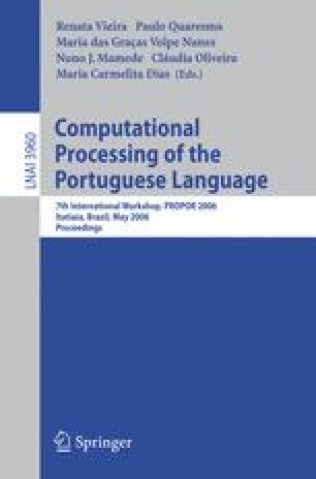
Computational Processing of the Portuguese Language ; 7th International Workshop, PROPOR 2006, Itatiaia, Brazil, May 13-17, 2006, Proceedings
Since 1993, PROPOR Workshops have become an important forum for - searchers involved in the Computational Processing of Portuguese,both written and spoken. The workshop and this book were structured around the following main t- ics, seven for full papers: (i) automatic summarization; (ii) resources; (iii) au- matic translation; (iv) named entity recognition; (v) tools and frameworks; (vi) systems and models; and another ?ve topics for short papers; (vii) information extraction; (viii) speech processing; (ix) lexicon; (x) morpho-syntactic studies; (xi) web, corpus and evaluation.

Computational intelligence for remote sensing
This book is a composition of different points of view regarding the application of Computational Intelligence techniques and methods to Remote Sensing data and applications. The book covers a broad range of topics, starting from the hardware design of hyperspectral sensors, and data handling problems, namely data compression and watermarking issues, as well as autonomous web services.

Computational intelligence and security ; Vol.3802 ; International Conference, CIS 2005, Xi'an, China, December 15-19, 2005, Proceedings, Part II
The two volume set LNAI 3801 and LNAI 3802 constitute the refereed proceedings of the annual International Conference on Computational Intelligence and Security, CIS 2005, held in Xi'an, China, in December 2005. The 338 revised papers presented - 254 regular and 84 extended papers - were carefully reviewed and selected from over 1800 submissions. The second volume is subdivided in topical sections on cryptography and coding, cryptographic protocols, intrusion detection, security models and architecture, security management, watermarking and information hiding, web and network applications, image and signal processing, and applications.

Computational Forensic ; 2nd International Workshop, IWCF 2008, Washington, DC, USA, August 7-8, 2008. Proceedings
This book constitutes the refereed proceedings of the Second International Workshop, IWCF 2008, held in Washington, DC, USA, August 2008. The papers are organized in topical sections on trends and challenges; scanner, printer, and prints; human identification; shoeprints; linguistics;decision making and search; speech analysis; signatures and handwriting.

Computational earthquake physics ; Part II
Exciting developments in earthquake science have benefited from new observations, improved computational technologies, and improved modeling capabilities. Designing realistic supercomputer simulation models for the complete earthquake generation process is a grand scientific challenge due to the complexity of phenomena and range of scales involved from microscopic to global. The present volume - Part II - incorporates computational environment and algorithms, data assimilation and understanding, model applications and iSERVO. Topics covered range from iSERVO and QuakeSim: implementing the international solid earth research virtual observatory by integrating computational grid and geographical information web services; LURR (Load-Unload Response Ratio) described in six papers involving this promising earthquake forecasting model; pattern informatics and phase dynamics and their applications, which was also a highlight in the Workshop; computational algorithms, including continuum damage models and visualization and analysis of geophysical datasets; evolution of mantle material; the state vector approach; and assimilation of data such as geodetic data, GPS data, and seismicity and laboratory experimental data.

Computational Collective Intelligence ; 12th International Conference, ICCCI 2020, Da Nang, Vietnam, November 30 – December 3, 2020, Proceedings
This volume constitutes the refereed proceedings of the 12th International Conference on Computational Collective Intelligence, ICCCI 2020, held in Da Nang, Vietnam, in November 2020.* The 70 full papers presented were carefully reviewed and selected from 314 submissions. The papers are grouped in topical sections on: knowledge engineering and semantic web; social networks and recommender systems; collective decision-making; applications of collective intelligence; data mining methods and applications; machine learning methods; deep learning and applications for industry 4.0; computer vision techniques; biosensors and biometric techniques; innovations in intelligent systems; natural language processing; low resource languages processing; computational collective intelligence and natural language processing; computational intelligence for multimedia understanding; and intelligent processing of multimedia in web systems.
Combinatorial and algorithmic aspects of networking ; Vol.3405 ; 1st Workshop on combinatorial and algorithmic aspects of networking, CAAN 2004, Banff, Alberta, Canada, August 5-7, 2004, Revised Selected Papers
The Internet is a massive global network of over 700 million users and it is addingusers at the rate of 300,000 per day. This large, distributed, and everchangingnetwork poses a challenge to researchers: How does one study, model, or under-stand such a decentralized, constantly evolving entity? The workshop Combi-natorial and Algorithmic Aspects of Networking and the Internet (CAAN 2004)provided a forum for the exchange of ideas on these topics. and among thepapers were some new and surprising results as well as some introductions tothe foundations of the field.The workshop program featured 12 peer-reviewed papers bracketed by Topics covered by the talks ranged from the Web graph to game theoryto string matching, all in the context of large-scale networks. This volume collectstogether the talks delivered at the workshop along with a number of survey articlesto round out the presentation and give a comprehensive introduction to the topic.
Combinatorial and Algorithmic Aspects of Networking (vol. # 4235) ; Third Workshop, CAAN 2006, Chester, UK, July 2, 2006, Revised Papers
This book constitutes the thoroughly refereed post-proceedings of the Third Workshop on Combinatorial and Algorithmic Aspects of Networking, held in Chester, UK in July 2006, co-located with the 13th Colloquium on Structural Information and Communication Complexity, SIROCCO 2006.The 10 revised full papers and one invited lecture cover a range from the Web graph to game theory to string matching, all in the context of large-scale networks.

Cognitive Systems ; Joint Chinese-German Workshop, Shanghai, China, March 7-11, 2005, Revised Selected Papers
This book organized in topical sections on multimodal human-computer interfaces, neuropsychology and neurocomputing, Chinese-German natural language processing and psycholinguistics, as well as information processing and retrieval from the semantic Web for intelligent applications.
