



الصفحة 187
الصفحة 187
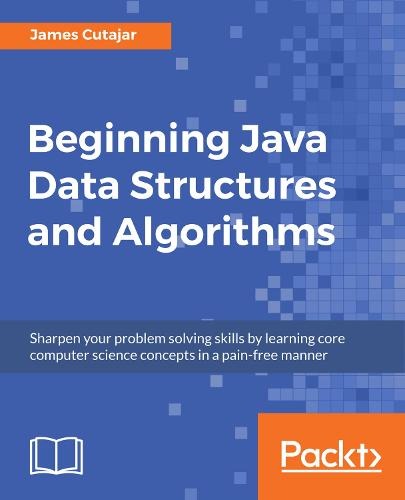
Beginning Java Data Structures and Algorithms : Sharpen your problem solving skills by learning core computer science concepts in a pain-free manner
Teaches you tools that you can use to build efficient applications. It starts with an introduction to algorithms and big O notation, later explains bubble, merge, quicksort, and other popular programming patterns. You’ll also learn about data structures such as binary trees, hash tables, and graphs. The book progresses to advanced concepts, such as algorithm design paradigms and graph theory. By the end of the book, you will know how to correctly implement common algorithms and data structures within your applications.
Beginning Java 17 Fundamentals : Object-Oriented Programming in Java 17
Learn the fundamentals of the Java 17 LTS or Java Standard Edition version 17 Long Term Support release, including basic programming concepts and the object-oriented fundamentals necessary at all levels of Java development. You will: Write your first Java programs with emphasis on learning object-oriented programming / How to work with switch expressions, value types (records), local variable type inference, pattern matching switch and more from Java 17 / Handle exceptions, assertions, strings and dates, and object formatting / Learn about how to define and use modules / Dive in depth into classes, interfaces, and inheritance in Java / Use regular expressions / Take advantage of the JShell REPL tool
Beginning HTML with CSS and XHTML : Modern Guide and Reference
Beginning HTML with CSS and XHTML: Modern Guide and Reference incorporates practical examples that will show you how to structure your data correctly using (X)HTML, along with styling and layout basics using Cascading Style Sheets (CSS). Youll also learn how to add dynamic behavior to your data using the JavaScript™ language.
Beginning GIMP : From novice to professional
Beginning GIMP: From Novice to Professional explains how to use the open source image manipulation program, GIMP version 2.4. You'll learn how to install GIMP on Windows, Linux, and MacOS X platforms. Once you've installed the application, you'll learn about the interface and configuration options, and then jump into a quick–and–simple project to familiarize yourself even further. With four–color graphics and screenshots throughout, you'll learn how to prepare camera images for display on web pagesincluding functions like rescaling, cropping, and balancing color. The book also explains with great detail how to utilize layers, paths, and masks. You'll also learn how to draw lines and shapes, use patterns and gradients, and even create your own brushes, patterns, and gradients.
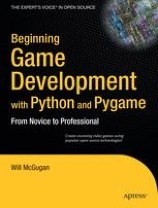
Beginning Game Development with Python and Pygame : From novice to professional
Beginning Game Development with Python and Pygame is written with the budding game developer in mind, introducing games development through the Python programming language and the popular Pygame games development library. You'll be privy to insights that will not only help you to exploit Pygame to its maximum potential, but also make you a more creative and knowledgeable games developer all round.

Beginning game development with Godot : Learn to create and publish your first 2D platform game
Learn the fundamentals of Godot by diving headfirst into creating a 2D platformer from scratch. This book is a hands-on, practical guide to developing 2D games using the Godot Engine 3.2.3/3.3, with the help of GDScript. You will: Understand the Godot engine and the benefits of using it for game development Master the fundamentals of programming in GDScript Use the Godot graphical interface to design and animate players, the game world, menus, and various games scenes Create your first 2D game in Godot and publish it to various platforms
Beginning deep learning with TensorFlow : Work with Keras, MNIST data sets, and advanced neural networks
Stats with an introduction to AI, where you’ll learn the history of neural networks and what sets deep learning apart from other varieties of machine learning. Discovery the variety of deep learning frameworks and set-up a deep learning development environment. Next, you’ll jump into simple classification programs for hand-writing analysis. Once you’ve tackled the basics of deep learning, you move on to TensorFlow 2 specifically. Find out what exactly a Tensor is and how to work with MNIST datasets. Finally, you’ll get into the heavy lifting of programming neural networks and working with a wide variety of neural network types such as GANs and RNNs. Deep Learning is a new area of Machine Learning research widely used in popular applications, such as voice assistant and self-driving cars. Work through the hands-on material in this book and become a TensorFlow programmer! You will: Develop using deep learning algorithms Build deep learning models using TensorFlow 2 Create classification systems and other, practical deep learning applications
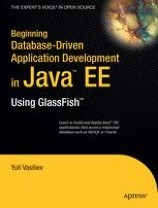
Beginning Database-Driven Application Development in Java EE : Using GlassFish™
The book explains in detail how you can organize your Java EE solution into a multilayer architecture, placing most emphasis on how to implement the persistence and database tiers of an application. Through many examples, this book shows how you can efficiently use the Java Persistence features available in the Java EE platform. Find out how you can greatly simplify the task of building the persistence layer of your Java EE application by moving some application logic into the underlying database, utilizing database views, stored programs, and triggers. The book also explains how to deploy Java EE applications to GlassFish, a free, open source Java EE 5–compliant application server.
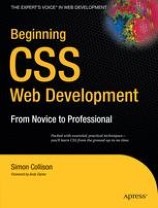
Beginning CSS web development : From novice to professional
There are many books out there on CSS, but Beginning CSS Web Development is different—it doesn't waste time discussing theory, and it delves straight into the practical matter. It provides you with what you need to know, faster. It is also completely up to date, covering the most modern CSS standards and design techniques. In addition to the essential CSS basics, this book covers advanced techniques like accessibility, hacks, and filters. The book concludes with a case study, and features a CSS reference section that allows you to look up required syntax as quickly as possible.
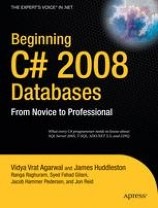
Beginning C# 2008 Databases : From novice to professional
Assuming only basic knowledge of C# 2008, Beginning C# 2008 Databases teaches all the fundamentals of database technology and database programming readers need to quickly become highly proficient database users and application developers. A comprehensive tutorial on both SQL Server 2005 and ADO.NET 3.0, Beginning C# 2008 Databases explains and demonstrates how to create database objects and program against them in both T–SQL and C#. Full of practical, detailed examples, it's been fully revised and updated for C# 2008 and offers the most complete, detailed, and gentle introduction to database technology for all C# programmers at any level of experience.
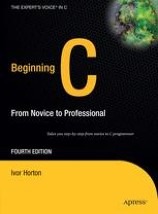
Beginning C : From novice to professional
With Beginning C: From Novice to Professional, Fourth Edition, you'll come to understand the fundamentals of the C language and learn how to program. All you need is this book and any one of the widely available free or commercial C or C++ compilers, and you'll soon be writing real C programs. You'll learn C from the first principles.
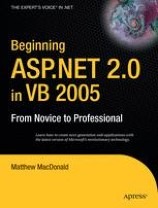
Beginning ASP.NET 2.0 in VB 2005 : From novice to professional
This book includes best practices and comprehensive discussions about key database and XML principles, which are essential for you to become effective with ASP.NET. The book also emphasizes the invaluable coding techniques of object orientation and code behind, which will enable you to build real-world websites immediately rather than just scraping by with simplified coding practices. By the time you've finished this book, you will have mastered the core techniques and possess the necessary knowledge to begin work as a professional ASP.NET developer.
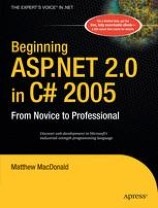
Beginning ASP.NET 2.0 in C# 2005 : From novice to professional
This book provides thorough coverage of ASP.NET, guiding you from beginning to advanced techniques, such as querying databases from within a web page and performance-tuning your site. You'll find tips for best practices and comprehensive discussions of key database and XML principles. The book also emphasizes the invaluable coding techniques of object orientation and code-behind, which will enable you to build real-world websites instead of just scraping by with simplified coding practices. By the time you finish this book, you will have mastered the core techniques essential to professional ASP.NET developers.
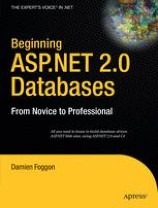
Beginning ASP.NET 2.0 Databases : From novice to professional
Beginning ASP.NET 2.0 Databases: From Novice to Professional is a comprehensive introduction to connecting a website to many different data sourcesnot just databases. You'll learn how to build a relational database, use SQL to communicate with it, and leverage both in your web applications. You'll also learn about the new features of ADO.NET and ASP.NET in .NET 2.0. The authors cover mission-critical issues, such as design, transactions, error handling, optimization, and scalability. They examine SQL Server, Jet, and MySQL databases, and highlight the differences among them.

Bee products and their applications in the food and pharmaceutical industries ; 1st ed.
Focuses on the health benefits of selected bee products by looking more closely at their pharmacological potentials and therapeutic applications in coping with various diseases. The book explores some of these products, such as royal jelly, propolis and bee venom, which is highly attractive to the food supplement sector due to the biological actions that are proved by scientific studies. Bee products also attract the cosmetics industry by utilizing those products in various applications such as hair products, toothpaste, sunscreen creams, lip balsams, or facial moisturizing creams. Each chapter focuses on a particular health benefit, providing more compact and detailed information about each activity for a specific interest. The mainframe of the book is based on the medicinal and pharmacological functions of bee products, with the therapeutic applications for each bee product supporting the mechanism of action of their biological functions.

Bee products : Chemical and biological properties
Presents an updated discussion on the chemical composition and biological properties of the main bee products, which until now have been presented separately in different editions This book scoops out studies about bee products most used in marketing and in traditional medicine such as honey, royal jelly, propolis, bee pollen and bee venom Discusses chemical composition and biological function of the different bee products on topics such as nutrition, aging and age-related diseases, cancer, neurodegenerative diseases and pathogen infections Bee products are rich in several essential nutrients and non essential nutrients, as sugars, minerals, proteins, free amino acids, vitamins, enzymes and polyphenols, that seem to be closely related to their biological functions. The effects of these products in nutrition, aging and age-related diseases, cancer, neurodegenerative diseases and pathogen infections are discussed.
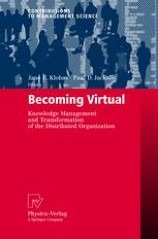
Becoming virtual : Knowledge management and transformation of the distributed organization
This book examines the capabilities needed to transform a globally distributed organization into a virtual organization (an organization that exists and operates across time and distance with the support of global communications technologies such as the Internet). It introduces techniques for definition of goals for virtualization, for monitoring progress toward virtualization and for studying the impact of virtualization on social uncertainty, knowledge sharing and knowledge transfer, organizational memory, transactive memory, communities of practice and organizational commitment, power and control. These techniques are applied in an extended case study of a development aid organization's attempts to use knowledge management for virtualization over a two year period. The multidisciplinary team of authors examines virtualization from points of view ranging from the organizational to the technological to the sociological and psychological.

Becoming citizens in a changing world : IEA international civic and citizenship education study 2016 International Report
Presents the results from the second cycle of the IEA International Civic and Citizenship Education Study (ICCS 2016). Using data from 24 countries in Asia, Europe and Latin America, the study investigates the ways in which young people are prepared to undertake their roles as citizens in a range of countries in the second decade of the 21st century. It also responds to the enduring and emerging challenges of educating young people in a world where contexts of democracy and civic participation continue to change. New developments of this kind include the increase in the use of social media by young people as a tool for civic engagement, growing concerns about global threats and sustainable development, as well as the role of schools in fostering peaceful ways of interaction between young people. Besides enabling the evaluation of a wide range of aspects of civic and citizenship education, including those related to recent developments in a number of countries, the inclusion of test and questionnaire material from the first cycle of the study in 2009 allows the results from ICCS 2016 to be used to examine changes in civic knowledge, attitudes and engagement over seven years.

Becoming a world-class university : The case of King Abdulaziz University
This book written by international experts in the field of educational innovation is a guide for universities to become world-class universities. It contributes to the current international intellectual debate on the future of higher education. It also tells the story of King Abdulaziz University in Jeddah (Saudi Arabia) and its effort to become a world-class university. The book discusses excellence in different aspects such as education, research, community services, strategic planning, knowledge economy and international cooperation.
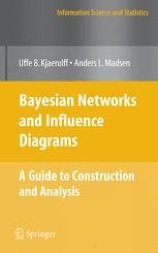
Bayesian networks and Influence diagrams : A guide to construction and analysis
Probabilistic networks, also known as Bayesian networks and influence diagrams, have become one of the most promising technologies in the area of applied artificial intelligence, offering intuitive, efficient, and reliable methods for diagnosis, prediction, decision making, classification, troubleshooting, and data mining under uncertainty. Bayesian Networks and Influence Diagrams: A Guide to Construction and Analysis provides a comprehensive guide for practitioners who wish to understand, construct, and analyze intelligent systems for decision support based on probabilistic networks. Intended primarily for practitioners, this book does not require sophisticated mathematical skills or deep understanding of the underlying theory and methods nor does it discuss alternative technologies for reasoning under uncertainty.
